
Ray Dalio warns Trump’s new budget bill could trigger a major debt crisis in the US

With President Trump’s sweeping new budget bill now signed into law, one of the world’s most respected investors is sounding the alarm. Billionaire hedge fund founder Ray Dalio believes the U.S. is heading straight toward a debt-driven economic storm.
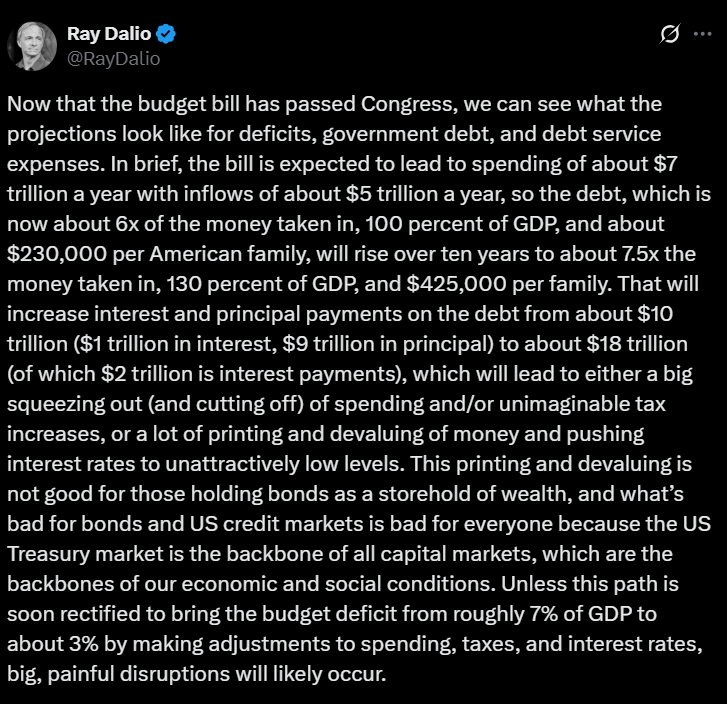
In a post on X, Dalio warned that if America stays on its current fiscal path, the country could see “big, painful disruptions” over the next decade. And the numbers are staggering.
Every American household could be on the hook for $425,000 in national debt
Dalio lays out the math in simple terms: under the new budget, the U.S. government is expected to spend around $7 trillion per year while bringing in only $5 trillion. That’s an annual deficit of $2 trillion—every single year.
At today’s pace, America’s national debt will grow from about $230,000 per household to roughly $425,000 in the next ten years. Total debt as a share of GDP would rise from 100% to around 130%.
That means the U.S. would owe 7.5 times more than its annual income, up from about 6 times today. As Dalio puts it, the country is essentially running on borrowed money.
What happens when the bill comes due
Dalio warns that this kind of structural deficit leaves the government with only a few painful options:
-
Massive spending cuts, including on healthcare, defense, and social programs
-
Unprecedented tax hikes, which could impact both corporations and individuals
-
Printing more money, which risks weakening the dollar and stoking inflation
He estimates that interest and principal payments on the debt will rise from $10 trillion to $18 trillion in the years ahead, swallowing a growing share of the federal budget.
Why this isn’t just theory
Dalio’s warning isn’t about a short-term blip in the economy. It’s a structural concern. The U.S. is now running a government that depends on ever-expanding debt, and that’s a model that only works until it doesn’t.
At the same time, the Federal Reserve can no longer keep interest rates at ultra-low levels without fueling inflation. That makes the cost of borrowing higher—and the debt problem even worse.
What this means for investors and markets
While markets are still celebrating the budget bill’s near-term boost—especially tax cuts and spending increases—Dalio sees a bigger story. The long-term cost of this fiscal expansion may outweigh the short-term benefits.
Here are a few implications worth considering:
-
U.S. Treasury yields may still have room to rise, as investors reassess America’s long-term fiscal health
-
The dollar could face persistent downward pressure, boosting demand for alternative stores of value like gold and Bitcoin
-
Equity valuations may come under pressure, particularly in sectors that have rallied the most in recent months
-
Future tax policy may turn sharply tighter, especially if deficits continue to spiral
In short, Dalio’s view is that the U.S. is on a dangerous fiscal trajectory—and unless something changes, the cost will be shared by every American through higher taxes, slower growth, or inflation.
Dalio’s message isn’t doomsday panic—it’s a sober reminder that growth fueled by debt has its limits. As he puts it, if spending isn’t reduced and taxes aren’t raised soon, “big, painful disruptions will likely occur.”