
Is Oscar’s Big Drop a Golden Buying Opportunity?

Recently, Centene (CNC) released a surprising announcement that sparked concerns across the Affordable Care Act (ACA) sector, causing Oscar Health (NYSE:OSCR) to drop approximately 15-20%. The market is worried about higher-than-expected claim risks, but is this sell-off justified?
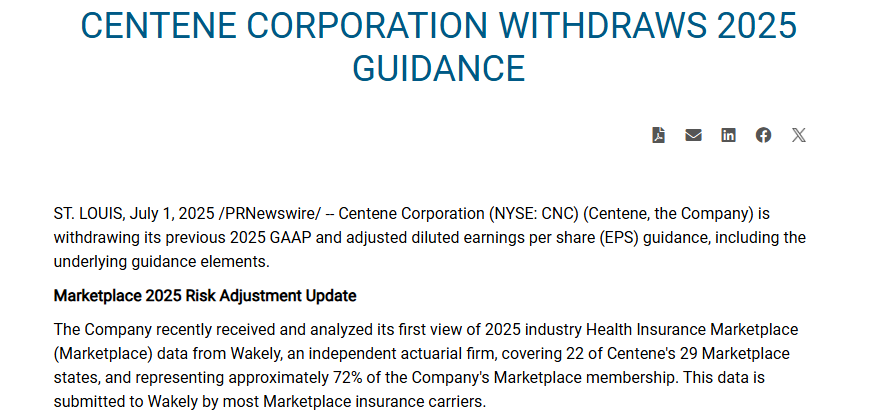
This decline appears to be an overreaction.
Oscar just posted a standout first-quarter report, with revenue up 42%, membership exceeding 2 million, and sales and administrative expenses (SG&A) below 16%, demonstrating solid operational leverage.
Unlike Centene, Oscar’s geographic coverage and risk profile differ, meaning a “spike in illness rates” won’t directly impact its performance. Additionally, its in-house tech platform and Campaign Builder AI continue to boost net promoter scores (NPS) and customer retention, creating a scalable growth engine.
Policy changes may introduce volatility, but Oscar’s structural cost advantages and $4.9 billion cash reserve provide a buffer against short-term market noise. The core demand in the ACA market remains strong, and Oscar’s current undervaluation offers significant upside potential. This aligns with our earlier model—when a company’s fundamentals remain steady but the stock dips due to external factors, it could be a buying window.
OK, let’s dive into the details and chat more about it.
Centene’s $18 Billion ACA Impact: A Caution, Not a Verdict for Oscar
On July 1, 2025, Centene disclosed preliminary ACA data showing higher-than-expected morbidity rates among its exchange members. The company lowered its 2025 risk adjustment revenue forecast by $1.8 billion (reducing EPS by about $2.75), citing slower market growth and a less healthy member base in key states.
While Oscar operates within the same ACA risk pool, where higher medical claims could theoretically affect risk adjustment revenue, its management has not signaled any unexpected risks. In fact, Oscar’s Q1 2025 results were robust (42% revenue growth, record profits), suggesting any increased health risks have been offset through pricing or membership adjustments.
Market Sentiment and Barclays’ Downgrade
Early July 2025 saw a cautious shift in market sentiment. Barclays initiated coverage on Oscar with an “underperform” rating, arguing that the recent stock rally is unsustainable, especially with policy risks on the horizon. Analysts highlighted that if ACA subsidies or cost-sharing reductions (CSR) are cut, Oscar could face “asymmetric downside risk.”

Barclays forecasts Oscar’s medical loss ratio (MLR) to rise over 100 basis points in 2026 (lowering EPS by about 30 cents) and questions the company’s optimistic 2027 EPS target of $2.25 (estimating $1.28 instead). They note that 34% of Oscar’s members are on subsidized Bronze plans—if CSR is eliminated, free premiums would end, potentially causing member churn and disrupting its risk pool.
Oscar’s Growth Strategy
Oscar aims to expand from 10 million covered lives in 2024 to 16 million by 2027, reflecting a 19% annual growth rate. While ambitious, this is achievable given its focus on ACA core markets, Medicare Advantage, and small group plans.
The million-plus new members from new markets and products show Oscar isn’t relying solely on organic growth—it’s actively targeting low-penetration states and new plan categories.
The remaining 4 million in growth will come from deeper penetration in existing markets, which is reasonable as scale and brand recognition improve retention. If Oscar manages its MLR, this broader coverage could accelerate fixed-cost leverage, outpacing Barclays’ “zero growth” projection.
Is It Still a Buy?
Personal health insurance is a cornerstone of the U.S. healthcare system, with the uninsured rate hitting a historic low of 8%.
Compared to peers, Alignment Healthcare (ALHC) projects $3.75 billion in 2025 revenue (up 38%) but only $35-60 million in adjusted EBITDA, yielding a forward EV/Sales of 0.9. Clover Health (CLOV) sees 30% insurance revenue growth but remains unprofitable, with a negative EV/EBITDA and sales multiple below 1.
Oscar, however, is profitable with positive EBIT and EBITDA, and its 42% revenue growth outpaces competitors. Yet its sales multiple of 0.57 is slightly above Centene’s 0.17 and below UnitedHealth’s 0.68, despite faster growth. Its 25x earnings multiple looks reasonable when adjusted for growth, and compared to medical SaaS firms trading at 30-40x, Oscar appears undervalued.
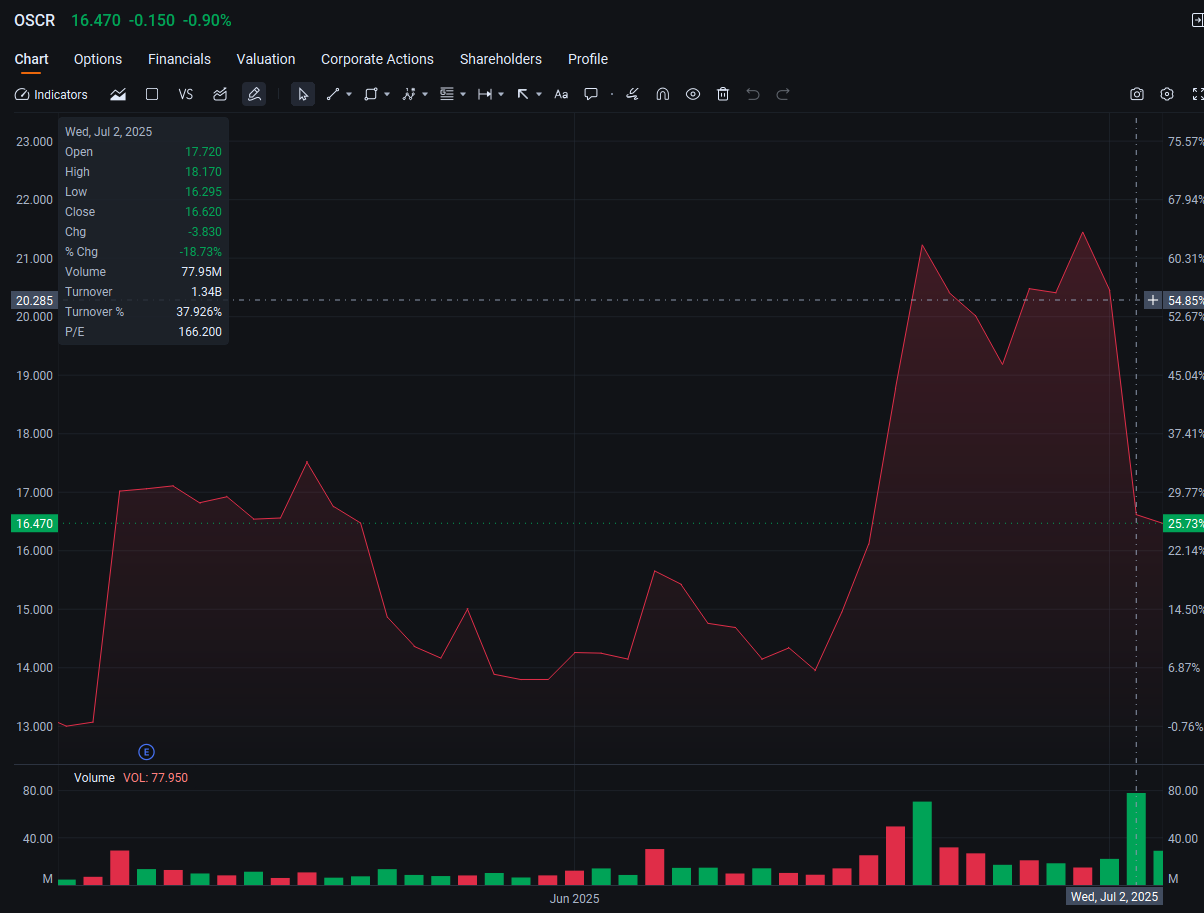
Wall Street consensus estimates Oscar’s 2025 EPS at $0.61, but based on the current price, 2027 EPS could reach $1.50, valuing it at 14x. This recent drop reflects market sentiment, not a fundamentals collapse. Oscar’s tech-driven cost advantage, record membership growth, and robust cash buffer provide strong resilience. Short-term ACA fluctuations won’t derail its growth trajectory.
Moreover, Oscar is building the API layer for the U.S. healthcare system—a platform play the market hasn’t fully priced in yet. A valuation reset could be on the horizon.$OSCR