
APAC Market Wrap - 7 Jul

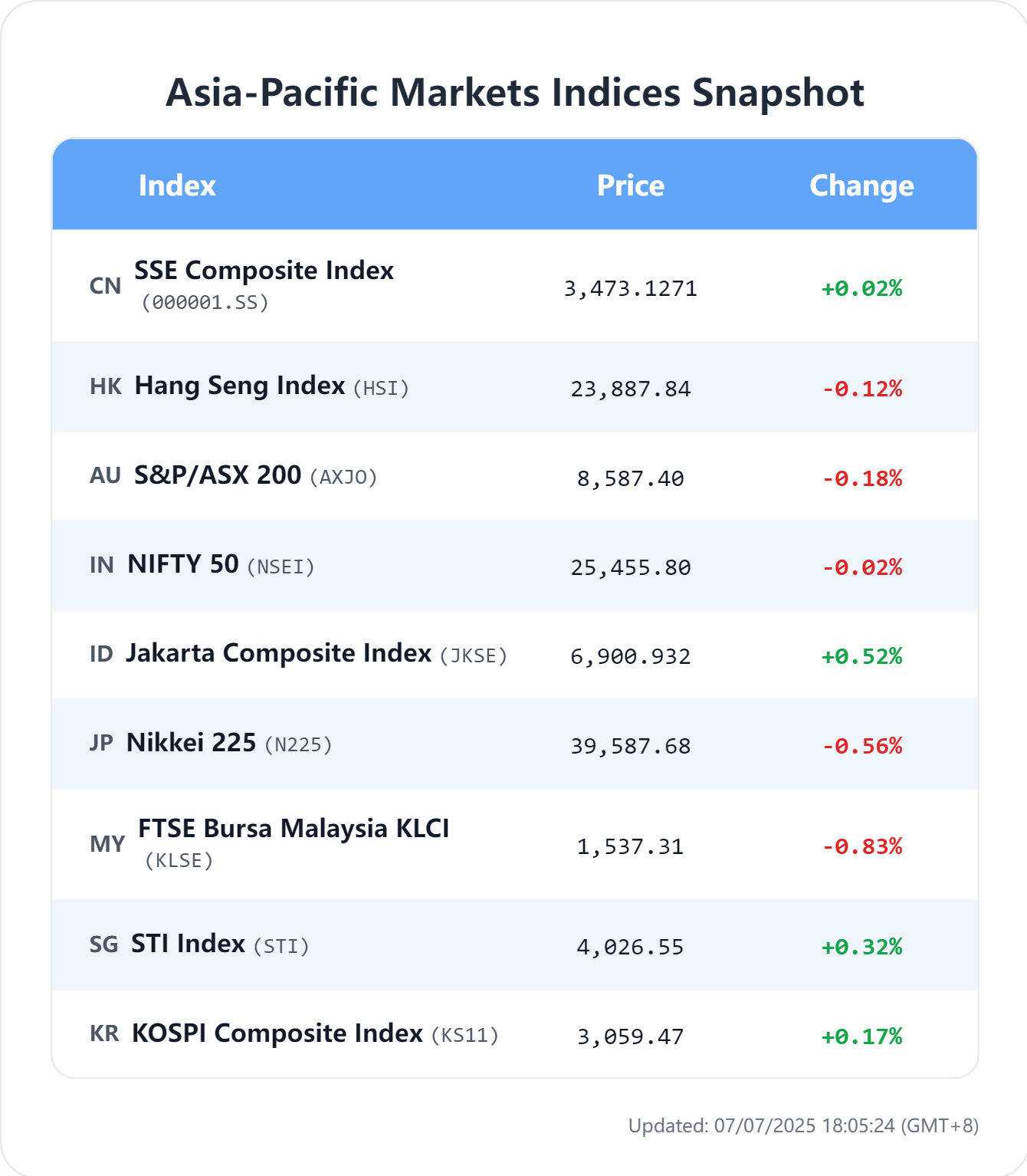
China: At the close, the Shanghai Composite rose 0.02%, the Shenzhen Component fell 0.7%, and the ChiNext Index dropped 1.21%.
Markets oscillated throughout the day, with the Shanghai Index turning green late, while the ChiNext Index led the declines. Total turnover across Shanghai and Shenzhen exchanges was 1.21 trillion yuan, a decrease of 219.9 billion from the previous trading day.
By sector, power, grid equipment, stablecoins, and real estate led the gains, while biotech, PCB, CPO, and innovative drugs saw the largest drops.
Hong Kong: The major Hang Seng indices showed mixed performance, with the Hang Seng Index down 0.12%, the Tech Index up 0.25%, and the State-owned Enterprises Index down 0.01%.
Sector-wise, tech stocks were mixed, gold stocks broadly declined, non-ferrous metals weakened, casino and gaming stocks rose across the board, catering stocks gained, property developers strengthened, and biotech stocks fell.
Japan Stock Market: The Nikkei 225 closed down 0.56% at 39,587.68 points. By sector, eight industries including services, retail, land transport, and pulp and paper saw gains. Conversely, 24 industries, including banking, non-ferrous metals, steel, rubber products, and securities commodity futures, experienced declines.
South Korea Stock Market: The KOSPI index closed up 0.17% at 3,059.47 points. Sector-wise, tobacco, bioengineering, and beverages saw collective gains, while electronics, utilities, and retail sectors posted significant declines.
Singapore Stock Market: The Straits Times Index rose 0.45%, closing at 4,031.86 points. Diversified media, industrial distribution, and waste management led the gains, while oil and gas, semiconductors, and furniture saw the largest drops.
Key Events
Unfazed by Trump’s Pressure, Ishiba Vows No Easy Compromise in U.S.-Japan Trade Talks
On July 6 local time, Japanese Prime Minister Shigeru Ishiba stated he would not “easily compromise” in trade negotiations with the U.S.
“We won’t give in easily. That’s why these negotiations take time and are challenging,” Ishiba said on a program. He noted that Japan has made significant investments in the U.S. economy and deserves treatment distinct from other nations, adding that Japan is preparing for “various scenarios.”
These remarks come as Japan races to secure a mutually beneficial agreement with the Trump administration before the “reciprocal tariff” deadline on Wednesday, July 9.
Japan’s Economic Recovery Faces Hurdle as Real Wages Drop to 20-Month Low in May
On Monday, new data from the Japanese government revealed that real wages in May saw the largest decline in nearly two years, driven by inflation outpacing wage growth. According to the Ministry of Health, Labour and Welfare, inflation-adjusted real wages fell 2.9% year-on-year, marking the steepest drop in 20 months, following a revised 2.0% decline in April.
Real wages, a key indicator of household purchasing power, have now declined for the fifth consecutive month this year.
Profit Surge of 152% Expected! LG Energy Solution Signals Surprise Q2 Performance
South Korean battery giant LG Energy Solution announced on Monday, July 7, that it expects a positive operating profit in the second quarter, driven by robust battery sales, without relying on previous U.S. tax incentives.
The company forecasts an operating profit of 492.2 billion won (approximately $361.2 million) for April to June, a 152% increase from the 195.3 billion won recorded in the same period last year.
Institutional Views
UBS: Dollar May Weaken if Trump Raises Tariffs Again
UBS Global Wealth Management analysts noted in a report that, in a worst-case scenario, the U.S. might reinstate the currently paused reciprocal tariffs, potentially weakening the dollar. The 90-day tariff suspension ends on July 9.
Analysts warn that the most severe outcome would be the U.S. imposing previously announced higher tariffs on all trade partners without agreements, leading to sell-offs of the dollar against the euro, Swiss franc, yen, and pound. They added that less liquid currencies, like those in emerging markets, could also decline.
Deutsche Bank: Gold Support Stems from U.S. Policy Uncertainty
Gold futures rebounded, shaking off earlier losses triggered by stronger-than-expected U.S. nonfarm payroll data. Deutsche Bank analysts said in a report that, after recovering from Thursday’s employment report setback, gold prices are set to close flat this week.
The report was mixed, but a slight drop in unemployment may lead the Fed to view tariff policy uncertainty as not yet severely impacting businesses. Analysts noted that while delayed rate cuts could hurt gold, its primary support comes from volatile U.S. policies, eroding confidence in U.S. assets and boosting gold’s safe-haven demand.
ING: OPEC+ Increased Production Strengthens Oil Price Downside Outlook
ING Group commodity strategists indicated in a report that OPEC+’s unexpected production hike reinforces expectations of further oil price declines. OPEC+ agreed to increase output by 548,000 barrels per day in August, far exceeding the previous 411,000 barrels per day.
A weaker supply outlook combined with demand uncertainty poses a double bearish pressure on prices. ING maintains its forecast of Brent crude falling to $60 per barrel by year-end, anticipating another production increase in September.
Citic Securities: "Big and Beautiful" Bill Negatively Impacts U.S. Healthcare and Renewables
Citic Securities’ research report stated that Trump’s signing of the "Big and Beautiful" (OBBB) bill, encompassing a broad conservative agenda, will increase the federal deficit by $3.4 trillion through 2034. On the U.S. bond market, the bill heightens future debt pressures, likely raising the long-end yield curve.
For U.S. stocks, earnings revisions have stabilized since late June, but the OBBB bill poses downside risks to healthcare and renewables. Focus could shift to tech sectors with aligned valuations and performance, manufacturing benefiting from reindustrialization, upstream resources, and nuclear power.
The bill favors tech giants, AI, and semiconductor equipment, while renewables face pressure (though storage policies soften). It also promotes traditional energy revival, highlighting nuclear power growth.