
Musk’s xAI Set to Launch Grok 4 — Can Tesla’s FSD and Optimus Really Benefit?

Shearing sheep
July 8, 2025
GoGPT Summarizes Articles
On Monday, Elon Musk revealed that his AI startup xAI will release its next-gen large language model, Grok 4, on Wednesday, July 9. The announcement has once again stirred up buzz across the AI and tech investing space, particularly due to its potential implications for Tesla’s Full Self-Driving (FSD) system and the humanoid robot Optimus.
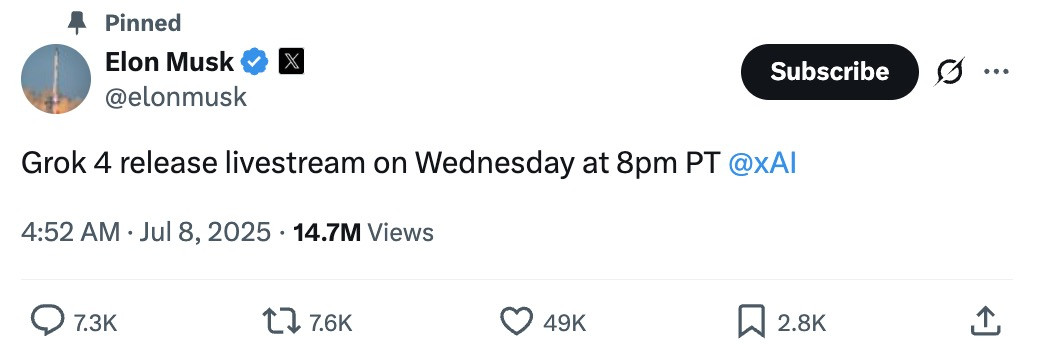
The release event will be streamed live at 8 p.m. PT on xAI’s official X account. According to insiders, xAI is also planning to unveil Grok 4 Code, a specialized version designed as a personal assistant for top-tier developers—possibly offering integration with custom code editors.
This launch comes just months after Grok 3 made headlines for outperforming models like Gemini, Claude, and GPT-4o on reasoning-heavy tasks such as advanced math, science, and spatial simulations. At the time, it was praised for its logical flexibility and its ability to grasp complex physical concepts—qualities that go far beyond basic chat functionalities.
So, what does this mean for Tesla?
Musk has hinted at a deeper integration of xAI’s large models with Tesla’s AI supercomputing ecosystem. The potential synergy between Grok and Tesla’s neural net training infrastructure could power up two of Musk’s most ambitious projects: autonomous driving and robotics.
If successful, Grok 4 could serve as a high-level reasoning engine for FSD, enhancing the car’s ability to make fast, context-aware decisions in unpredictable environments. For Optimus, it could significantly boost real-time decision-making, spatial awareness, and even conversational capabilities—areas critical to making humanoid robots truly useful in multi-task scenarios.
To be clear, this is still speculative. AI integration at this level isn’t plug-and-play, especially when safety and latency are key concerns. But on paper, combining Grok’s deep reasoning capabilities with Tesla’s low-latency visual-behavior models does paint a compelling picture: a next-gen autonomous system that can “see, think, and act” in real time.
Beyond Tesla, the timing of Grok 4’s release adds fuel to the increasingly competitive AI race. With OpenAI’s GPT series and Google’s Gemini 2.5 Pro already in the market, xAI is looking to carve out a space not just in conversational AI, but also in applied, reasoning-intensive use cases.
This all plays into a broader trend: demand is surging not only for AI compute infrastructure—where Nvidia remains dominant—but also for enterprise-grade AI software. Companies like C3.ai, AppLovin, and Palantir have recently reported strong earnings, underscoring investor interest in software that drives real operational efficiency.
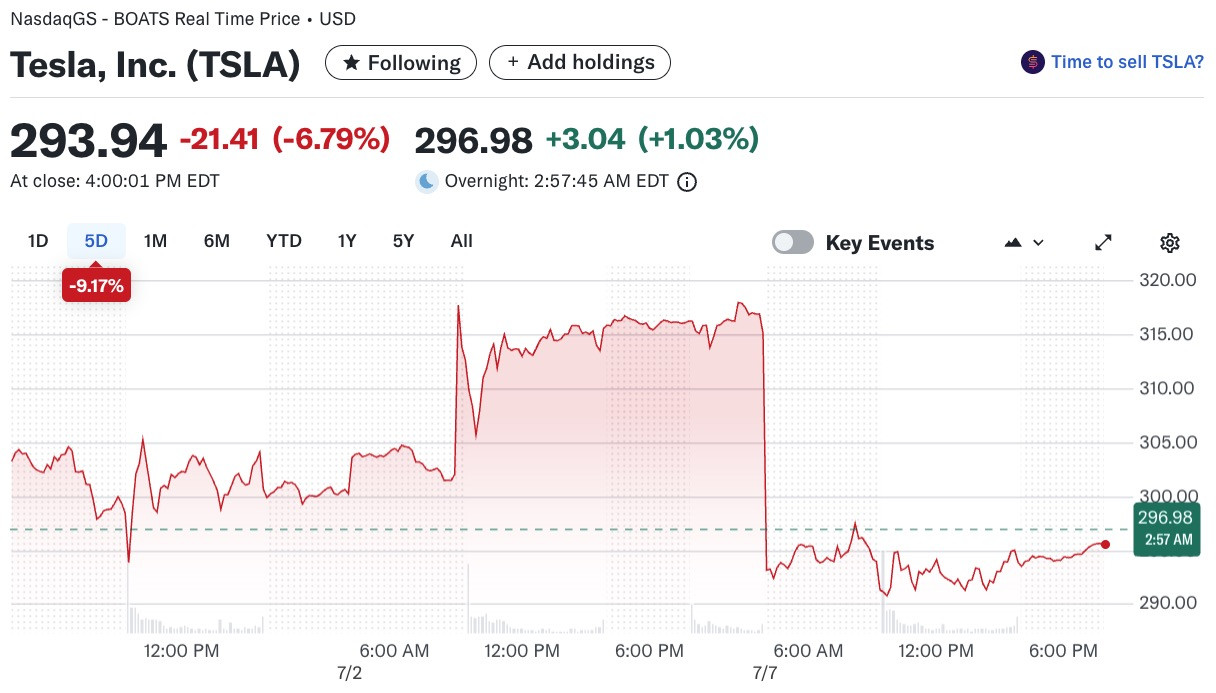
Yet despite the buzz around xAI’s innovations, Tesla stock fell nearly 7% on Monday, wiping out more than $68 billion in market cap. The drop followed Musk’s announcement of a new political party—“America Party”—which many investors saw as a distraction from Tesla’s core business. The optics don’t help: Musk promising more focus on Tesla while simultaneously launching a political movement and doubling down on xAI.
Grok 4 might be a leap forward for AI reasoning, and its potential integration into Tesla systems is fascinating. But until we see tangible results, the market remains wary of Musk’s expanding portfolio of ventures—and how they affect Tesla’s long-term focus.
#U.S. Tech Giants: Tracking U.S. Market Leaders#$Tesla Inc. Common Stock(TSLA)