
Tech Giants Push Back as EU AI Law Faces Possible Delay

With less than a month to go before key parts of the EU’s Artificial Intelligence Act are set to take effect, pressure is mounting from both Silicon Valley giants and major European players to hit the brakes. Companies like $GOOGL’s parent Alphabet, $META , $ASML, and French AI firm Mistral are urging the European Commission to delay the law’s enforcement—and, in a rare turn, they’re getting political backing from some EU leaders.
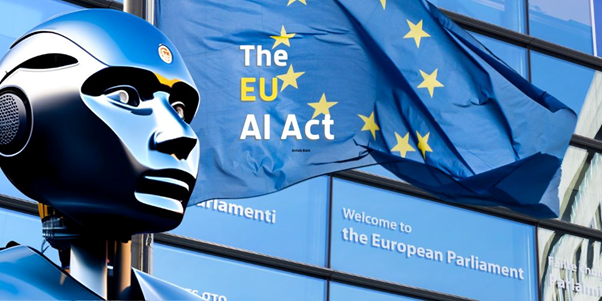
For markets, this isn’t just a sudden spike in regulatory risk. It’s a sign of deeper tension between the ideal of governance and the realities of the AI industry.
What Is the AI Act and Why Are So Many Companies Nervous?
The AI Act, passed in 2024, is the world’s first comprehensive law aimed at regulating artificial intelligence. It’s often compared to the GDPR but for AI. The legislation takes a tiered, risk-based approach and places strict requirements on general-purpose AI (GPAI) models.
GPAI refers to large-scale foundational models that can be used across various domains—think OpenAI’s GPT series, Google’s Gemini, or Mistral’s Mixtral. Starting August 2, developers of such models will be required to:
-
Disclose training data sources and comply with EU copyright law
-
Provide technical documentation and pre-launch testing reports
-
Conduct mandatory tests for bias, toxicity, and robustness
-
For high-impact models, report major incidents to the EU and disclose energy usage
Sounds fair? Maybe. But here’s the issue: the law is set to go live, yet no one knows exactly how to implement it.
Why Are So Many Companies Calling for a Delay?
Two main reasons—uncertainty and high costs.
First, the “AI Code of Practice,” a document meant to clarify compliance procedures, was supposed to be released in May but never arrived. Without it, companies don’t know what’s expected of them or what might count as a violation. Trying to comply now feels like walking a tightrope blindfolded.
Second, European startups are already at a disadvantage compared to their U.S. counterparts when it comes to legal and compliance resources. Once GPAI rules kick in, many smaller firms may struggle to keep up. A letter signed by 45 European AI companies openly calls for a two-year delay to give companies breathing room.
Even governments are starting to speak out. Sweden’s Prime Minister Ulf Kristersson recently said the rules were “too confusing” and should be paused. The U.S. government, back in April, sent a formal letter to the EU urging a re-evaluation of the law’s feasibility.
Meta’s global affairs head described the law as “completely unworkable,” and a Google executive said some of the testing and copyright rules “go far beyond what’s reasonable.”
Who Stands to Gain if the Law Is Delayed?
From a market perspective, the most obvious winners would be the big model developers—Google, Meta, Microsoft, OpenAI—especially those with significant business in Europe.
Right now, the commercialization of large AI models is at a turning point. Companies are racing to build plug-in ecosystems, API platforms, and search integrations to turn these models into real revenue. But developing these tools comes with enormous costs—everything from data compliance and licensing to compute infrastructure.
If the August rollout is postponed, these companies would benefit in three ways:
-
They could delay costly testing and disclosure
-
Move faster in launching products across Europe
-
Gain time to build user bases and establish market dominance
European AI startups, meanwhile, would be spared from being overwhelmed by regulatory hurdles before they’re ready—giving them a chance to grow before being asked to comply with rules designed for much bigger players.
My Take
So far, the European Commission hasn’t confirmed whether a delay is coming—but the political signals suggest a softening stance.
Sweden’s PM, Finnish officials, and top tech lobbyists have all voiced concerns that the rules are too complex to enforce as written. And with the U.S. government formally weighing in, there’s now international pressure as well.
In my view, a full delay is unlikely. But what’s more probable is a phased or technical postponement of certain rules, especially those requiring detailed compliance procedures. The EU may try to protect its credibility while quietly giving the industry more time.
Because this fight isn’t just about red tape—it’s about who gets to shape the rules of the AI age.
This isn’t just another regulatory dispute. It’s a flashpoint in a much larger global divide over how to govern AI.
The EU wants to be the rule-setter. The U.S. leans toward market-driven innovation. And the world’s tech giants are playing a global chess game—looking for jurisdictions where they can innovate fast while keeping compliance costs low.
This back-and-forth between regulation and resistance will shape the AI race in the months ahead—deciding who builds faster, who scales smarter, and ultimately, who wins.