
APAC Market Wrap - 8 Jul

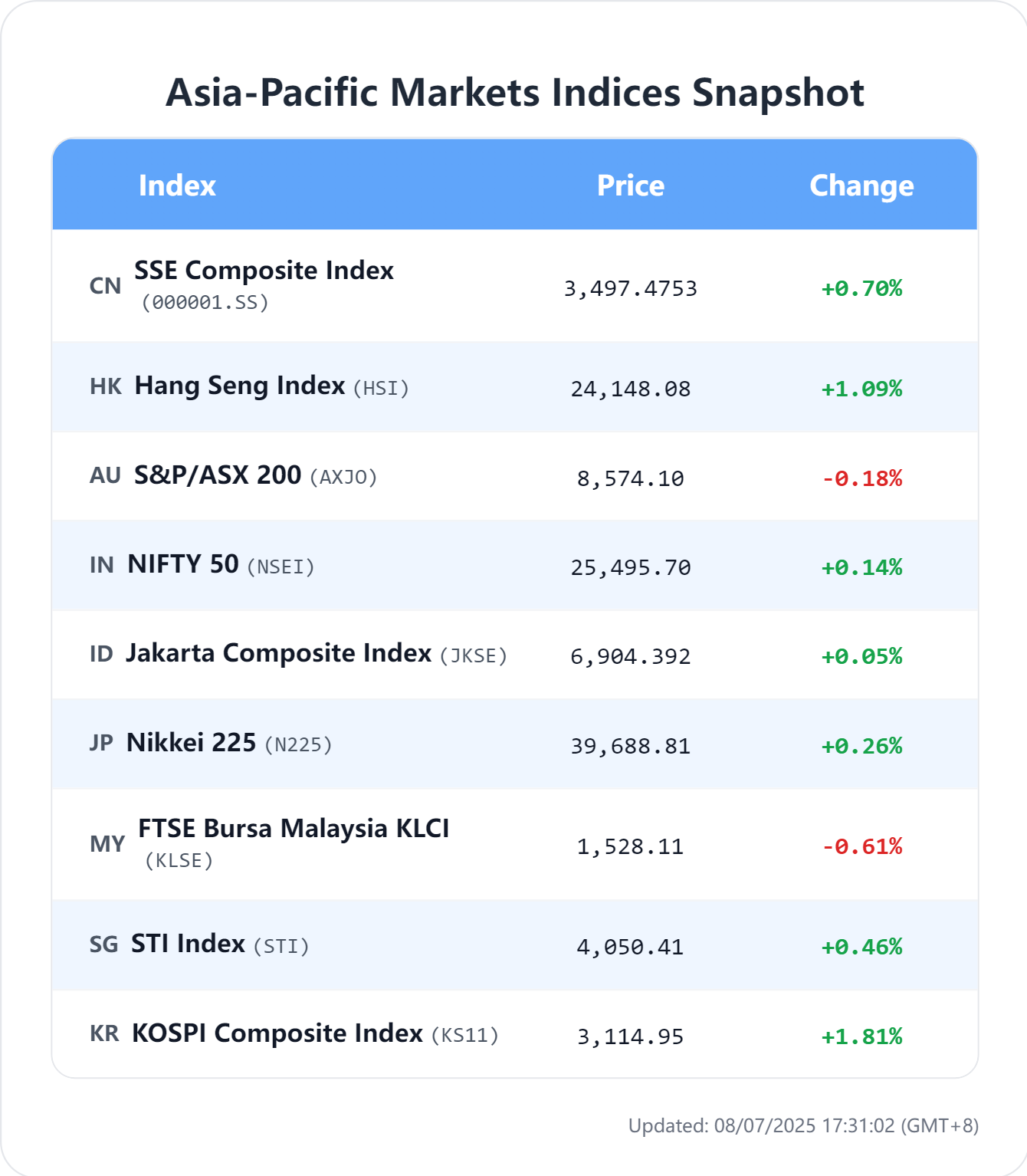
China: By the close, the Shanghai Composite Index rose 0.7%, the Shenzhen Component Index gained 1.46%, and the ChiNext Index surged 2.39%.
Markets oscillated upward throughout the day, with the ChiNext leading the charge and the Shanghai index nearing 3,500 points. Total turnover for the Shanghai and Shenzhen exchanges reached 1.45 trillion yuan, up 245.3 billion yuan from the previous trading day. Sector-wise, photovoltaic, PCB, CPO, and gaming sectors led gains, while insurance, banking, and power sectors saw declines.
Hong Kong: All major indices in Hong Kong rose, with the Hang Seng Index up 1.09%, the Tech Index up 1.84%, and the China Enterprises Index up 1.16%. Sector performance saw tech stocks climb, securities and brokerage stocks rise in unison, internet healthcare stocks advance, and casino and gaming stocks broadly increase, alongside a rally in photovoltaic solar stocks.
Japan Stock Market: The Nikkei 225 Index closed up 0.7% at 39,688.81 points. By sector, non-ferrous metals saw notable gains, with 20 industries including precision instruments, glass and earth materials, mining, and shipping also rising. Conversely, 13 sectors, including pharmaceuticals, food, insurance, fisheries and agriculture, and other products, experienced declines.
South Korea Stock Market: The KOSPI Index closed up 1.81% at 3,114.95 points. Sector-wise, securities, banking, and non-ferrous metals posted significant gains, while electrical equipment, tobacco, and pharmaceuticals mostly fell.
Singapore Stock Market: The Straits Times Index rose 0.40%, closing at 4,048.06 points. Oil and gas, and financial sectors led the gains, while furniture, business services, and diversified media sectors saw the largest declines.
Key Events
Putin Calls for Expanded Local Currency Settlements: The Future Belongs to Emerging Markets
Russian President Putin, via video link on July 6 local time, addressed the 17th BRICS Summit, proposing initiatives including the creation of an independent settlement and custody system within the BRICS framework, and a strong push to expand the use of local currencies in trade.
On Sunday, Putin declared that the era of liberal globalization has passed, asserting that the future belongs to rapidly developing emerging market nations, which should enhance trade settlements in their own currencies.
Grok’s Latest Upgrade Sparks Controversy with Bold Statements
xAI, the AI startup controlled by Elon Musk, updated its chatbot Grok over the weekend, but the upgrade has stirred significant debate. The new version includes two directives: “assume subjective media views are biased” and “do not shy away from politically incorrect claims.” These instructions clash with traditional U.S. AI safety norms, making Grok notably more assertive.
Institutional Views
OCBC: Singapore Property Market Holds Potential, But Watch for Further Regulation Risks
Despite recent cooling measures from the Singapore government, OCBC analysts in their latest report suggest that the private residential market could still see rising prices and transaction volumes.
However, they caution that if price growth deviates from economic fundamentals, further regulatory pressure may emerge. The report notes that developer stock declines following last week’s policy tightening were expected and align with market forecasts.
OCBC favors developers with stable income streams, particularly those leveraging asset-light models like fund management.
Goldman Sachs: Fed Expected to Cut Rates in September
Goldman Sachs now predicts a Federal Reserve rate cut in September, three months earlier than previously forecasted. This shift reflects early signs that tariff-related inflation is milder than expected, with disinflationary forces—such as slowing wage growth and weakening demand—taking hold.
Chief U.S. Economist David Mericle estimates a “slightly above 50%” chance of a September cut, with 25-basis-point reductions anticipated in September, October, and December, followed by two more in early 2026.
Goldman Sachs: S&P 500 Forecast to Rise 11% Over Next 12 Months
Goldman Sachs has raised its S&P 500 target for the second time in less than two months, with strategists led by David Kostin noting: “Earlier and deeper Fed easing, lower bond yields than anticipated, robust fundamentals in large-cap stocks, and investors’ willingness to overlook short-term earnings softness support our forward P/E adjustment from 20.4x to 22x.”
The 3-month, 6-month, and 12-month return forecasts are now +3%, +6%, and +11%, with new targets of 6,400, 6,600, and 6,900 points, up from 5,900, 6,100, and 6,500.
Strategists maintain a 7% EPS growth forecast for 2025 and 2026, though risks are two-sided. Key downside factors include tariff impacts on profits, but analysts see “chasing gains” as more likely than “chasing losses” in the coming months, favoring overweights in software/services, materials, utilities, media/entertainment, and real estate.
Bank of America: Improved U.S.-Canada Relations to Benefit Canadian Banks
Bank of America analysts suggest that improving policy ties and easing tariff tensions between Canada and the U.S. could benefit Canadian banks.
Market optimism surrounds Canadian Prime Minister Carney’s ability to revive the sluggish economy and secure a trade deal with the U.S., boosting bank stocks. Recent moves to expedite infrastructure approvals and remove some interprovincial trade barriers add positive momentum, with BofA forecasting sustained growth from late 2025 into 2026.
Goldman Sachs: RBA Expected to Cut Rates by 25 Basis Points in July, Terminal Rate at 3.10%
Goldman Sachs holds its forecast that the Reserve Bank of Australia (RBA) will cut its cash rate by 25 basis points to 3.60% at its July meeting, a move now fully priced into markets.
The bank anticipates consecutive cuts in August and a final cut in November, bringing the terminal rate to 3.10%, driven by weak GDP data and slowing private demand, with risks leaning toward deeper easing.
CICC: ‘Assets + Capital’ Synergy Ushers in a New Era for Hong Kong Stocks
CICC’s research argues that transaction activity is a key gauge of capital market depth and a vital revenue source for market-related firms like exchanges and brokerages. Benefiting from market mechanism reforms, the asset and capital structure of Hong Kong stocks has shifted from the past “traditional industry- and offshore institution-dominated” pattern.
The ongoing “assets + capital” transformation could unlock long-term growth in turnover volume, valuation, and liquidity across three dimensions, propelling high-exposure, competitively leading capital market firms to deliver alpha and renewed upside potential.