
Crypto Week Approaches: Is U.S. Digital Asset Policy About to Pivot?

The U.S. House has designated the week of July 14, 2025 as “Crypto Week,” during which it will consider three landmark bills that could reshape the digital asset landscape overnight.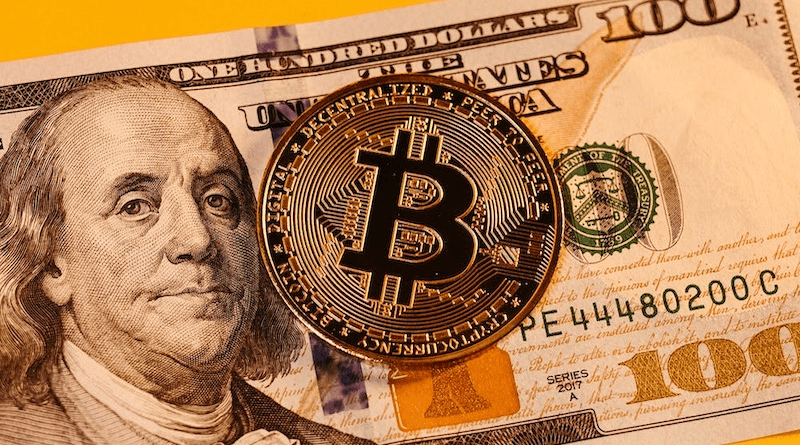
The CLARITY Act aims to delineate SEC and CFTC oversight, the GENIUS Act would set a federal framework for stablecoin issuance, and the Anti-CBDC Act seeks to ban a retail Fed-issued digital dollar.
Market volatility is likely until the fate of these proposals is decided, and investors are already eyeing crypto-adjacent equities and ETFs for potential gains.
What Are the Core Provisions of the CLARITY Act?
Defining Regulatory Boundaries
Under the CLARITY Act, tokens classified as commodities or securities will be explicitly assigned to either the Commodity Futures Trading Commission (CFTC) or the Securities and Exchange Commission (SEC).Exchanges, token issuers, and investors would benefit from unambiguous compliance guidelines.
Why It Matters
By reducing regulatory uncertainty, proponents argue the Act could spur innovation within U.S. markets, prompting more domestic blockchain projects and narrowing the gap with overseas competitors.
How Will the GENIUS Act Transform Stablecoin Oversight?
Establishing Nationwide Standards
Having already passed the Senate, the GENIUS Act mandates that all U.S. dollar–pegged stablecoins be 100% backed by U.S. dollars or similarly liquid reserves. Issuers managing over $50 billion in market cap would face yearly audits.
Preserving Dollar Dominance
Championed by President Trump, the bill reflects a strategic push to reinforce the U.S. dollar’s primacy in global digital finance. A curated, regulated stablecoin ecosystem could channel more transactional volume—and data—through American rails.
Defending Financial Privacy: What’s in the Anti‑CBDC Act?
Guarding Against a Direct Fed‑Issued Digital Dollar
The Anti‑CBDC Act prohibits the Federal Reserve from issuing any central bank digital currency (CBDC) directly to the public. Lawmakers frame this as a bulwark for consumer privacy, preventing potential government tracking of individual transactions.
Balancing Innovation and Rights
While some industry voices welcome a Fed digital dollar to improve payment efficiency, privacy advocates warn of unprecedented surveillance capabilities. This bill cements the latter perspective, emphasizing civil liberties over digital modernization.
Investor Opportunities and Market Implications
Spotlight on Exchange Platforms
- Circle ($CRCL )
As the second‑largest stablecoin issuer with roughly $61.7 billion in USDC circulating, Circle stands to gain if the GENIUS Act becomes law. JPMorgan highlights Circle’s compliance pedigree under MiCA and forecasts significant upside from renewed trust in regulated stablecoins.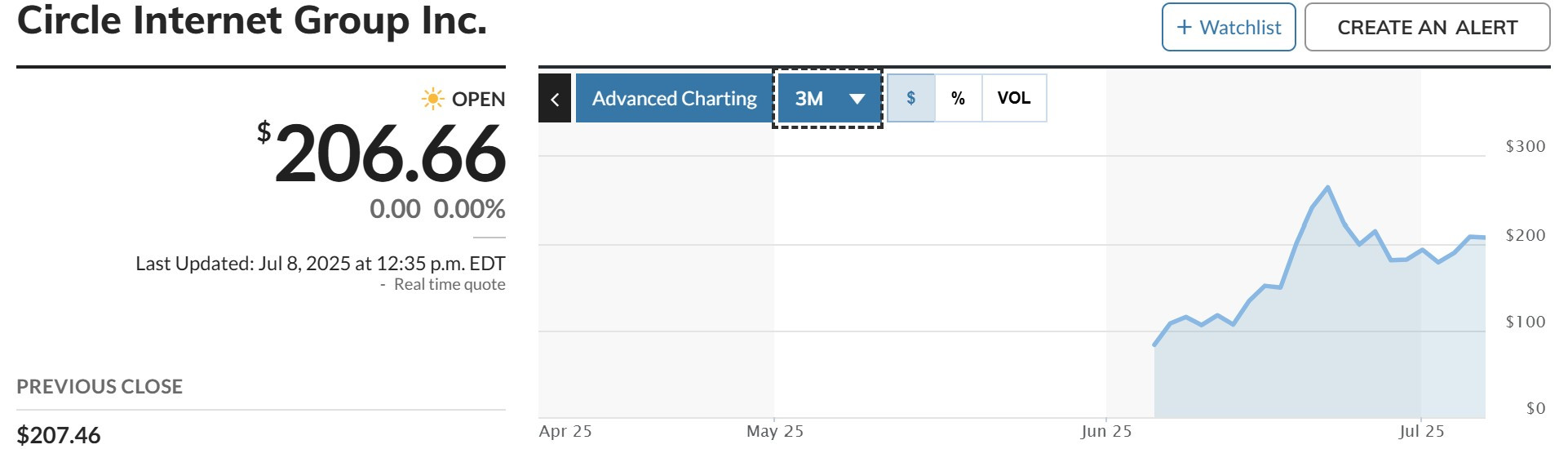
- Coinbase ($COIN )
Recent 43% YTD gains belie further runway: analysts liken it to “the Amazon of crypto” and have raised its 2027 price target to $510, citing its entrenched position in U.S. trading, stablecoin operations, and on‑ramps like its Base L2 network.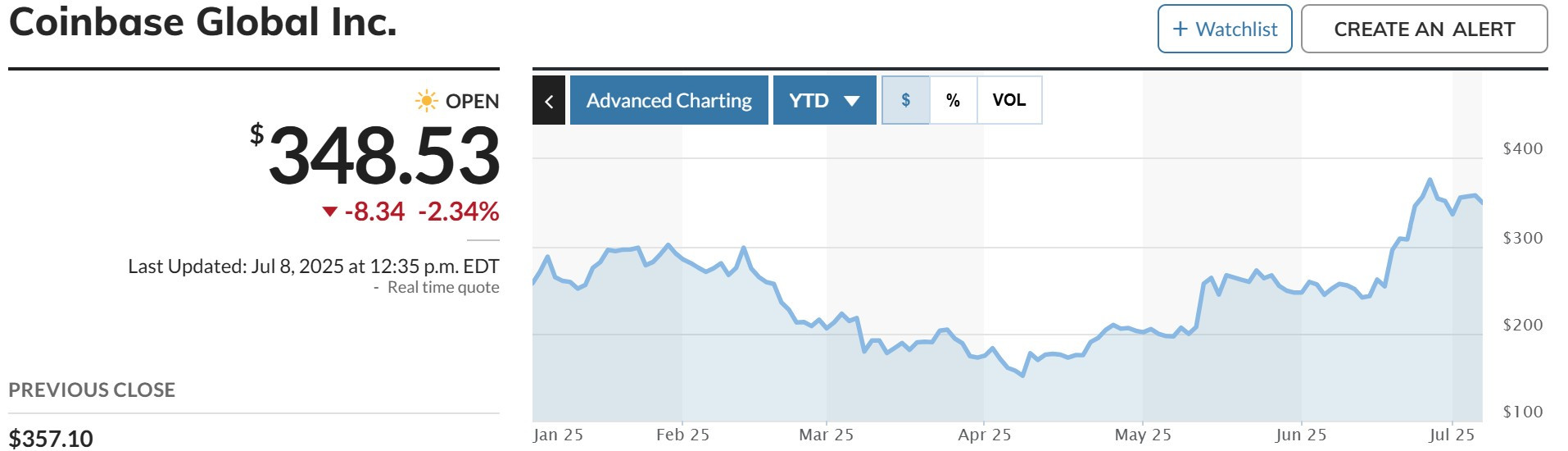
- Robinhood ($HOOD )
Rocketing over 150% this year, Robinhood’s EU MiFID license enables tokenized stock trading. Its step into Ethereum L2s signals ambition beyond brokerage, though recent disputes over unauthorized OpenAI and SpaceX token offerings underscore compliance risks.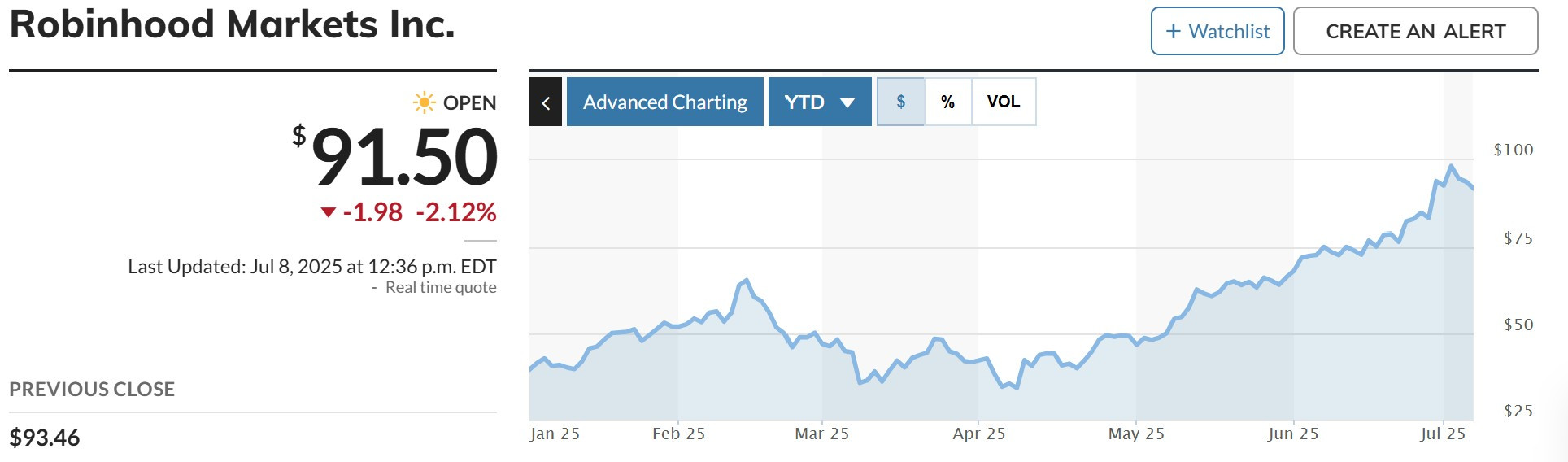
Which Mining and Infrastructure Players Are Pivoting to AI?
KULR Technology ($KULR )
Secured a $20 million revolving credit line from Coinbase Credit, collateralized by KULR’s Bitcoin holdings. The funds will finance the company’s self‑described “Bitcoin‑first” strategy supporting aerospace energy storage and on‑balance‑sheet BTC accumulation.
CoreWeave–Core Scientific Merger
CoreWeave’s all‑stock, $9 billion takeover of Core Scientific ($CORZ ) at a 33% premium will close in Q4 2025, contingent on regulatory approvals. The merger aligns GPU‑driven AI capacity with existing power infrastructure.
Other Notable Transitions
- IREN Ltd ($IREN ) expanded to 50 EH/s of mining capacity and 2,400 NVIDIA Blackwell GPUs for AI cloud revenue.
- Applied Digital ($APLD ) pivoted from crypto mining to HPC, securing two 15‑year, $7 billion AI data center contracts.
- Cipher Mining ($CIFR ) landed $50 million from SoftBank to fuel its HPC pivot.
- Bit Digital ($BTBT ) spun out WhiteFiber for GPU services, filed for its IPO, and inked multi‑year, multi‑megawatt Cerebras and Shafeform deals.
- Riot Platforms ($RIOT ) paused its BTC expansion to explore up to 1 GW of AI infrastructure at Corsicana, TX.
- Hut 8 ($HUT ) launched Highrise AI, offering GPU‑as‑a‑Service with over 1,000 NVIDIA H100s.
- MARA Holdings ($MARA ) rolled out immersion‑cooled 2PIC700 systems, rebranding to “edge compute” to serve AI and crypto.
- TeraWulf ($WULF ) supplies sustainable energy to G42’s Core42 AI division and continues BTC mining.
- Galaxy Digital ($GLXY ) leased 133 MW at its Helios data center to CoreWeave, projecting $1.7 billion EBITDA.
- Hive Blockchain ($HIVE ) is converting a 7.2 MW Toronto site to a Tier 3 liquid‑cool HPC hub under “BUZZ HPC.”
- Bitfarms ($BITF ) teamed with ASG and WWT for North American AI feasibility studies.
- Bitdeer Technologies ($BTDR ) secured priority access to NVIDIA’s DGX H100 SuperPODs, building a full‑stack AI service.
What Comes Next for “Crypto Week” and Beyond?
With Congressional deliberations looming on July 14, market participants brace for headlines that could revitalize—or roil—the crypto sector. “Buy the rumor, sell the news” may prevail as volatility spikes around committee votes.
Institutions, exchanges, miners, and token issuers alike face a pivotal test: can Washington deliver regulatory clarity without stifling growth? Investors should position for sharp moves in both on‑chain assets and listed equities as the U.S. redraws the digital finance map.