
SoFi Sees a Golden Opportunity as Federal Student Loan Limits Tighten

While headlines have been dominated by AI, tariffs, and commodity prices, something big is quietly unfolding in the world of student finance. President Trump has signed a new law that introduces sweeping changes to the federal student loan system. On the surface, it looks like a fiscal reform. But beneath it, a major market shift is already taking shape—one that could benefit private lenders like SoFi more than anyone else.
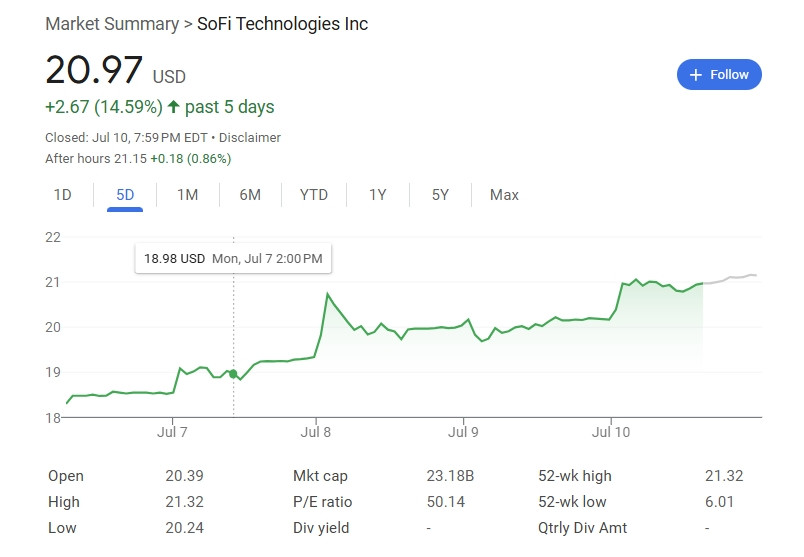
This policy change isn’t just about budget cuts. It’s about redrawing the boundaries between public and private education finance. And SoFi is ready to step in.
What the New Rules Actually Do and Why It Matters
Under the new law, the federal government is capping how much students and families can borrow:
-
Graduate students can now borrow a maximum of $100,000 in total federal loans
-
Professional students like those in medical or law school have a cap of $200,000
-
Parent PLUS loans, which previously could cover the full cost of attendance, are now limited to $65,000 per student
For years, students could rely on generous federal aid to fully finance high-cost degrees. Now that safety net is shrinking. These new limits are expected to create a funding gap—especially for graduate and professional students—forcing many to turn to private lenders for help.
Why SoFi Is Perfectly Positioned to Win
For $SOFI , this shift couldn’t have come at a better time.
If you’re not familiar, SoFi (short for Social Finance) is one of the most successful fintech platforms in the U.S., offering everything from student loans to credit cards to investing tools. But its roots are in student lending, especially for high-credit, high-earning-potential borrowers—exactly the kind of customers who will be affected most by these new limits.

Here’s why SoFi stands to benefit:
-
It knows its audience: Graduate students at top-tier schools are its bread and butter
-
It’s built for speed: Fully digital, fast approval, and transparent terms
-
It fills the gap: With federal aid shrinking, SoFi can be the next stop for high-achieving students who need more funding
CEO Anthony Noto made it clear earlier this year: if the government cuts back on federal loans, SoFi is ready to move. That moment has arrived.
Why the Government Is Scaling Back and What It Reveals
For decades, the U.S. federal loan system operated under a simple principle: if you qualified, the government would fund you—often in full. This led to ballooning student debt (now over $1.6 trillion), steadily rising tuition costs, and growing concerns about long-term repayment burdens.
Trump’s move reflects a shift in mindset. Instead of unlimited government backing, the new policy suggests that education financing should be more market-driven, with individuals and private lenders sharing more of the risk.
Supporters say it’s fiscally responsible. But for families and students, it could mean less flexibility, more financial stress, and a much greater reliance on private markets.
The Risks Behind SoFi’s Big Moment
Make no mistake—this is a major opportunity for SoFi. With other lenders pulling back in recent years, it’s one of the few players left with the scale and brand recognition to grab market share.
But big opportunities come with big risks.
-
Credit quality could suffer: As SoFi expands its customer base, it may have to approve borrowers with weaker financial profiles
-
Economic headwinds could hit hard: A downturn or rising unemployment could lead to more defaults
-
Policy swings add uncertainty: A future administration could reverse these changes, leaving SoFi exposed
In other words, this isn’t a simple win. It’s an aggressive expansion into a market that’s changing rapidly—and unpredictably.
What This Really Means for Students and Families
This isn’t just a financial story. It’s a social one.
With the government stepping back, families may have to make harder decisions about where to study, what to study, and how much debt to take on. Private lenders offer access, but not always the same protections. And while SoFi’s tools are excellent for some borrowers, others may find themselves priced out or pushed into stricter terms.
The long-term concern is whether this shift will widen the gap between those who can afford a top-tier education and those who can’t. If student financing becomes more market-based, education access could become more unequal.
My Take on What Comes Next
To me, this is about more than just student loans. It’s about a changing philosophy in how America funds higher education.
We’re moving from a model of broad federal support to one that increasingly relies on private capital. SoFi might thrive in that environment, but the broader system may become more fragile—especially if economic conditions worsen or default rates climb.

For investors, SoFi could be a standout in the coming quarters. For students and families, though, the road ahead may be more uncertain than ever.