
APAC Market Wrap - 11 Jul

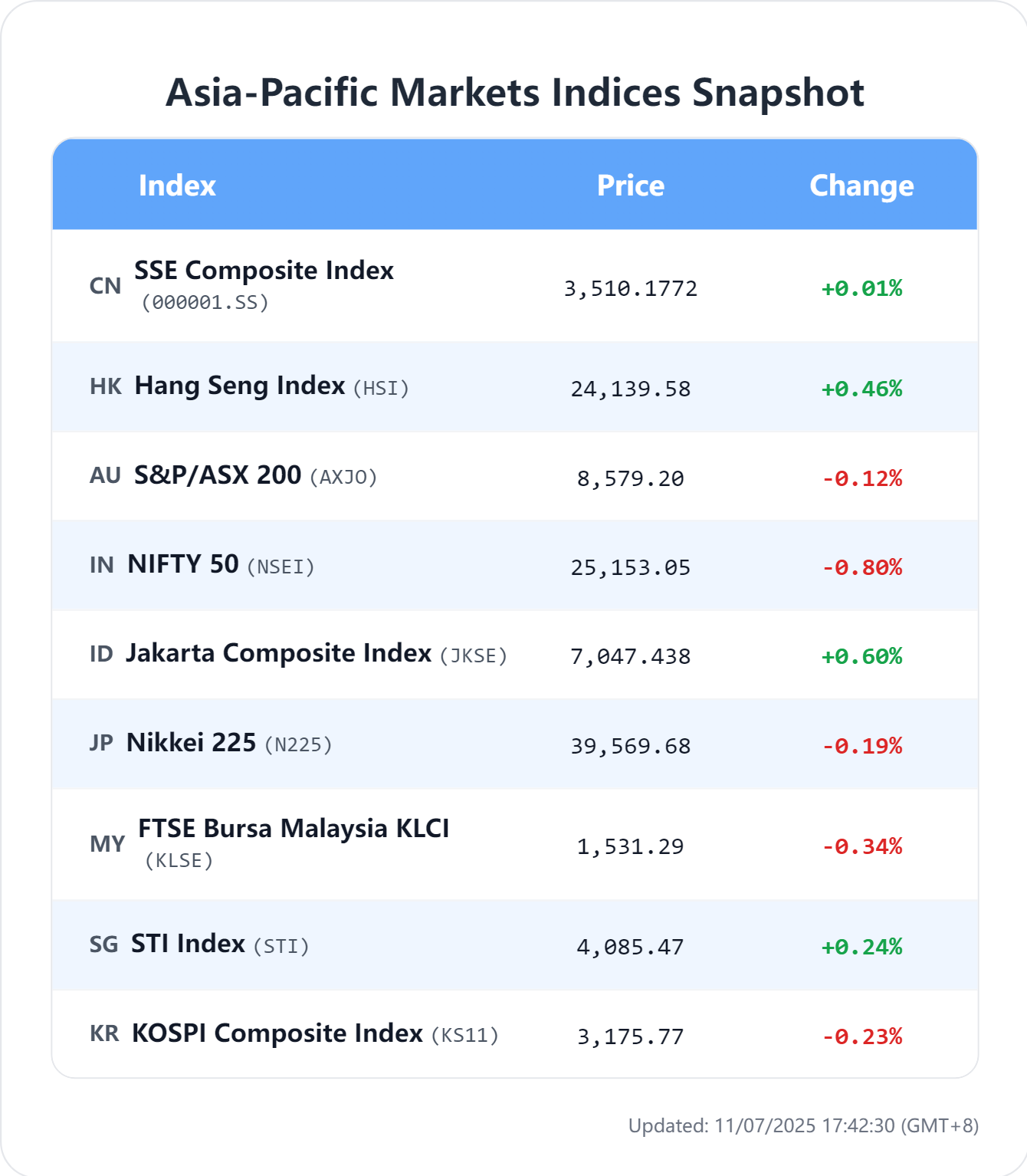
China: Markets rose early but retreated, with major indices posting slight gains. The Shanghai Composite Index rose 0.01%, the Shenzhen Component Index gained 0.61%, and the ChiNext Index climbed 0.8%. Sector-wise, rare earth permanent magnets, securities, internet finance, and non-ferrous metals led gains, while banks, PCB, gaming, and papermaking sectors lagged.
Hong Kong: All major indices advanced. The Hang Seng Index rose 0.46%, the Hang Seng Tech Index gained 0.61%, and the State-Owned Enterprises Index increased 0.22%.
Sectors showed mixed results, with tech stocks varying, securities and brokerage stocks rising broadly, biotech stocks advancing, insurance stocks strengthening, semiconductor stocks shining, sports apparel stocks declining, and cryptocurrency concept stocks with ETFs continuing to rise.
Japan Stock Market: The Nikkei slipped 0.19% to 39,569.68. By industry, 24 sectors, including shipping, pulp and paper, steel, securities, commodity futures, and banking, posted gains, while 8 sectors, such as electric power, non-ferrous metals, and services, fell.
South Korea Stock Market: Stocks in South Korea declined, with the Kospi Composite Index dropping 0.2% to 3,175.77, ending a four-session winning streak. By sector, venture capital, diversified communication services, and leisure and electrical products rose, while aerospace and defense, conglomerates, oil and gas, machinery, and electrical equipment declined.
Australia Stock Market: The S&P/ASX 200 (XJO) fell 0.11% to 8,580.100 points. Home construction, industrial products, and metals and mining sectors led gains, while apparel, education, and real estate lagged.
Singapore Stock Market: The Straits Times Index rose 0.30% to 4,087.81 points. Industrial products, building materials, and forestry products topped gains, while apparel, pharmaceuticals, and medical devices saw losses.
Malaysia Stock Market: The Malaysia Index dipped 0.03% to 1,536.07 points. Communication and media, and technology sectors led the rise, while utilities, business trusts, and healthcare declined.
Key Events
Nvidia CEO Jensen Huang Enters Global Top 10 Billionaires, Nears Buffett by $10 Billion
With Nvidia’s market cap surpassing $4 trillion, CEO Jensen Huang’s net worth has soared. On July 11, holding about 3.5% of Nvidia, Huang ranked 10th globally, with his net worth hitting $143 billion as of Thursday’s U.S. close, up over $28.7 billion year-to-date. Just ahead is Warren Buffett at $144 billion, a mere $10 billion gap. With Wall Street bullish on Nvidia, Huang may soon overtake Buffett.
Yen Weakness Highlights Concerns Over Japan Election, Tariffs
Amid today’s sharp forex swings, traders noted the yen as the weakest G-10 currency, a trend likely to persist through Japan’s Upper House election.
Investors are digesting yen depreciation fears, with an inconclusive ruling party outcome potentially dampening demand for Japanese assets. U.S. tariff threats loom, despite Japan’s unsuccessful pivot after multiple U.S. official meetings.
Tesla Officially Enters India Market, Mumbai Experience Center Opens July 15
Tesla’s first India showroom opens next week in Mumbai’s Bandra Kurla Complex on July 15, following the import of $1 million in cars and accessories. Despite CEO Elon Musk’s complaints about high Indian import tariffs, this marks Tesla’s entry into the world’s third-largest auto market.
Institutional Views
Goldman Strategists: Raise Asia Stock Targets, Upgrade Hong Kong Rating
Goldman Sachs strategists lifted Asia stock forecasts, citing a favorable macro environment and tariff clarity.
Led by Timothy Moe, they raised the MSCI Asia Pacific (ex-Japan) Index 12-month target by 3% to 700 points, implying a 9% dollar return. They upgraded Hong Kong to “market weight,” seeing it as a key beneficiary of Fed easing and a weaker dollar.
Goldman: Brazil’s Retaliatory Tariffs Could Worsen Losses
Analyst Alberto Ramos predicts Brazilian exporters will urge President Lula to avoid retaliating against Trump’s 50% tariff, set for next month.
Ramos estimates a 0.3-0.4% GDP hit for Brazil, with retaliation risking further economic and inflation damage. “It’s unclear if or how Brazil will retaliate,” he said.
BNP Paribas: Eurozone Needs More Defense, Infrastructure Spending to Ease Aging Pressure
Economists Francisco Tiago Carvalho and Luca Pennarola at BNP Paribas suggest increased defense and infrastructure spending could offset eurozone demographic challenges. Germany, the largest economy, plans a major fiscal shift toward weapons and infrastructure.
CITIC Securities: Watch U.S. Stock Opportunities Post-Reciprocal Tariff Disruptions
CITIC Securities notes U.S. stocks’ rebound to highs sparks debate, with July data steady but not reversing a slight economic slowdown. Earnings may face minor cuts, but IT and telecom sectors show strong profit growth.
Valuations remain high, though a moderate H2 correction is expected. Top tech stocks, with solid earnings delivery, offer value, especially post-July tariff noise, with potential fund inflows by Q4.