
Trump Threatens Russia with 100 Percent Tariffs if No Peace Deal in 50 Days

The trade war narrative is heating up again—and this time, it’s not just about economics. President Trump is turning up the pressure on Russia, and pulling America’s key trade partners like the EU, China, and India into the mix.
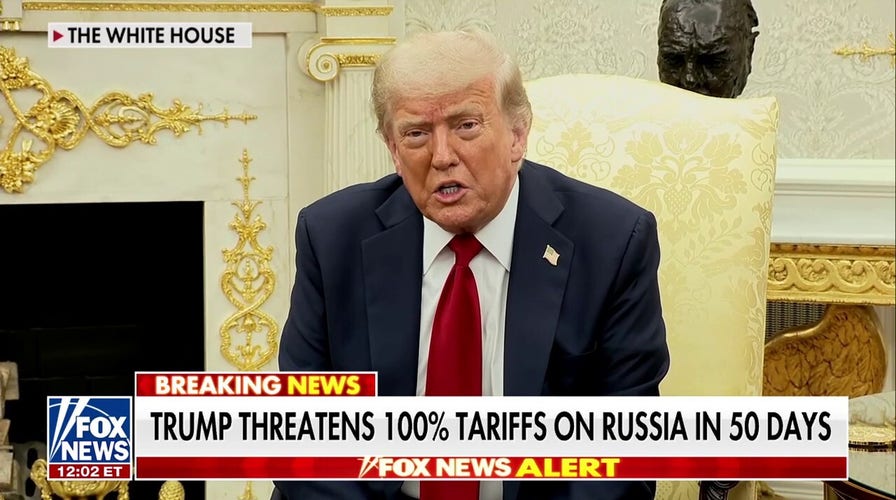
Trump gives Moscow a countdown on Ukraine
Speaking in the Oval Office on July 14 alongside NATO Secretary General Mark Rutte, President Trump made a dramatic announcement:
“We’re going to do very severe tariffs if there’s no deal in 50 days—maybe 100%.”
But here’s the twist: he’s not just targeting Russia directly. He’s floating the idea of secondary tariffs—a tactic that punishes other countries for continuing to do business with Russia. For example, if India keeps buying Russian oil, the US could slap a 100% tariff on Indian goods exported to the US.
It’s a classic Trump move: don’t just hit your opponent—make their friends feel the pain too.
Congress is going even further
Trump’s threat might sound aggressive, but it’s actually mild compared to what Congress is cooking up.
A bipartisan bill called the Sanctioning Russia Act of 2025 is already in motion. It proposes a 500% direct tariff on Russian imports—and the same kind of secondary tariffs on any country that buys Russian oil, gas, uranium, or petroleum.
If either Trump’s plan or the congressional version goes through, it could seriously impact countries like China, India, South Korea, and Turkey—all of whom still trade heavily with Russia.
This is no longer just about punishing Moscow. It’s a pressure campaign aimed at the whole global trading system.
Europe chooses negotiation but keeps its options open
Trump didn’t stop with Russia. Over the weekend, he also threatened to impose 30% tariffs on goods from the EU and Mexico.
Europe is taking a more measured approach—for now. EU Trade Commissioner Maros Sefcovic said he would continue talks:
“I cannot imagine walking away without genuine effort.”
But don’t mistake diplomacy for weakness. The EU has already prepared two packages of retaliatory tariffs. One would hit $24.5 billion worth of US goods. A second, larger plan targeting up to $102 billion is also in the works.
In other words, Brussels is still at the table—but it’s got its weapons lined up just in case.
Trump’s tariff threats are part of a familiar playbook: escalate first, negotiate later. The EU knows this, which is why they’re stalling retaliation while keeping leverage in their back pocket.
China’s exports bounce back but US shipments still plunge
Meanwhile, China’s trade numbers just came in—and they’re better than expected.
Exports rose 5.8% year-on-year in June, up from 4.8% in May. That’s helped lift China’s GDP above gloomy early-year forecasts.
But zoom in on exports to the US, and the story changes. They fell 16.1% from a year earlier. That’s actually an improvement from May’s brutal 34.5% drop, but still signals continued weakness in US-China trade.
ING economist Lynn Song summed it up in a note:
“Exports have held up better than expected, and helped GDP beat downbeat expectations.”
Still, it’s clear the US market is no longer the engine of China’s export machine.
What I’m watching next
-
Trump’s threat may be a bluff—but it could still shake up global markets.
He’s known for using aggressive rhetoric to push for deals, and this could be more of the same. -
Congress, on the other hand, is going full throttle on real sanctions.
If they pass the 500% tariff bill, we’re talking about an entirely new level of economic warfare. -
Europe and China are both in the crosshairs, but their strategies are different.
China is playing it quiet and steady. The EU is balancing between diplomacy and quiet preparation. -
Markets should worry less about tariffs in isolation, and more about tariffs plus a strong dollar and high US rates.
That combo could hit supply chains, currencies, and commodities hard.
If Trump actually follows through on these threats in the next 50 days—and hits both Europe and China—it could spark a new wave of volatility across global markets, from stocks to oil to currencies.
Key dates to watch:
-
Whether Trump finalizes the tariffs before August
-
Whether the EU pulls the trigger on its retaliation
-
Whether Congress advances the 500% tariff bill
-
Whether China quietly pushes back via currency or trade shifts
If you found this useful, follow along—I’ll be tracking how this global tariff game plays out, and what it means for markets, investors, and the world economy.