
Johnson & Johnson Q2 2025 Preview: Staying Resilient Amid Patent & Macro Pressures

Shearing sheep
July 15, 2025
GoGPT Summarizes Articles
J&J ($JNJ) is set to report its Q2 2025 earnings before the U.S. market opens on Wednesday, July 16. This report will effectively kick off the earnings season for the pharmaceutical and biotech sectors.
Wall Street expects Q2 revenue to reach $22.79 billion, reflecting a modest 1.5% year-over-year increase, while earnings per share (EPS) are forecast at $2.66, representing a 5.7% decline compared to the same period last year.
Over the past 30 days, consensus EPS estimates have been revised upward by 0.5%, signaling cautious optimism. J&J has consistently delivered positive surprises over the past four quarters, with an average earnings beat of 5.71%, including a 7.78% upside last quarter.
Innovative Medicine Segment Still Driving Growth
J&J’s Innovative Medicines division remains the backbone of the company’s growth strategy. The Consensus Estimate for this segment stands at $14.5 billion in Q2, supported by solid performance in several key therapies:
-
Darzalex (multiple myeloma): Estimated revenue of $3.44 billion, benefiting from robust market expansion and increased adoption.
-
Tremfya (psoriasis and psoriatic arthritis): Expected to deliver $1.09 billion.
-
Erleada (prostate cancer): Projected sales of $903.9 million.
These core assets continue to gain market share and maintain strong demand. Meanwhile, a new generation of therapies—including Carvykti, Tecvayli, Talvey, and Rybrevant—is also gaining traction and contributing meaningfully to revenue.
Additionally, the FDA’s recent approval of Imaavy (nipocalimab) for generalized myasthenia gravis introduces a promising new asset to J&J’s immunology pipeline, though initial revenue impact may be limited this quarter.
J&J’s acquisition of Intra-Cellular Therapies for $14.6 billion earlier this year has significantly enhanced its neuroscience portfolio, further supporting the company’s updated 2025 guidance and its longer-term strategic outlook.
MedTech: Mixed Signals Across Geographies
The MedTech segment is projected to bring in around $8.25 billion in revenue. Growth in this division is largely driven by strong contributions from recent acquisitions—Abiomed and Shockwave—along with steady uptake of cardiovascular and surgical devices in developed markets.
However, headwinds remain. Volume-based procurement (VBP) policies in China continue to pressure pricing and volumes in the Asia Pacific region. Additionally, tariff-related costs, mostly originating from China, are expected to amount to approximately $400 million for the full year. A significant portion of this burden is likely to impact Q2 results, particularly within MedTech.
Challenges and Headwinds
While the Innovative Medicine and MedTech segments are delivering growth, several challenges are weighing on the broader business.
Stelara Patent Cliff
The most notable concern is the rapid erosion of Stelara sales following the introduction of biosimilar competition in the U.S. Earlier this year, companies including Amgen, Teva, and Samsung Bioepis/Sandoz launched biosimilar versions of Stelara following the expiration of exclusivity rights.
In Q1, Stelara-related revenue loss shaved 470 basis points off top-line growth. For Q2, both internal and consensus estimates peg Stelara sales at $1.88 billion, significantly below previous quarters.
Broader Product Pressures
-
Imbruvica continues to lose share due to increased competition from newer oral therapies in the U.S., with expected Q2 revenue of $684.8 million.
-
Legacy products such as Zytiga and Remicade are under pressure from generics and biosimilars.
-
The Medicare Part D redesign is introducing reimbursement headwinds that could negatively affect sales of Tremfya, Erleada, and Uptravi, partially offsetting volume gains.
Legal Overhang
On the legal front, J&J continues to face significant challenges related to talc litigation. The company’s third attempt to resolve these claims through bankruptcy was rejected in April, requiring it to revert to traditional litigation to defend thousands of individual lawsuits. This process is expected to be prolonged and could result in ongoing financial uncertainty.
Future Outlook
J&J has characterized 2025 as a “catalyst year”, setting the stage for an acceleration in the second half of the decade. According to management commentary:
-
Sales growth in both Innovative Medicines and MedTech is expected to improve in H2 2025, driven by new launches and easier year-over-year comparisons.
-
Free cash flow remains strong, totaling $3.4 billion in Q1, up from $2.85 billion a year earlier. This supports continued dividend payments and potential buybacks.
-
Earnings growth is projected to rebound in 2026 and beyond, underpinned by pipeline progress and recent acquisitions that are expected to mature.
Still, successful execution will be key—particularly in managing pricing pressure, offsetting biosimilar erosion, and navigating international regulatory challenges.
Analyst Ratings and Stock Valuation
From a valuation standpoint, J&J appears reasonably priced relative to its peers and historical averages:
-
Forward P/E: 14.4x, below both the industry average of 15.1x and J&J’s five-year average of 15.7x.
-
Dividend yield: 2.3% as of June 2025, backed by strong free cash flow.
-
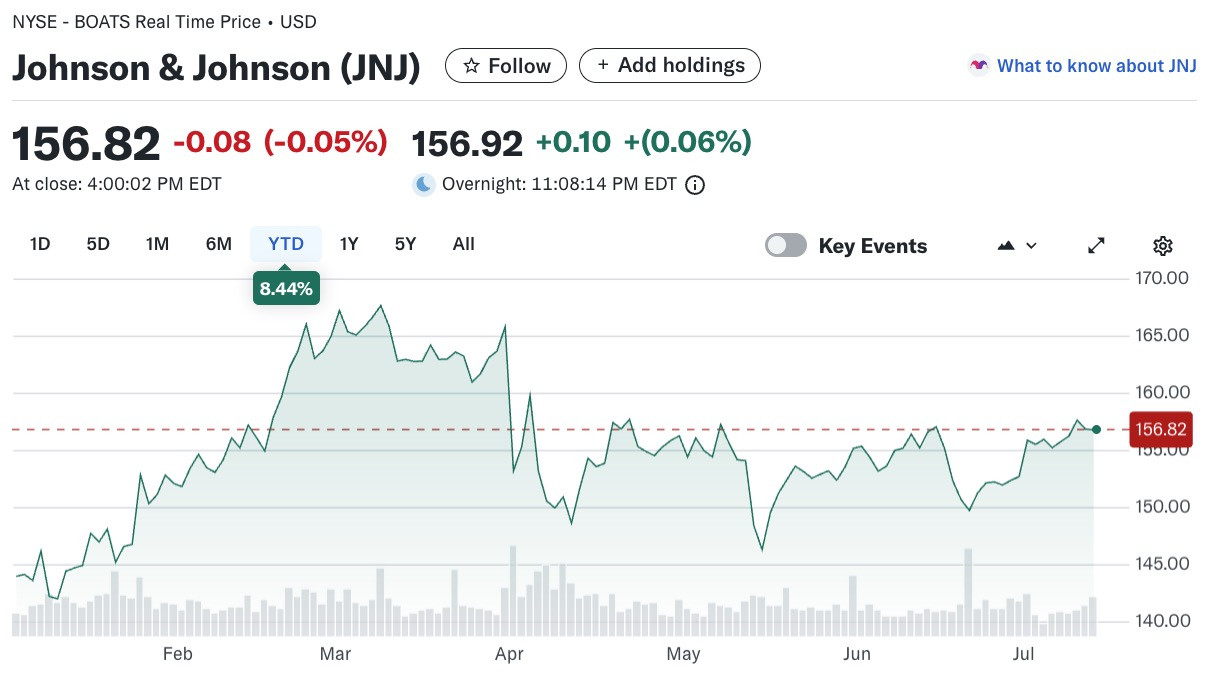
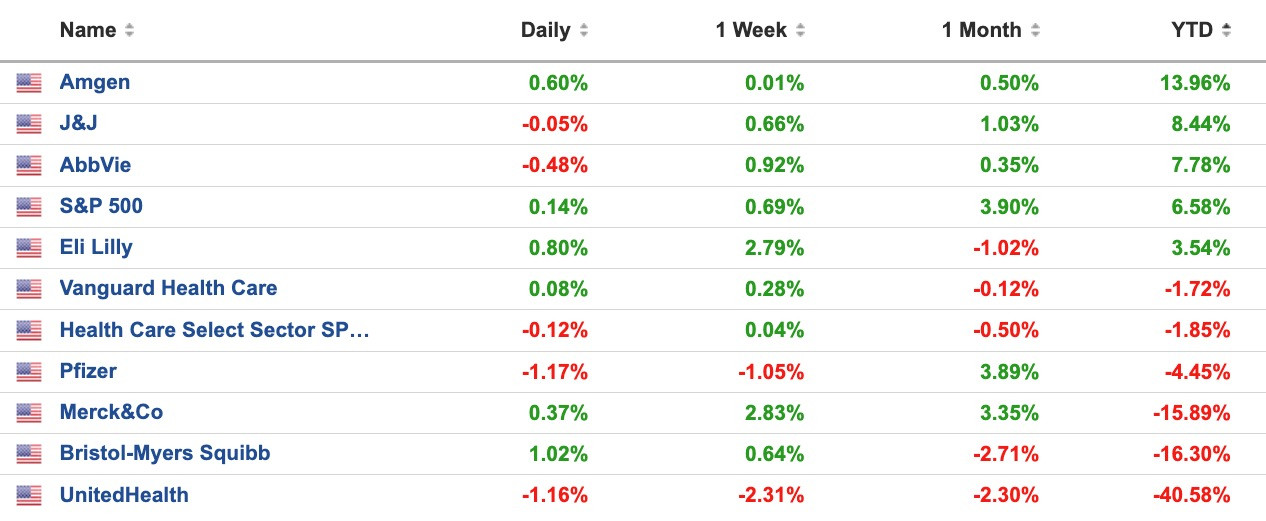
Stock performance: Shares are up 8.44% year-to-date, outperforming both the broader healthcare sector and the S&P 500.
Analyst sentiment remains mixed:
-
Wall Street consensus rates J&J as a Moderate Buy, with an average 12-month price target of $173.47, implying about 10.6% upside. Price targets range from $159 to $185.
-
Seeking Alpha’s Quant Rating is Hold, citing valuation concerns and signs of slowing growth momentum.
-
Bank of America Securities maintains a Neutral rating with a price target of $161, viewing the stock as fairly valued given its current growth outlook.
-
HSBC recently reaffirmed its Buy rating and adjusted its price target to $180, down from $184.
-
Goldman Sachs also maintains a Buy rating and raised its target to $176 from $172.
-
Morgan Stanley holds an Equalweight rating and slightly increased its price target to $171 from $169.
My Take
Johnson & Johnson remains a high-quality, diversified healthcare name with a long-term track record of innovation, stable returns, and disciplined capital allocation. While short-term risks—especially the Stelara cliff, China-related MedTech pressure, and legal uncertainty—are real, they’re also well understood and largely priced in.
The key question for investors is not whether Q2 will beat expectations—it might—but whether J&J can effectively transition toward its next generation of growth drivers. With products like Darzalex, Carvykti, and Tecvayli gaining steam, and a bolstered neuroscience pipeline, J&J appears positioned to maintain steady momentum through macro and competitive challenges.
If you're looking for a healthcare stock with both income stability and long-term growth potential, JNJ is worth holding—or even buying—on weakness.
#Q2 Earnings Hunter: Share Your Stories#$Johnson & Johnson(JNJ)