
APAC Market Wrap - 15 Jul

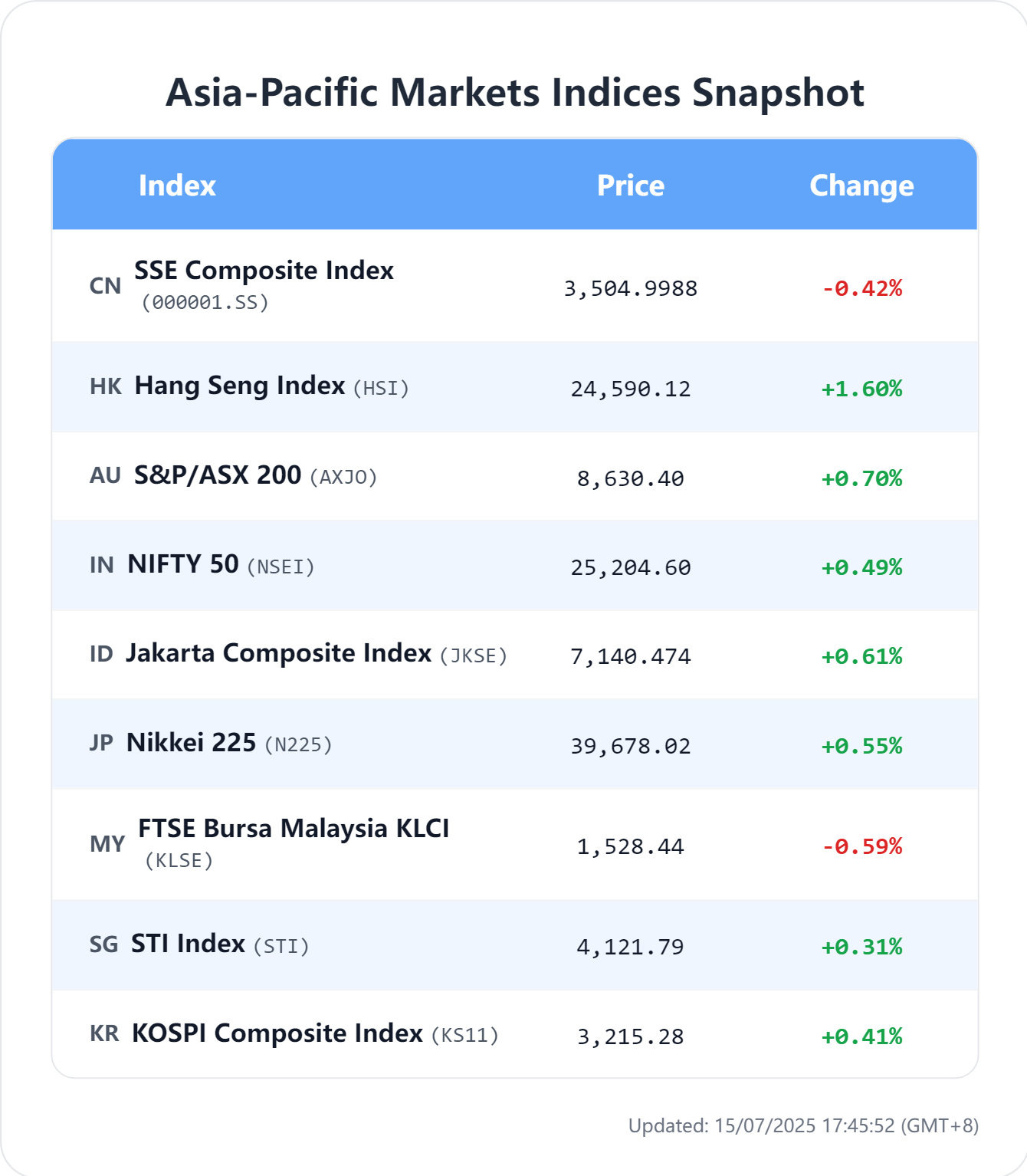
China: The market experienced volatility and divergence throughout the day, with mixed performance across the major indices. By the close, the Shanghai Composite fell 0.42%, the Shenzhen Component rose 0.56%, and the ChiNext Index gained 1.73%. Sector-wise, CPO, liquid-cooled servers, AI agents, and gaming sectors led the gains, while coal, power, oil and gas, and silicone sectors saw the largest declines.
Hong Kong: All three major Hong Kong indices rose, with the Hang Seng Index up 1.60%, the Hang Seng Tech Index up 2.80%, and the State-Owned Enterprises Index up 1.65%. Sector performance showed gains in tech stocks, Apple-related stocks, mobile gaming stocks, and innovative drug concepts, while building materials stocks mostly declined, and internet healthcare stocks generally rose.
Japan Stock Market: The Nikkei rose 218.40 yen, or 0.55%, closing at 39,678.02 yen (with a trading volume of approximately 1.57 billion shares). By industry, 13 sectors including non-ferrous metals, insurance, electronic equipment, and pharmaceuticals saw gains, while 19 sectors such as wholesale, real estate, pulp and paper, and shipping declined.
South Korea Stock Market: The Kospi rose 0.41% to 3,215.28. By sector, health management companies and services, biotechnology, machinery, and aerospace defense sectors advanced, while insurance, automotive, and venture capital sectors fell.
Australian Stock Market: The XJO S&P/ASX 200 rose 0.70%, closing at 8,630.30 points. Sectors with significant gains included aerospace, industrial products, and biotechnology, while medical distribution, forestry products, and agriculture led the declines.
Singapore Stock Market: The Straits Times Index rose 0.26%, closing at 4,119.82 points. Cyclical retail, personalized services, and transportation sectors led the gains, while metals and mining, non-alcoholic beverages, and insurance sectors saw the largest drops.
Malaysia Stock Market: The Malaysia Index fell 0.79%, closing at 1,525.40 points. Closed-end funds and real estate investment sectors led the gains, while construction and business trust sectors declined.
Key Events
South Korea to Develop Roadmap for MSCI Developed Market Inclusion
South Korea’s Ministry of Finance announced on Tuesday that it will release a comprehensive roadmap later this year to pursue inclusion in the MSCI Developed Market Index by global index provider Morgan Stanley Capital International.
The plan was unveiled at the launch meeting of a task force established for this goal, comprising officials from the Ministry of Finance, the Bank of Korea, and major domestic financial firms.
Japan Bond Crisis Enters New Phase: 10-Year Yield Breaks Warning Line
The Japan bond crisis has escalated, with the 10-year yield approaching a new high of 1.6% since 2008, unlike ultra-long-term bonds, its rise has a more direct impact on the real economy.
This movement coincides with the eve of the Japanese Senate election, raising market concerns that a loss for the ruling coalition could trigger a shift in fiscal policy.
Opposition campaign policies promising higher fiscal deficits may spark a “bond vigilante” sell-off, potentially replaying the UK’s “Truss moment” for Japan.
Institutional Views
Barclays: Asian Currencies Likely to Lag Other Emerging Market Currencies
Barclays stated that due to low yields and concerns over U.S. tariffs, Asian currencies are likely to underperform relative to other emerging market currencies through the Northern Hemisphere summer.
“In an environment of generally low volatility and increased arbitrage appetite, Asian currencies offer little attractiveness,” wrote strategists Mitul Kotecha and others in a client report.
Mizuho CEO: Japanese Bond Market Expected to Weather Volatility
The CEO of Mizuho Financial Group indicated that the turmoil in Japan’s bond market is unlikely to spread to the 10-year segment.
“I don’t see any turbulence in the 10-year area,” said Masahiro Kihara, CEO of Japan’s third-largest bank, in an interview in London. “As long as the 10-year is stable, I think we’re fine.”
Goldman Sachs: U.S.-South Korea Tariff Talks May Take Longer Than Expected
Goldman Sachs noted that U.S.-South Korea tariff negotiations may take longer than anticipated, as both sides need to renegotiate the cost-sharing for U.S. troops stationed in South Korea. Current talks cover defense cost-sharing, which could slow the process.
Analysts at Goldman said this issue adds complexity to trade negotiations—South Korea plans to adhere to the existing 2024 agreement, requiring $1.11 billion in defense costs by 2026, while President Trump seeks a higher contribution.
Goldman expects a trade deal to eventually be reached, given shared strategic interests in manufacturing, energy, and shipbuilding.
Moody’s: Global Growth May Slow to Just Above 2% This Year
Stefan Angrick of Moody’s Analytics said that due to uncertainties from shifts in U.S. trade policy, global economic growth may slow from nearly 3% in 2024 to just above 2% in 2025 and 2026.
U.S. policy fluctuations in trade, fiscal spending, and immigration are disrupting growth and inflation outlooks.
New tariff threats, financial market volatility, and geopolitical hotspots are major risks to an already dimming prospect.
With heightened uncertainty from escalating military conflicts, central banks are proceeding cautiously with policy changes. As uncertainty complicates planning, investment decisions and hiring are delayed, putting pressure on businesses.
Rabobank: Trump’s “Major Statement” on Russia, If Involving Energy Sanctions, Could Drastically Alter Oil Market Outlook
U.S. President Trump expressed dissatisfaction with Russian President Putin over the Russia-Ukraine issue, and investors are awaiting further details of a “major statement” on Russia expected Monday evening, driving oil prices up.
Both Brent and WTI crude futures rose 0.5%. Rabobank analysts said: “Trump may announce additional sanctions on Russia.
if these target Russian energy, it could drastically change the oil outlook.” However, price gains are limited by escalating trade tensions, with the latest U.S. tariff threats casting a shadow over energy demand prospects.
Rabobank: Yen May Face Short-Term Volatility
Jane Foley of Rabobank wrote in a report that the yen may experience short-term volatility due to tariff uncertainties but should gradually recover over the long term.
The threat of hefty U.S. tariffs on the Japanese economy has been dragging on its growth outlook. She noted this has weakened market expectations for the Bank of Japan’s ability to raise rates.
If signs emerge that Japan will avoid the 25% tariffs threatened by President Trump, the yen should get a boost. Rabobank forecasts that if the Bank of Japan raises rates, the USD/JPY exchange rate could fall to 140 within 12 months.