
JPMorgan Q2 Earnings Beat Expectations, CEO Dimon Warns of Tariff and Geopolitical Risks

On Tuesday Eastern Time, JPMorgan released its second-quarter earnings.
The bank’s Q2 net profit fell to $15 billion but exceeded Wall Street expectations, with CEO Jamie Dimon crediting a robust performance, particularly in market operations. Following the announcement, JPMorgan’s stock saw slight pre-market volatility, dipping 0.5%.
The earnings report showed JPMorgan’s total Q2 revenue at $45.7 billion, surpassing the market’s $44 billion forecast but down from $51 billion in the same period last year. Net profit was $15 billion, with adjusted net profit at $14.2 billion after special items. Net interest income grew 2% to $23.3 billion.
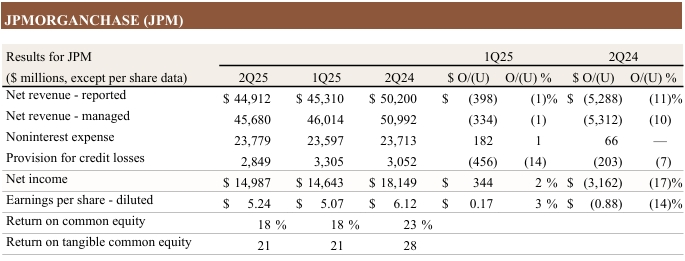
Adjusted earnings per share (EPS) came in at $5.24, significantly above the expected $4.48 but below last year’s $6.12. Excluding one-time items, Q2 EPS was $4.96.
Driven by fixed income and equity gains, trading revenue rose 15% to $8.9 billion amid market volatility. Investment banking revenue grew 7% to $2.5 billion, fueled by active M&A and debt underwriting.
Investors have long been concerned about the sluggish M&A advisory business at major banks, which was expected to rebound this year.
However, successive tariff announcements have led many companies to adopt a wait-and-see approach, awaiting clearer policy signals.
Doug Petno, co-head of JPMorgan’s global banking business, previously noted that many clients “hit the brakes” during market swings.
JPMorgan’s workforce decreased by over 1,300 to 317,160, though it remains the largest among peers after rapid expansion in recent quarters. The bank does not anticipate major layoffs through 2025.
Dimon highlighted the U.S. economy’s resilience in Q2, citing the eventual passage of tax reform and potential regulatory easing as positive factors.
However, he cautioned about persistent risks, including trade uncertainties, geopolitical conflicts, and the federal government’s fiscal deficit.
As a banker frequently sought for advice by Washington and global leaders on global and macro issues, Dimon’s comments often influence both the capital and corporate sectors in the U.S.
Over the past two years, major U.S. banks have benefited from a high-interest-rate environment, though markets widely expect the Federal Reserve to cut rates twice this year, potentially impacting bank profitability.
Notably, the Fed approved a proposal last month to revise the enhanced supplementary leverage ratio rules applicable to large U.S. banks, including Bank of America, JPMorgan, and Goldman Sachs.
Wells Fargo also reported its Q2 earnings earlier Tuesday, posting a net profit of $5.5 billion, or $1.60 per share, well above the expected $1.41 and last year’s $1.33.
However, its stock fell 2% in pre-market trading due to disappointment over the industry guidance.