
How Did Blackstone Become the King of Global Capital?

Yesterday, BlackRock released its earnings report. Despite a share price drop, the report itself was fairly solid.
However, today we’re not talking about BlackRock but its often-confused counterpart, the private equity giant, Blackstone.
As the world’s most renowned alternative investment firm, Blackstone Group has grown from an obscure startup into a nearly $100 billion market cap institution with diverse businesses, its unique business model and exceptional asset management capabilities serving as a beacon for countless investment professionals.
So, how did Blackstone rise to prominence? And why does it always manage to navigate the turbulent financial waves like a master surfer?
Today, let’s dive deep and unveil the mystery of this financial titan.
The Entrepreneurial Journey of Wall Street’s “Odd Couple”
In 1985, in a Manhattan office less than 30 square meters, two former Lehman Brothers executives—Peter Peterson and Stephen Schwarzman—were debating the name of their new company.
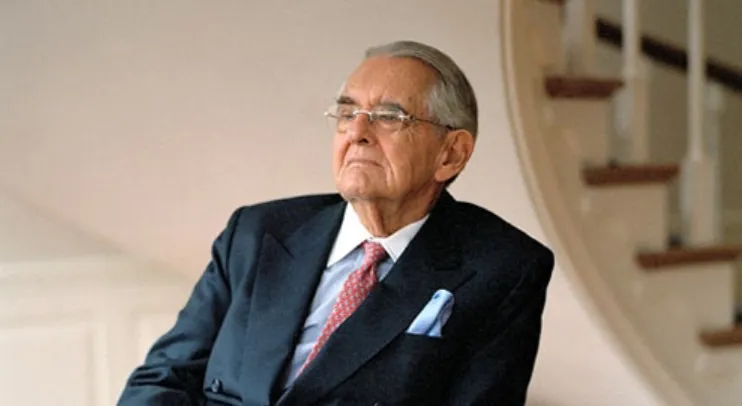
Peterson, 21 years older than Schwarzman, had served as U.S. Commerce Secretary under President Nixon before joining Lehman, boasting an extensive network in business and politics.
In contrast, Schwarzman was a fresh Harvard Business School graduate, but their mutual admiration forged an “odd-couple” friendship.
In 1985, each contributed $200,000 to start a company focused on mergers and acquisitions.
At the time, Wall Street firms often named companies directly after their founders, but they found this too “ordinary.” Instead, they cleverly combined “Schwarz” (black) and the Greek “Petrus” (stone), giving birth to “Blackstone.”
From Private Equity to Diversified Expansion
Founded during the booming 1980s Wall Street bubble, Blackstone keenly spotted investment opportunities amid crises, entering the market through “distressed asset acquisitions.”
In simple terms, Blackstone used “leveraged buyouts” to acquire undervalued assets, injected operational resources to reshape their value, and exited with multiples in profit.
Initially, Blackstone targeted real estate, using limited funds to establish a hotel franchise company, successfully disposing of distressed assets, gaining valuable real estate investment experience, and expanding its influence in the investment world.
A series of successful leveraged buyouts brought early wins, fueling greater ambitions.
In 1989, Blackstone acquired the transportation division of U.S. Steel for $13.4 million, exiting two years later with a nearly 48x return, achieving an annualized return of 130%.
In 1991, by acquiring a series of hotel businesses led by Henry Silverman, Blackstone pioneered a decade-long “buy low, sell high + leverage + active management” model.
This approach, continuously refined, became one of Blackstone’s core strengths and was widely emulated by other alternative investment firms on Wall Street.
Entering the 21st century, the dot-com bust led to a prolonged stock market slump. Blackstone swiftly pivoted to the debt market, seeking new growth opportunities.
In October 2000, Blackstone acquired the mortgage for 7 World Trade Center from Teachers Insurance and Annuity Association, entering the debt market and quickly establishing a foothold.
In 2002, through debt restructuring projects for Adelphia Communications and Charter Communications, Blackstone reaped substantial profits, solidifying its position in the debt market.
In 2006, Citigroup’s investment banking head proposed a bold idea to Schwarzman: let Blackstone raise funds in the capital markets, becoming the first fund manager with permanent capital.
On June 21, 2007, Blackstone went public, raising $4.13 billion in the fifth-largest U.S. IPO of that year (behind Visa, AT&T, etc.).
Blackstone and BlackRock: From “Family” to Rivals
Many often confuse Blackstone (Black Stone) and BlackRock (Black Rock) due to their similar names.
In fact, the two firms are indeed related and were once “family.”
In 1988, a young Larry Fink, armed with a fixed-income investment plan, walked into Schwarzman and Peterson’s office.
Fink, a former star trader at First Boston, had gained fame for designing mortgage-backed securities but left after a $100 million loss in 1986. After two years of unemployment, Fink started his own venture.
Schwarzman and Peterson admired Fink’s plan, seeing echoes of their own entrepreneurial beginnings, and each invested $2.5 million to establish “Blackstone Financial Management.”
This fixed-income-focused subsidiary grew rapidly, like a carefully planted seed in fertile financial soil, reaching $20 billion in assets under management in just six years.
However, as the company grew, tensions over equity allocation and strategic vision emerged.
Fink focused on long-term growth, advocating for employee incentives to attract and retain talent, while Schwarzman prioritized maintaining control to stick to the firm’s strategy, leading to irreconcilable differences.
In 1994, Blackstone sold the subsidiary to PNC Financial Services for $240 million, allowing it to become the independent “BlackRock,” now a global asset management giant.
Schwarzman later called this “the biggest mistake of my life,” but it marked the start of both firms’ independent, competitive journeys.
Post-split, BlackRock soared, leveraging market insights and advanced technology to become one of the world’s largest asset managers.
Through passive investment strategies and ESG (Environmental, Social, Governance) advocacy, BlackRock attracted global institutional investors, securing a prominent place in the financial markets.
Betting on AI Digital Infrastructure: Blackstone’s Future Battle
The rapid rise of artificial intelligence (AI) has become a catalyst for industry transformation.
Blackstone, quick to seize this trend, shifted its strategy early, focusing on AI infrastructure with a $2 trillion digital infrastructure plan. As Ken Caplan, Blackstone’s Global Co-Chief Investment Officer, said, “Data is the new oil, and we aim to own the pipelines.”
This statement not only highlights Blackstone’s strategic pivot but also marks its transformation from a traditional investment giant to an “AI infrastructure provider.”
Over the past five years, Blackstone has invested $70 billion to acquire data center operators like QTS and AirTrunk, gaining mature businesses, client bases, and valuable land reserves.
From an investment perspective, Blackstone has not only captured the AI era’s pulse but also leveraged its diversified investment expertise to build a full industry chain.
While heavily investing in data centers, Blackstone is also backing wind, solar, and smart grid projects to create a “green data center ecosystem.”
For example, its investment in Invenergy has built 4,100 miles of transmission lines in North America, providing clean, sustainable energy to data centers.
This “AI + energy” dual-bet model positions Blackstone uniquely to profit from both the digital revolution and energy transition.

Remarkably, amid volatile markets, Blackstone has shown bold resilience.
In early 2025, Nvidia’s chip shortage sparked market panic, but Blackstone doubled down, accelerating data center acquisitions in the Asia-Pacific.
Blackstone’s vision for AI infrastructure is clear: using its land reserves, it plans to build large-scale, high-efficiency, eco-friendly data centers globally, particularly in emerging markets with high data demand, to meet growing AI computing needs.
In data center development, Blackstone continues to scale up renewable energy investments, expanding wind and solar projects while upgrading smart grid technology to ensure stable, clean energy supply.
Additionally, Blackstone is exploring energy storage solutions, such as advanced battery systems, to address renewable energy intermittency, ensuring continuous data center operations and building a global network of data centers and energy synergy.
In the accelerating global digital transformation, Blackstone’s early AI infrastructure bets have solidified its leadership in global investments and laid a strong foundation for future growth, reshaping the global capital markets.
Today, every Blackstone investment decision influences capital flows, shapes the global economic future, and carries profound geopolitical implications.
As Schwarzman said, “The true king of capital is always greedy when others are fearful.”