
APAC Market Wrap - 16 Jul

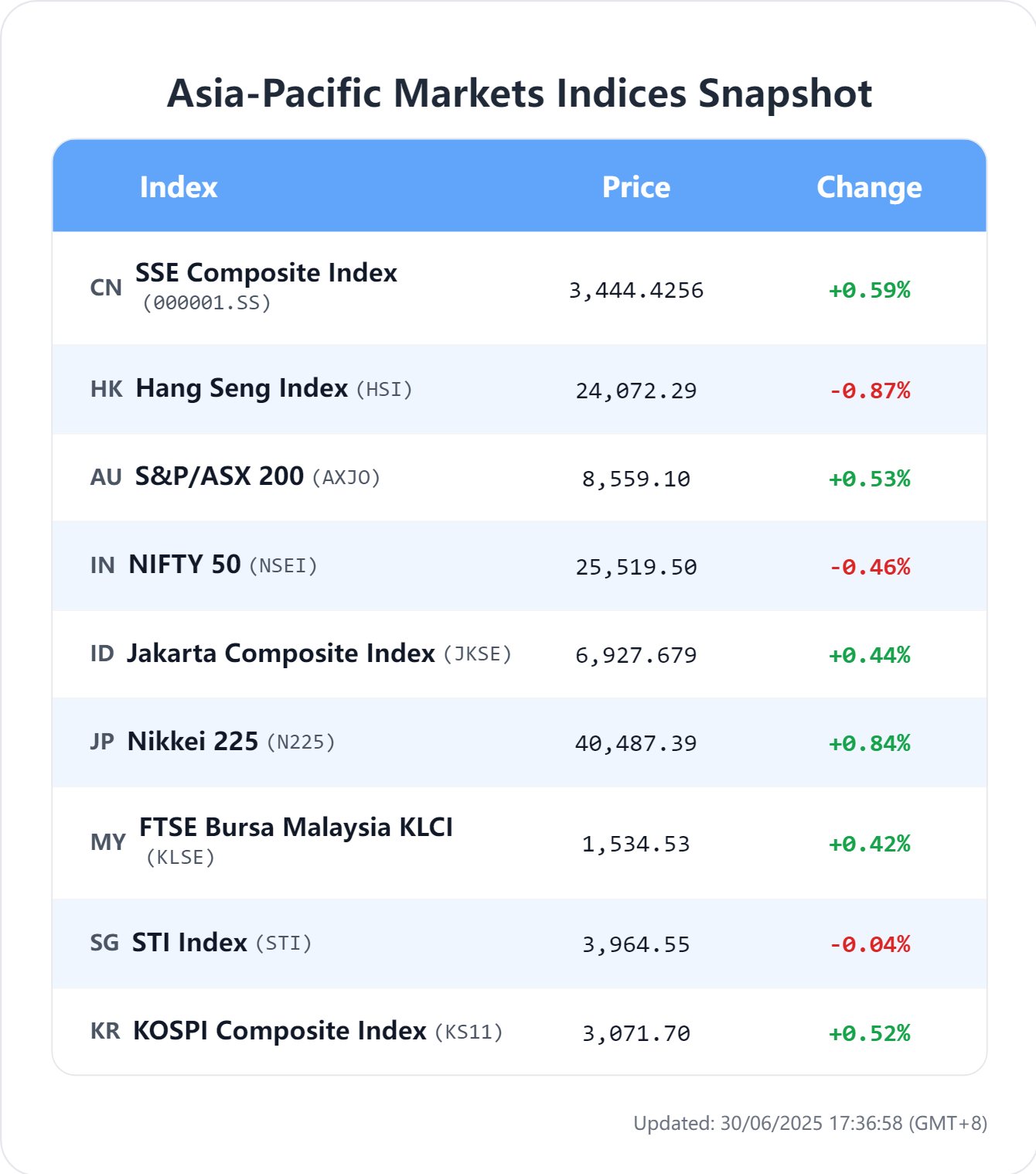
China: Markets fluctuated with a downward bias, with major indices slightly lower.
At close, the Shanghai Composite fell 0.03%, the Shenzhen Component dropped 0.22%, and the ChiNext Index declined 0.22%.
Sectors like animal vaccines, chemical pharmaceuticals, innovative drugs, and humanoid robots led gains, while insurance, steel, PCBs, and rare earth magnets saw the largest declines.
Hong Kong: Hong Kong’s three major indices turned lower in late trading, with the Hang Seng Index down 0.29%, the Hang Seng Tech Index down 0.24%, and the H-share Index down 0.18%.
Tech stocks showed mixed performance, building materials broadly declined, some new consumer concept stocks retreated, catering weakened, and property services and management stocks mostly fell.
Japan: The Nikkei Average edged lower, closing down 14.62 yen at 39,663.40 yen.
Eight sectors, including other products, information & communication, food, and warehousing & transportation, rose, while 25 sectors, such as real estate, pulp & paper, securities & commodity futures, banking, and insurance, fell.
South Korea: Stocks in South Korea slipped Wednesday, as the Kospi Composite Index fell 0.9% to 3,186.38, snapping a two-session winning streak. Display equipment, communication equipment, and biotechnology sectors rose, while securities, banking, and steel sectors declined.
Australia: The S&P/ASX 200 (XJO) rose 0.70%, closing at 8,561.80. Aerospace, industrial products, and semiconductors led gains, while agricultural machinery, building materials, and diversified financials saw the largest declines.
Singapore: The Straits Times Index rose 0.30%, closing at 4,119.82. Non-alcoholic beverages, clothing & accessories, and waste management led gains, while interactive media, industrial distribution, and forestry products saw significant declines.
Malaysia: The Malaysia Index fell 0.91%, closing at 1,511.50. Construction saw slight gains, while financial services and consumer goods & services declined.
Key Events
Richemont Q1 Japan Sales Drop 15% as Yen Strength Curbs Luxury Boom
The consumption frenzy in Japan’s luxury market, driven by yen fluctuations, has faded, impacting Cartier’s parent company, Richemont.
The Swiss luxury group reported a 15% year-on-year sales drop in Japan for its fiscal Q1 at constant exchange rates, compared to a 59% surge last year fueled by yen depreciation and booming international tourism.
Bank of Indonesia: Trade Deal to Boost Economic Growth in H2
Bank of Indonesia Governor Perry Warjiyo said strong export performance, supported by U.S. trade negotiations, will drive improved economic growth in the second half.
Backed by fiscal stimulus and stronger domestic activity, full-year growth is projected at 4.6%-5.4%. The Indonesian rupiah has appreciated due to stable central bank policies and sustained foreign capital inflows.
Korea Exchange Chief Vows to Eradicate Unfair Stock Trading
Korea Exchange Chairman Jung Eun-bo announced Wednesday that South Korea will strengthen market oversight to eliminate unfair stock trading practices.
At a Busan press conference, Jung outlined plans for the exchange’s market supervision unit, stating, “We will thoroughly eradicate unfair practices like backdoor listings and remove so-called zombie companies targeted by market manipulators.”
Institutional Views
Bank of America: Trade War-Driven Global Recession Seen as Top Tail Risk
Bank of America’s July Global Fund Manager Survey shows 38% of investors view a trade war sparking a global recession as the biggest tail risk event—low-probability events that could cause significant losses.
20% cited inflation preventing Fed rate cuts as the second-largest tail risk, and 14% pointed to dollar depreciation due to capital outflows as the third.
Bank of America: Recession Fears Drop, 65% Bet on Soft Landing
Bank of America’s July survey indicates 59% of investors believe a recession is unlikely, a “significant shift” from April when 42% saw a recession as possible.
Nearly two-thirds (65%) expect a soft landing—slowing inflation without significant economic slowdown—while only 9% anticipate a hard landing with economic contraction.
ING: Eurozone Economy Should Find Some Support
ING analyst Colin wrote that a 1.7% rise in Eurozone factory output in May, reversing April’s decline, combined with a “pre-tariff boost effect,” should provide some economic support.
Capital Economics: Bank of Canada July Rate Cut Door Firmly Shut
Capital Economics analyst Thomas Ryan said Canada’s June inflation report shows persistent cost pressures, likely due to a weaker Canadian dollar and retaliatory tariffs on U.S. imports.
With the core CPI’s three-month annualized growth rate hitting a six-month high of 3.5%, Ryan noted, “The door to a July rate cut by the Bank of Canada is now firmly shut.”