
Tesla Q2 Earnings Preview: What Can Offset the Drop in Car Sales?

Shearing sheep
July 21, 2025
GoGPT Summarizes Articles
Tesla ($TSLA) will report its Q2 FY2025 earnings after the market closes on July 23. Expectations are muted this quarter — and for good reason. Vehicle sales are down, competition is rising, and bold bets like Robotaxi and Optimus are still far from generating meaningful revenue. So the question is: what can rescue Tesla this time?
Lower Revenue, Lower Profit
Wall Street expects Tesla to report $22.36 billion in revenue — down over 12% from Q2 last year. EPS is forecast to fall even more sharply, dropping over 23% to $0.32. The drag is clear: automotive sales.
In Q2, Tesla delivered 384,122 vehicles, down 13.5% YoY, though up 14% from Q1. Production came in at 410,244 units — flat YoY but a notable increase from Q1. The problem is that even as production improves, demand is facing headwinds.
Management previously blamed the Q1 shortfall on the Model Y transition. But with new Model Y production ramping up smoothly in Q2, that excuse doesn’t hold anymore.
The demand drop is especially visible in Europe, where May sales were down 28%, despite broader EV market growth. CEO Elon Musk’s increasingly political public persona — particularly his support for far-right European parties — appears to be alienating some consumers.
Meanwhile, Tesla is losing market share. GM, for example, has grown its U.S. EV market share to 12.9% in H1 2025, gaining more than 6 percentage points. While Tesla has lost about the same amount. The competition is no longer just chasing — it’s catching up.
Gross Margins Under Pressure
Another key metric is Tesla’s automotive gross margin, which is projected to fall to around 15% this quarter — down from 18% a year ago and below the 16.3% posted in Q1.
Several factors are at play here: rising input costs, temporary price cuts of up to $7,500 (due to the loss of U.S. EV tax credits), and growing pressure from competitors. On top of that, a key revenue source — regulatory credits — may be starting to dry up.
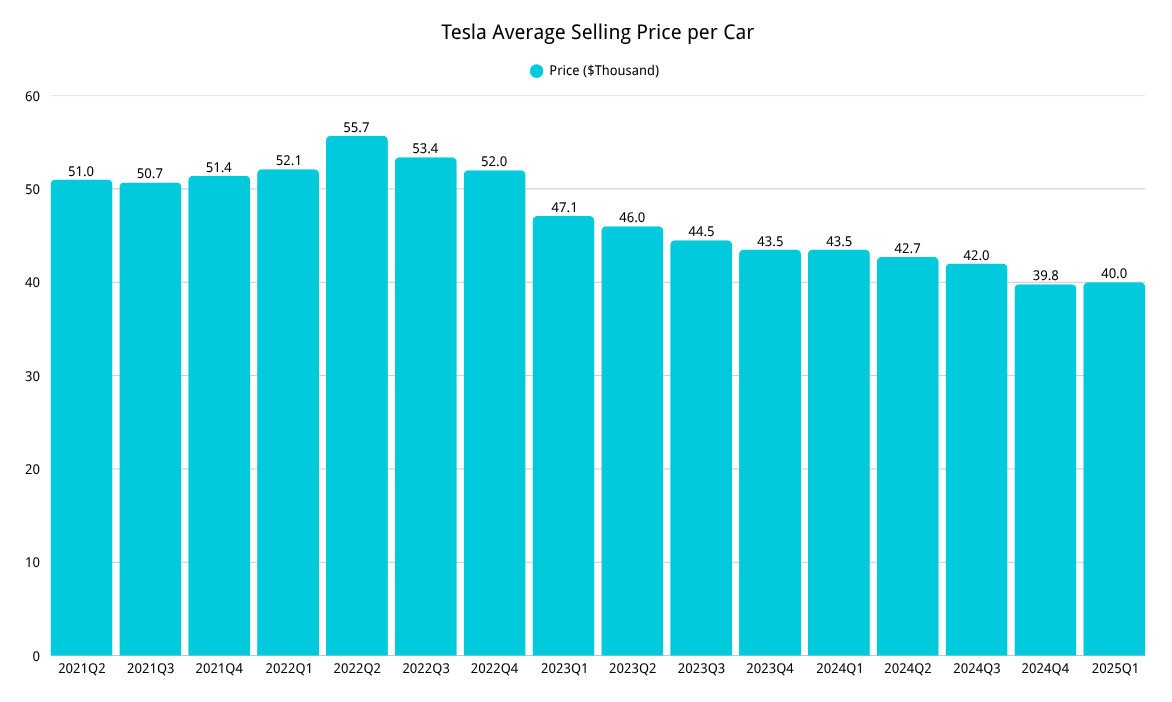
Source: Bloomberg, as of July 18, 2025
Under a new tax law signed earlier this year, automakers no longer face the same emissions penalties (CAFE fines), reducing their need to purchase credits from Tesla.
In Q1, Tesla generated $595 million in regulatory credits — more than its $409 million in net income. In FY2024, credit sales totaled $2.8 billion, accounting for roughly 39% of annual net income.
While long-term contracts may soften the initial impact, this is a structural headwind Tesla will need to address.
Energy Storage Momentum
Tesla’s energy business could be the highlight of Q2.
In Q1, energy storage made up 14.1% of total revenue and delivered higher gross margins than the automotive business. That momentum is expected to continue in Q2.
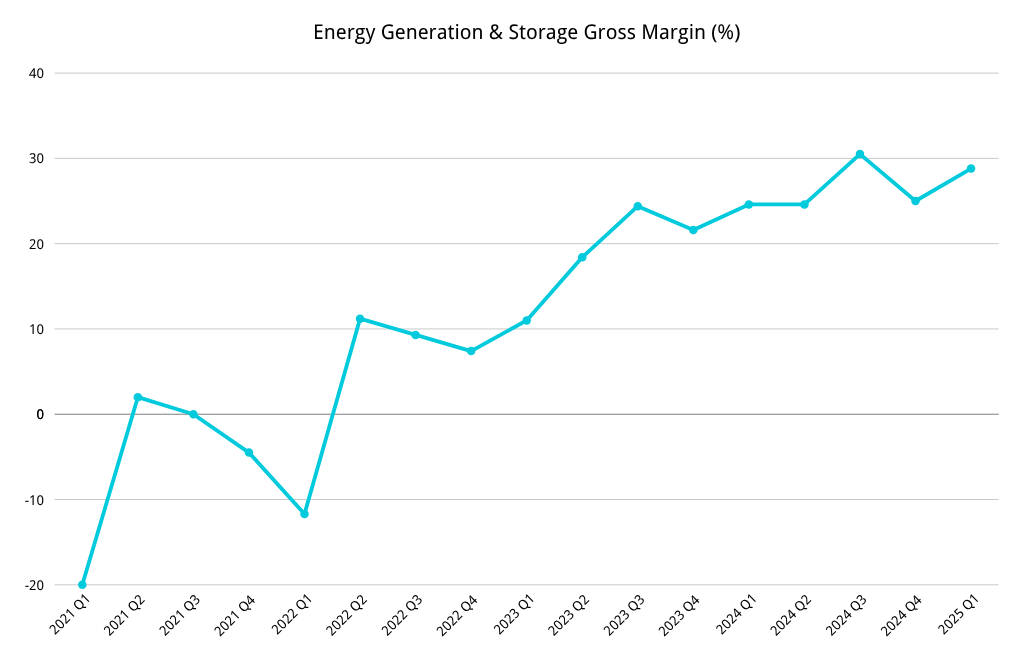
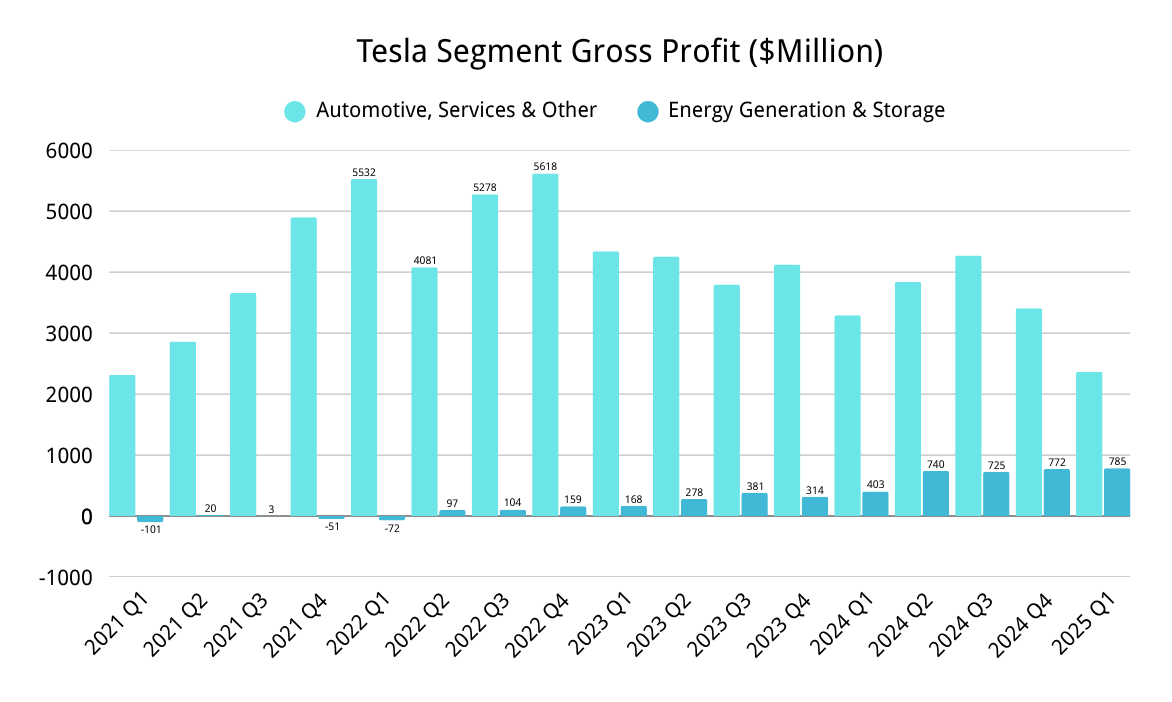
Tesla deployed 9.6 GWh of energy storage in Q2 — a slight YoY increase — led by strong demand for products like Megapack and Powerwall. Revenue from energy generation and storage is forecast to reach $3.03 billion, representing a strong YoY and sequential increase.
A major driver is the new Shanghai Megapack factory, which began production earlier this year. Not only is it serving domestic demand in China, it’s also exporting to countries like Australia. Importantly, the Shanghai Megapacks use CATL batteries — roughly half the cost of U.S.-produced equivalents — significantly boosting margins.
Tesla’s “services and other” revenue segment is also growing steadily, expected to hit $3.15 billion in Q2, up 20% YoY. This includes maintenance, insurance, and vehicle parts — less flashy than EVs or robots, but increasingly important as a stable, recurring revenue stream.
AI, Robotaxi, and Musk’s Focus
Tesla launched trial operations of its Robotaxi service in Austin on June 22. While the news generated headlines, the market’s response was muted — and that’s understandable. These are long-term bets that won’t generate meaningful revenue anytime soon.
However, trial usage could help increase uptake of Tesla’s Full Self-Driving (FSD) subscription, which remains a high-margin service the company is trying to scale. It won’t move the needle just yet, but it’s something to watch.
Elon Musk is also expected to talk up Optimus V3, Tesla’s humanoid robot, now integrated with the Grok AI chatbot. These moonshot projects may represent future upside — but they remain speculative for now.
Adding to investor anxiety is Musk’s political activity. From involvement in DOGE to launching a new political outfit — the “America Party” — questions remain about how focused the CEO is on Tesla’s core business.
Guidance
The most important part of the Q2 call may not be the actual results, but Tesla’s forward guidance.
After pulling its 2025 delivery outlook in Q1, investors are now expecting updated targets. Street estimates range between 1.35 million and 1.66 million deliveries for FY2025 — a wide gap.
Key areas to watch include:
-
Updated delivery forecasts
-
Progress on low-cost EV development
-
Timeline for wider Robotaxi/FSD rollout
-
Commentary on headwinds from tariffs, tax credit changes, and macro demand
Analyst Ratings and Valuation
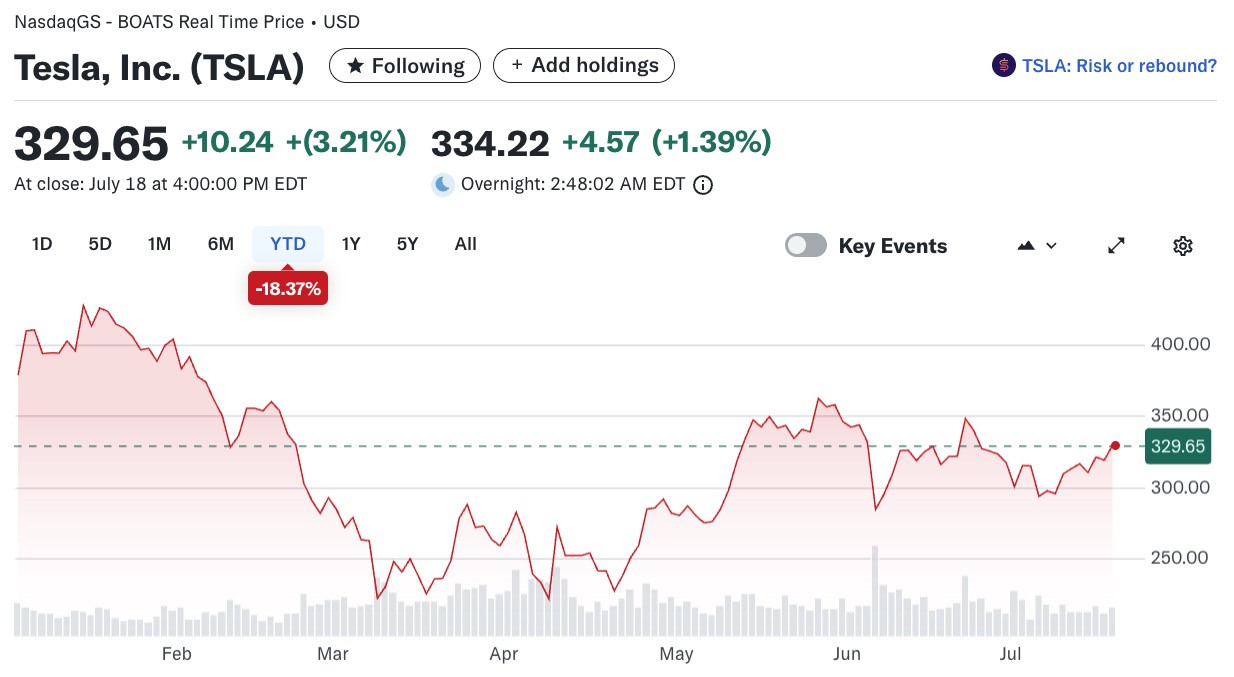
Tesla is down 18.37% year-to-date, underperforming both the S&P 500 and its EV peers. Analyst sentiment has become increasingly divided:
-
UBS maintains a Sell rating, calling Tesla “fundamentally overvalued,” with a $215 price target.
-
J.P. Morgan reiterated its bearish stance, citing risks tied to valuation and shrinking subsidies.
-
Goldman Sachs issued a Neutral rating and a $285 price target on July 11.
-
Wedbush, led by Dan Ives, remains bullish, recently raising its target to $500, citing long-term AI and Robotaxi potential.
Across major platforms, analyst consensus sits at Neutral/Hold, with the average 12-month price target near $300 — about 9–10% below current levels.
In terms of valuation, Tesla currently trades at over 150 times forward earnings — a premium that reflects high expectations for the monetization of FSD, Robotaxi, and Optimus. However, with the core automotive business showing signs of weakness and future growth drivers still largely speculative, the market's lofty assumptions are facing growing scrutiny.
Final Thought
Risks remain — especially in the automotive segment. Margins are under pressure, competition is intensifying, and Tesla’s boldest innovations have yet to turn into profits.
But if the energy storage business surprises to the upside, or if management provides a credible, grounded growth outlook, Tesla could stabilize sentiment heading into the second half of the year.
Right now, the stock trades at a lofty valuation that demands not just vision — but execution. We’ll find out soon whether Tesla can deliver more than just electricity this quarter.
What’s Your Estimate?
While investors wait to see if Tesla’s Q2 numbers will confirm a shift in momentum, there's another way to get involved: our app is running a bounty challenge—guess Tesla’s autonomous miles in Q2 2025.
#Earnings Guess Fun#$Tesla Inc. Common Stock(TSLA)