
APAC Market Wrap - 21 Jul

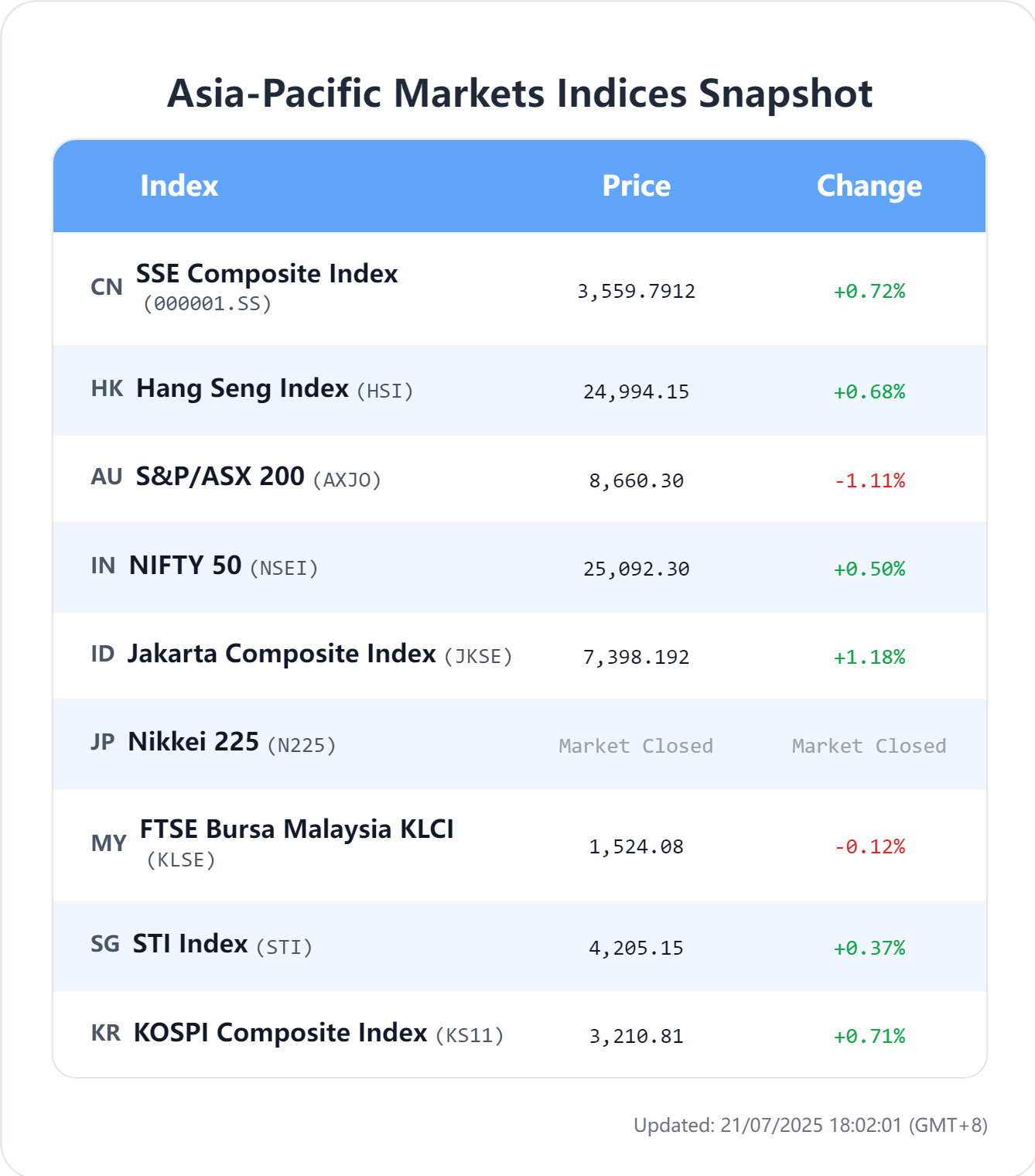
China: At close, the Shanghai Composite rose 0.72%, the Shenzhen Component gained 0.86%, and the ChiNext Index climbed 0.87%. Markets opened strong and trended upward all day, with the Shanghai and ChiNext Indices hitting new yearly highs.
Sectors like cement, building materials, steel, and ultra-high voltage led gains, while cross-border payments, banking, Zhipu AI, and photolithography sectors saw declines.
Hong Kong: The Hang Seng Index closed up 0.68%, and the Hang Seng Tech Index rose 0.84%. Building materials, steel, and power sectors topped the gains, with Huaxin Cement up over 85%, Dongfang Electric up more than 65%, and Chongqing Iron & Steel up over 25%.
Japanese Stock Market: Japanese stock and bond markets closed for a national holiday.
South Korea Stock Market: The KOSPI index edged up 22.74 points, a 0.71% increase. Paper and timber, energy equipment, and steel sectors rose, while card companies, tobacco, and shipping firms fell.
Australia Stock Market: The S&P/ASX 200 (XJO) dropped 1.02% to 8,668.20 points. Diversified financials, aerospace, and other energy sectors led gains, while banking, auto parts, and diversified media lagged.
Singapore Stock Market: The Straits Times Index rose 0.42% to 4,207.13 points. Forestry, industrial products, and oil & gas sectors saw modest gains, while waste management, steel, and software sectors declined.
Malaysia Stock Market: The FBM KLCI fell 0.08% to 1,524.59 points. Real estate investment, healthcare, and utilities saw slight gains, while construction, consumer goods & services, and real estate sectors dropped.
Key Events
Ishiba to Remain Despite Election Loss, Yen Strengthens
Japanese Prime Minister Ishiba announced he will continue as leader despite the ruling coalition losing its Senate majority.
Singapore Stock Market Hits 14th Straight Record High
Boosted by strong inflows into high-yield stocks, Singapore’s benchmark index hit a 14th consecutive record high on Monday. Other emerging Asian markets also opened broadly positive this week. The MSCI Emerging Markets Currency Index fell, down over 1% since its July 3 peak.
The FTSE Straits Times Index rose for the 11th straight session, marking its longest winning streak, peaking at 4,225.790 with a 0.9% gain.
Gains in banks, telecoms, and industrials drove the index. Analysts note Singapore’s appeal as a relative safe haven amid global risks, with ample liquidity, a strong currency, low rates, and dividend-yielding stocks in demand.
DBS Bank analysts said: “Low rates and lack of other yield options may continue to support market activity.”
South Korea Considers Raising Stock Transaction Tax
According to the Korea Economic Daily, citing unnamed sources, the South Korean government is exploring a stock transaction tax hike to offset potential revenue losses from dividend tax breaks.
The tax was nearly eliminated under the previous administration.
The government is also considering reverting the relaxed capital gains tax threshold, raised from 1 billion KRW to 5 billion KRW by former President Yoon Suk Yeol’s administration last year.
Institutional Views
Bank of America strategists say the trade war is challenging the “U.S. exceptionalism” narrative, with global stock funds flowing to the U.S. dropping sharply in 2025. Citing EPFR Global data, BofA reports U.S. stock funds attracted less than half of global inflows this year (vs. 72% in 2024).
Foreign inflows slowed to under $2 billion in the past three months from $34 billion in January.
Trump’s erratic trade policies, growing fiscal deficits, and a weakening dollar are cooling investor enthusiasm. Some asset managers warn the U.S. is no longer a safe haven amid political risks.
Commerzbank forex analyst Thu Lan Nguyen suggests that even significant ECB rate cuts won’t halt a further EUR/USD increase. She attributes the euro’s recent strength to U.S. policies undermining the dollar.
Nguyen notes: “How high EUR/USD goes depends on what the White House cooks up.” With no control over external factors, the ECB can’t prevent a sharp euro rise. Commerzbank forecasts EUR/USD at 1.20 by December 2025 and 1.25 by September 2026.