
Coca-Cola Q2 Earnings Preview: Can Marketing Strategy Save Slowing Growth?

Shearing sheep
July 22, 2025
GoGPT Summarizes Articles
Coca-Cola ($KO) is set to report its Q2 2025 results before the U.S. market opens on July 22. Wall Street expects EPS of $0.83, down 1.2% year-over-year, on revenue of $12.59 billion, a modest 1.9% increase. On the surface, this looks like stable, if unspectacular, growth. But under the hood, there are deeper concerns about whether Coca-Cola can still control the narrative around its long-term growth strategy.
Pricing Power Fatigue
Over the past few quarters, Coca-Cola has relied heavily on price increases to support its top line. In Q1, the company delivered a slight beat—$11.22 billion in revenue versus the $11.17 billion expected—with EPS at $0.73. But most of that outperformance came from pricing, particularly in North America, where concentrate prices rose 4%. Globally, Coca-Cola raised product prices by an average of 5.8% in 2024.
However, this strategy is starting to show its limits. Volume growth is losing momentum, and revenue growth has been decelerating since early 2022. Full-year sales have only inched up from $43 billion to $47 billion over the past three years. Even with nearly $5 billion in share buybacks, EPS has barely grown—from $2.37 in early 2022 to $2.49 today. Net profit margins have also narrowed from over 25% to around 23%.
To make matters worse, Coca-Cola trades at a GAAP forward P/E ratio of around 24x—higher than some of its peers—despite relatively muted earnings momentum. With 65% of revenue coming from outside the U.S., foreign exchange headwinds have become a recurring issue. Analysts expect FX to knock off roughly 3% of revenue and 5–6% of comparable EPS this quarter. Combined with political uncertainties, including tariffs and regulatory pressures (such as proposed restrictions on sugary beverages within the SNAP food-stamp program), the macro setup doesn’t look friendly.
In fact, sentiment among analysts tracking the company has turned increasingly cautious. Over the past 30 days, Coca-Cola’s revenue estimates have been revised downward eight times, reflecting growing concerns about its near-term performance.
Turning to Marketing and Innovation
Still, Coca-Cola isn’t standing still. In response to shifting consumer habits, the company is doubling down on marketing. Its marketing spend is being increased to 11% of sales this year—higher than its five-year average of 10%. The focus is clear: zero-sugar sodas, low-calorie options, and functional or nutritional beverages. This shift is meant to reposition Coca-Cola beyond its sugary drink identity and capture new, health-conscious segments of the market.
Morgan Stanley’s analysts see Coca-Cola’s push into these categories, combined with its global brand equity, as a smart strategic pivot. However, they caution that it must translate into volume gains soon to validate the heavier marketing investment. While rival PepsiCo reported a strong Q2 performance helped by international expansion and stronger snacks performance, Coca-Cola has yet to show that it can replicate that kind of diversified strength across product categories and geographies.
Still, some on Wall Street are maintaining a cautiously optimistic view. Organic revenue for 2025 is projected to grow 5–6%, and EPS is expected to increase by 2–3%. Those numbers are respectable, but perhaps underwhelming when paired with the stock’s current valuation and the growing risks around FX, input costs, and changing consumer behavior—especially amid the rise of GLP-1 weight-loss drugs, which could curb demand for sugary beverages in the long run.
Analyst Ratings
Despite these headwinds, leading institutions hold mixed, but still generally positive views on KO:
-
Morgan Stanley reaffirmed its Overweight rating with an $81 price target based on strong brand equity and the shift toward healthier products.
-
UBS maintains a Buy rating, recently raising its target to $86 highlighting free cash flow stability and brand durability .
-
BNP Paribas issued an Outperform rating with a target of $83 .
-
J.P. Morgan sets a more conservative $78 target LG but still holds a neutral/hold recommendation .
-
Piper Sandler and RBC Capital weigh in with targets at $80 and $76, respectively.
-
Barclays offers a more cautious take with a $73 target, reflecting concerns over valuation and sluggish volume growth .
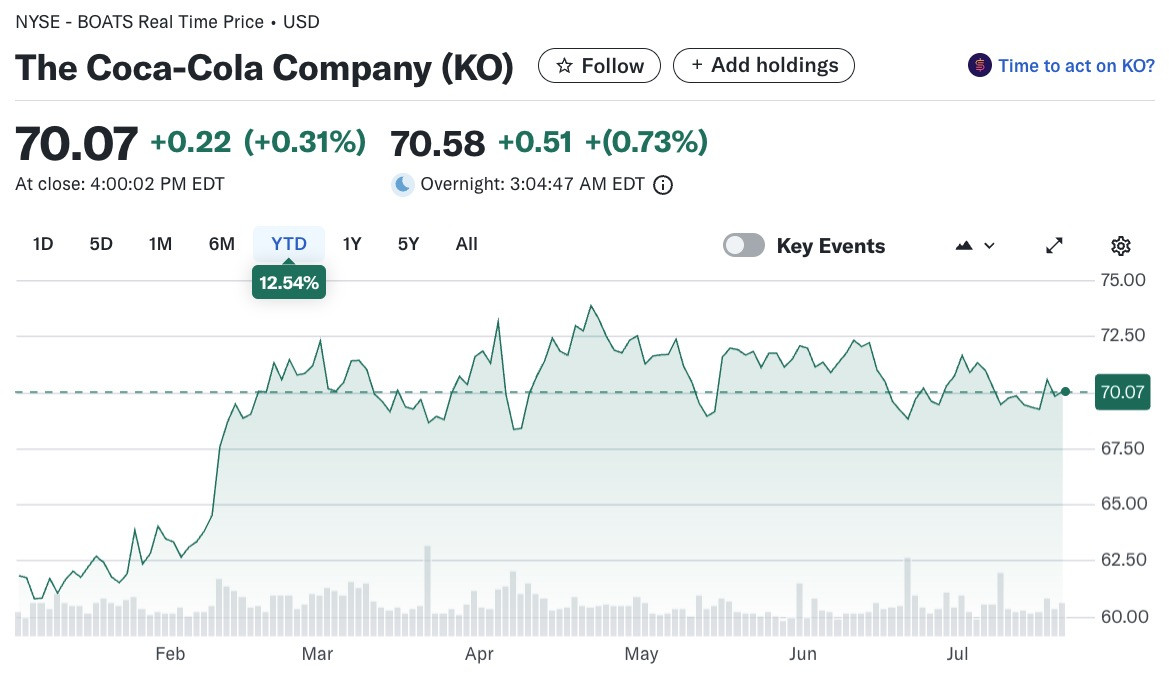
The Street consensus target price averages $77–79, suggesting a 10–13% upside from the current price of $70.07.
Bottom Line
Coca‑Cola’s Q2 report could be more than just numbers—it may reveal if the long-touted pivot toward brand and volume growth is taking hold. If elevated marketing spend and product innovation begin to yield volume gains, the company may be turning a corner. If not, stagnant volumes and margin squeeze could call into question its premium valuation.
This quarter isn’t just an earnings reveal; it’s a test of Coca‑Cola’s new growth playbook—can a legacy beverage be reinvented in a tougher macro world?
What’s Your Estimate?
While investors wait to see if Coca‑Cola’s Q2 numbers will confirm a shift in momentum, there's another way to get involved: our app is running a bounty challenge—guess how many bottles Coca-Cola sold in Q2 2025.
#Q2 Earnings Hunter: Share Your Stories#$Coca-Cola Company(KO)