
APAC Market Wrap - 23 Jul

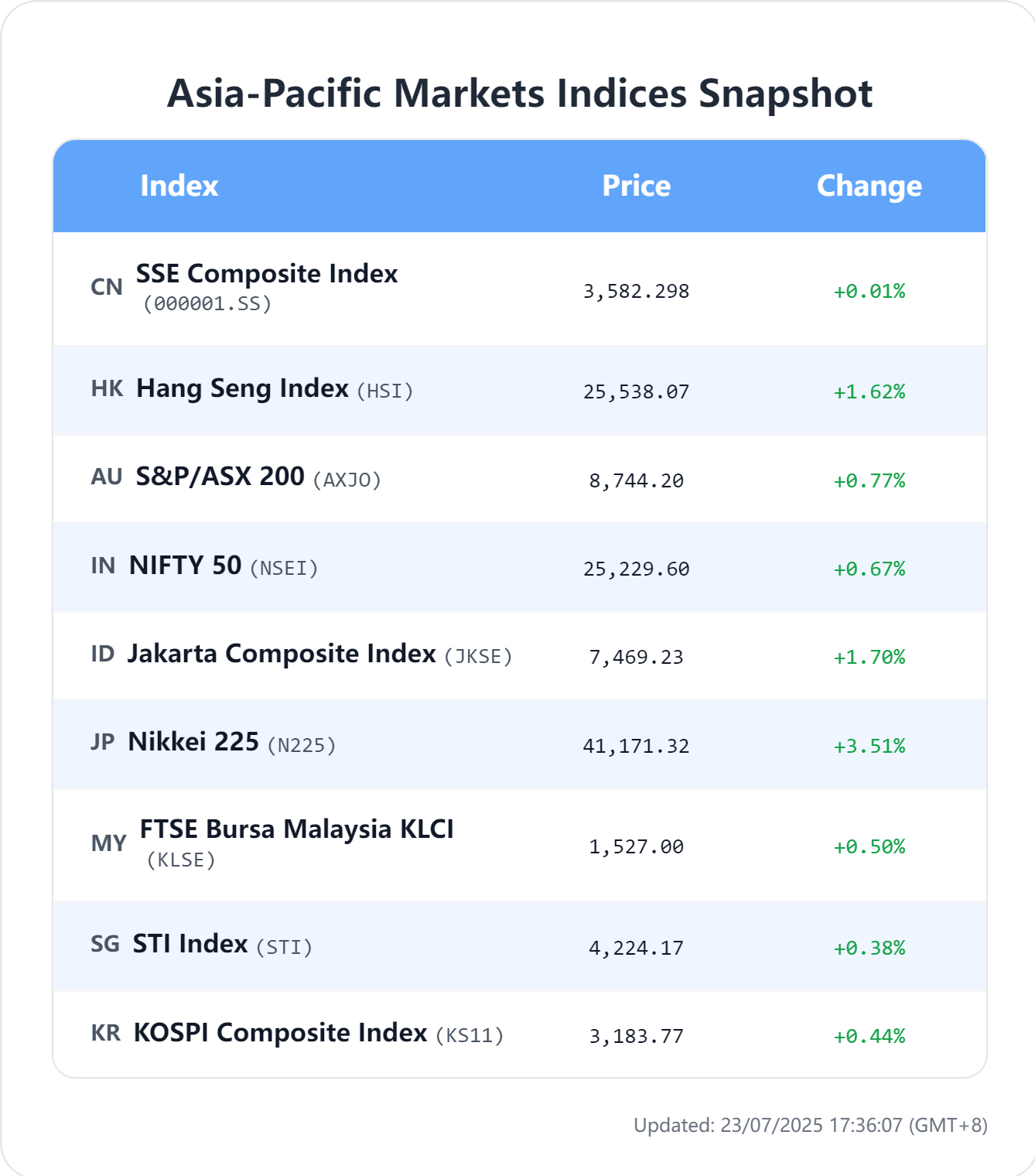
China: Markets surged early but pulled back, with the Shanghai Composite losing the 3,600-point mark. By close, the Shanghai Composite rose 0.01%, the Shenzhen Component fell 0.37%, and the ChiNext Index dropped 0.01%. Sector-wise, super hydropower, beauty care, insurance, and securities led gains, while Hainan, military, ultra-high voltage, and cement sectors saw declines.
Hong Kong: All three major indices rose, with the Hang Seng Index up 1.62%, the Hang Seng Tech Index gaining 2.48%, and the State-Owned Enterprises Index up 1.82%. Sector performance showed tech stocks rising across the board, most mobile gaming stocks up, building materials stocks mostly down, internet healthcare stocks up, Hong Kong retail stocks down, and securities & brokerage stocks broadly up.
Japan Stock Market: The Nikkei average rebounded sharply, up 1,396.40 yen (3.51%) to close at 41,171.32 yen. All 33 sectors rose, with transportation machinery, banking, metal products, precision instruments, and pharmaceuticals showing notable gains.
South Korea Stock Market: The KOSPI index edged up 13.84 points (0.44%). By sector, autos, trading companies, steel, and paper rose, while integrated utilities, venture capital, and food sectors fell.
Australia Stock Market: The S&P/ASX 200 (XJO) rose 0.69% to 8,737.200 points. Forestry products, building materials, and industrial distribution saw slight gains, while aerospace & defense, diversified financials, and industrial products posted larger declines.
Singapore Stock Market: The Straits Times Index rose 0.55% to 4,231.28 points. Non-alcoholic beverages, software, and industrial products saw slight gains, while industrial distribution, diversified media, and apparel & accessories recorded larger drops.
Malaysia Stock Market: The FBM KLCI rose 0.68% to 1,528.79 points. Tech, utilities, and healthcare saw slight gains, while real estate and transport & logistics declined.
Key Events
Emerging Market Bonds Surge, Spreads Near 2007 Lows vs. U.S. Treasuries!
Concerns over Trump’s erratic trade war impacting emerging markets have eased, with investors now focusing on these nations’ improving economic conditions. Meanwhile, Trump’s criticism of Powell and rising U.S. government debt levels have made U.S. Treasuries less appealing.
As traditional safe-haven assets lose luster, investors are flooding into emerging market bonds, pushing spreads on high-grade government and corporate bonds versus U.S. Treasuries to their lowest since the financial crisis.
Latest data shows investment-grade emerging market sovereign bond spreads at 1.04 percentage points over U.S. Treasuries, and corporate bond spreads at 1.1 percentage points—marking sovereign spreads at their tightest since 2007, with corporate spreads nearing pre-Trump election lows.
Trump Claims U.S.-Japan Trade Deal Reached
On Tuesday ET, U.S. President Trump announced a “massive deal” with Japan, including a 15% “reciprocal” tariff on Japanese exports to the U.S.
“We just reached a massive deal with Japan—possibly the biggest ever,” Trump said on Truth Social. “Japan will invest $550 billion in the U.S., and we’ll get 90% of the profits.”
Reports indicate Trump also said Japan will “open its country” to trade in autos, trucks, rice, certain other agricultural products, and more.
He added the deal will create “hundreds of thousands of jobs.”
Korea Rules Out Further Beef, Rice Market Opening in U.S. Tariff Talks
Insiders say the Korean government has decided not to use further opening of its beef and rice markets as leverage in U.S. tariff negotiations, deeming them “red lines.”
The decision was made at a related ministerial meeting Tuesday.
Korea is pushing for full exemption or reduction of “reciprocal” tariffs on steel and autos, making agriculture a focal point in talks.
The U.S. has requested Korea lift import bans on U.S. beef over 30 months old and expand U.S. rice imports.
However, due to sensitivities around safety and food security, Korea is considering opening markets for corn and other bioethanol fuel crops instead.
Institutional Views
Citi: Robust Growth and Price Improvements Could Boost China Assets
Citi’s 2025 H2 domestic macro outlook, by director and Greater China chief economist Xiangrong Yu, suggests focusing on nominal growth recovery alongside real growth momentum. If growth remains resilient and prices improve, China assets’ appeal will rise.
ING: UK Fiscal Woes Weigh on Pound
ING forex strategist Francesco Pesole notes the pound’s recent drop against the euro may reflect market concerns over UK fiscal health, with the euro’s reserve currency appeal growing. Tuesday data showed UK government borrowing hit £20.7 billion in June, well above expectations, potentially heightening worries.
Saxo Bank: U.S.-Japan $550B Investment a Political Show, Trump’s Focus Shifts
Saxo Bank chief investment strategist Charu Chanana in Singapore says low expectations for a breakthrough made Trump’s announcement a mild upside surprise, offering short-term relief to Japanese stocks. The tariff cut from 25% to 15% is significant, likely boosting export-driven sectors, though details—especially on autos—remain key.
The $550 billion FDI news is seen as political theater, not a tradable catalyst. Strategically, the deal avoids immediate tariff hikes, shifting Trump’s attention elsewhere.
TD Securities: Trump’s Push for Japanese Ag Market Opening Could Shake Fragile Politics
TD Securities APAC senior rates strategist Prashant Newnaha says the U.S.-Japan trade deal is a surprise positive, as the LDP’s loss of Senate majority had delayed expectations, and the 15% tariff is below Trump’s threatened 24%-25%.
However, Trump’s demand for U.S. agricultural market access poses a risk, facing significant political resistance that could further destabilize Japan’s fragile political landscape.