
Tesla's Operating Income Declines 42% Amid Strategic Shift

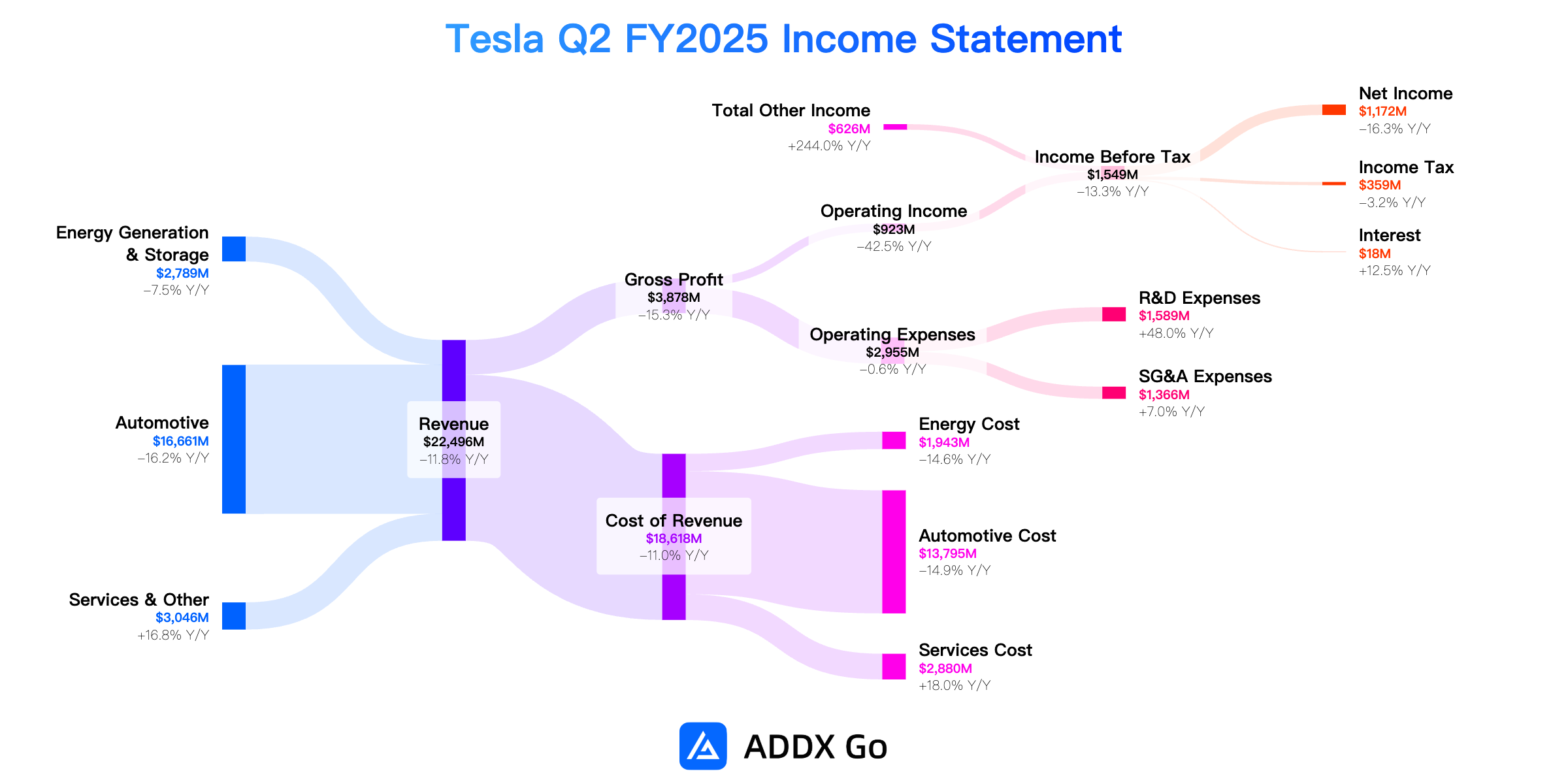
Tesla, Inc. reported Q2 2025 financial results with total revenues of $22.496 billion, a 12% decrease year-over-year. Net income attributable to common stockholders (GAAP) for the quarter was $1.172 billion, reflecting a 16% decline compared to the prior year. The company's operating income decreased 42% year-over-year to $0.9 billion, resulting in a 4.1% operating margin. This quarter's revenue fell short of the analyst estimate of $22.125 billion.
Operational Milestones and Autonomy Focus
Q2 2025 marked a significant shift for Tesla as it began its transition from an electric vehicle and renewable energy leader to a prominent player in AI, robotics, and related services. The company launched its first Robotaxi service in Austin in June, aiming to continually improve safety and rapidly scale the network using a camera-only architecture and neural networks. Tesla also expanded its vehicle offering with the first builds of a more affordable model in June, slated for volume production in the second half of 2025. Additionally, development continued on Semi and Cybercab, both targeting volume production in 2026. The company achieved the world's first autonomous delivery to a customer with a new production Model Y.
Energy Business and AI Infrastructure Growth
The Energy business continued its critical role, with trailing twelve-month Energy storage deployments achieving their 12th consecutive quarterly record. Gross profit for Energy Generation and Storage reached a record $846 million, increasing sequentially and year-over-year. Tesla began deploying Megapacks from Megafactory Shanghai, recognizing the importance of regionalizing energy storage manufacturing. Furthermore, Tesla expanded its AI training compute by adding 16k H200 GPUs at Gigafactory Texas, bringing Cortex to a total of 67k H100 equivalents, underscoring its commitment to AI advancement.
Outlook and Strategic Priorities
Despite an uncertain macroeconomic environment influenced by shifting tariffs and fiscal policies, Tesla continues to prioritize high-value investments in capital expenditures and research and development while maintaining a strong balance sheet. The company's key priorities include delivering affordable and compelling autonomy-capable models to maximize its global vehicle fleet, growing the Energy business, and advancing its robotics efforts. Tesla expects its hardware-related profits to be increasingly complemented by accelerating AI, software, and fleet-based profits over time. Plans for new vehicles launching in 2025 remain on track, with the Cybercab, a purpose-built Robotaxi product, scheduled for volume production starting in 2026 using a revolutionary "unboxed" manufacturing strategy.