
Intel Q2 Earnings Preview: Strategic Vision Takes Center Stage

Shearing sheep
July 24, 2025
GoGPT Summarizes Articles
Chipmaker Intel ($INTC) is set to report its second-quarter earnings after the bell on Thursday, July 24. While the company’s near-term financials aren’t expected to impress, this report carries weight for another reason: it’s the first full quarter under new CEO Lip-Bu Tan, and investors are eager to see how he plans to reset the company’s direction.
Expectations Are Low
Wall Street estimates suggest Intel will post EPS of just $0.01, a sharp 50% drop from a year ago. Revenue is expected to decline by over 7% to $11.88 billion—marking the fifth straight quarter of falling sales and the sixth consecutive quarter of net loss.
This paints a clear picture: Intel is still deep in turnaround mode.
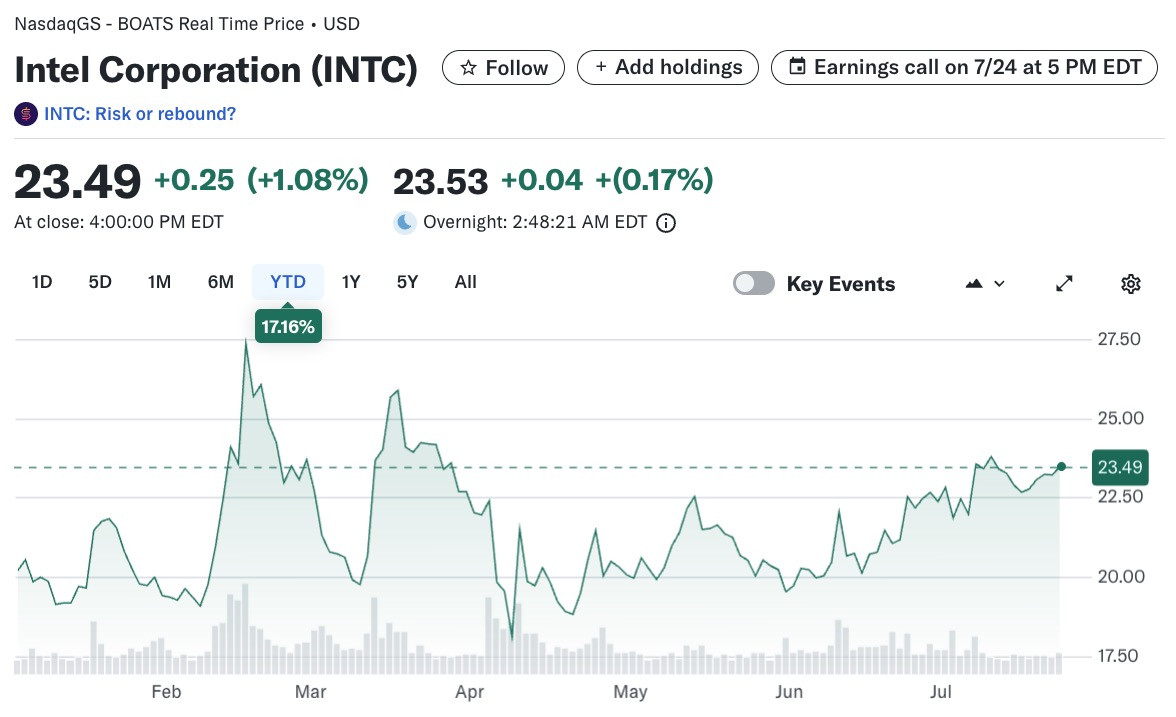
Over the past three months, both earnings and revenue forecasts have seen 29 downward revisions. Yet despite the weak sentiment, INTC shares are up 17% year-to-date, signaling that investors may be betting on longer-term changes rather than near-term numbers.
Foundry, Process Nodes, and AI Strategy
More than the headline figures, the real story this quarter is about Intel’s strategic direction—particularly its foundry ambitions and chip process roadmap.
Intel’s 18A process technology, a cornerstone of former CEO Pat Gelsinger’s plan to compete with TSMC and Samsung, is now under review. According to reports, Tan is shifting attention toward 14A instead. If 18A is indeed sidelined or limited to internal use, it could trigger a large writedown after years of heavy R&D investment.
This move also raises questions about Intel Foundry Services (IFS), which aimed to turn Intel into a major contract chip manufacturer. But as Loop Capital points out, if Intel Products doesn’t feed enough volume into IFS—and if external clients aren’t convinced—the foundry business may struggle to stay economically viable.
Analysts are also watching for clues about Intel’s positioning in AI. While Nvidia dominates the space and AMD is gaining ground, Intel has yet to carve out a clear competitive advantage. Bernstein analysts have warned that structural challenges in Intel’s core CPU and server markets are only deepening.
Mixed Signals from Analysts
Analysts remain cautious on Intel, with most maintaining a Hold stance and modest target price adjustments.
-
Stifel raised its price target to $24.50 (from $21) and reiterated a Hold rating, highlighting the need for clearer visibility into CEO Tan’s turnaround plan.
-
UBS lifted its target to $25 (from $21) but kept a Neutral stance, calling the strategic pivot away from 18A “logical but operationally challenging.”
-
Bernstein maintained a Market Perform rating with a $21 target, arguing that structural headwinds outweigh short-term earnings beats. Analyst Stacy Rasgon noted the stock is “event-driven—hard to short, but harder to own.”
-
Loop Capital initiated coverage with a Hold rating and a $25 target, warning of a “catch-22” between Intel’s foundry ambitions and its dependence on TSMC for competitive products.
-
HSBC and Wedbush also stayed on the sidelines, with price targets of $22 and $19, respectively.
According to Visible Alpha, all 11 analysts covering Intel rate it Hold, with an average target of $22. Consensus remains that while a turnaround is possible, it’s still too early to call.
A Long Tunnel, but Maybe a Light?
To Tan’s credit, there’s been action. Intel has begun cutting non-core operations, reducing workforce headcount, and refocusing internal resources. And while those measures could eventually help margins and reduce cash burn, analysts argue that none of them matter unless Intel finds a way to regain competitiveness—especially in AI and high-end compute.
UBS described the situation as a long tunnel with a light at the end. The only question is how long investors are willing to wait.
Bottom Line
Intel’s Q2 numbers probably won’t change the narrative. But CEO Lip-Bu Tan’s commentary might. Investors will be looking for a roadmap that includes realistic manufacturing goals, a clearer AI strategy, and a more disciplined portfolio — all while navigating tariffs and a slowing PC market.
At this point, the stock is less about beating quarterly estimates and more about convincing investors that a credible turnaround is finally in motion.
What’s Your Estimate?
While investors wait to see if Intel’s Q2 numbers will confirm a shift in momentum, there's another way to get involved: our app is running a bounty challenge — predict how many units Intel shipped in Q2 2025.
#Q2 Earnings Hunter: Share Your Stories#$Intel Corp(INTC)