
APAC Market Wrap - 24 Jul

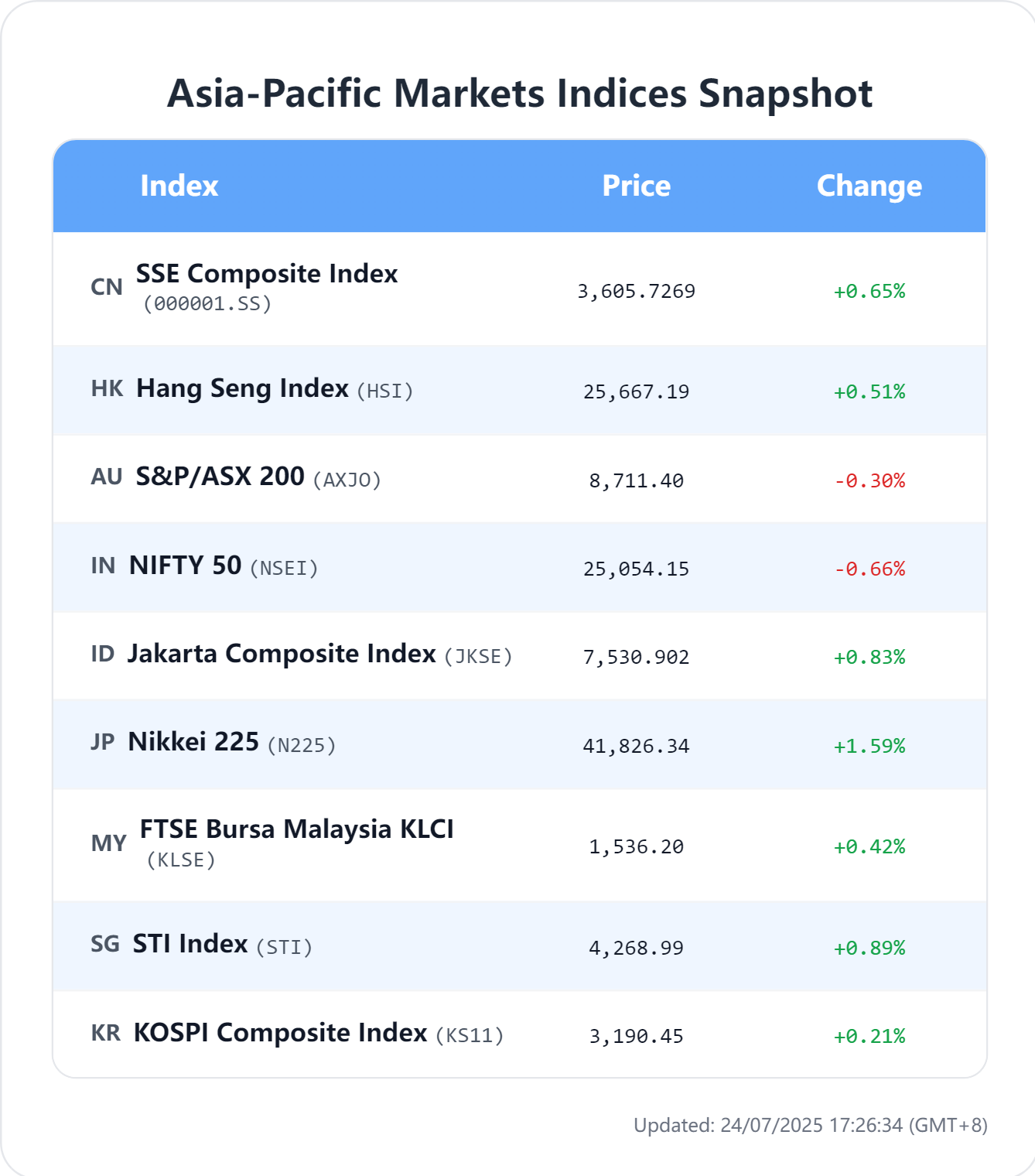
China: Markets oscillated upward all day, with all major indices hitting new yearly closing highs, Shanghai Composite closing above 3,600. By close, Shanghai rose 0.65%, Shenzhen 1.21%, ChiNext 1.5%. Sector-wise, Hainan Free Trade, rare earth, lithium, and hydropower led gains, while precious metals, banks, and CPO lagged.
Hong Kong: Hong Kong’s major indices were mixed, Hang Seng up 0.51%, Hang Seng Tech down 0.05%, State-owned Enterprises up 0.18%. Sector-wise, semiconductors rose broadly, Apple concepts gained, and photovoltaic solar stocks moved upward.
Japan Stock Market: Nikkei average rose sharply 1.59%, up 655.02 yen to 41,826.34 yen. Among sectors, all 33 industries gained, with banks, precision instruments, rubber products, non-ferrous metals, and machinery showing notable increases.
South Korea Stock Market: Kospi index rose slightly, up 6.68 points or 0.21%. By sector, electrical products, communication equipment, and energy equipment/services rose, while paper and wood, IT services, publishing, and utilities fell.
Australia Stock Market: XJO S&P/ASX 200 fell 0.32% to 8,709.400 points. Sector-wise, forestry products, semiconductors, agriculture, and biotech saw slight gains, while capital markets, aerospace, and diversified media posted larger declines.
Singapore Stock Market: Straits Times Index rose 0.99% to 4,273.05 points. Industrial and consumer goods/services saw slight gains, while forestry products, utilities, and industrial products recorded larger drops.
Malaysia Stock Market: Malaysia Index rose 0.69% to 1,540.32 points. Tech, utilities, and healthcare saw slight gains, while real estate, energy, and tech fell.
Key events
RBA Governor Bullock: Rate cuts should be “cautious, gradual”
RBA Governor Michelle Bullock said the RBA’s rate-setting board believes a “cautious, gradual” approach to monetary easing is appropriate. She added that labor demand remains robust while core inflation is gradually easing.
Bullock, speaking in Sydney on Thursday, said the “low” unemployment rate and recent strong job growth were “impressive and encouraging.” This came a week after data showed Australia’s unemployment rate unexpectedly rose to 4.3%, a four-year high, due to near-stagnant hiring activity in June.
Vietnam estimates Trump tariffs could cut U.S. exports by up to a third
Internal Vietnamese government assessments indicate that if U.S. President Trump’s tariff measures take effect, Vietnam’s exports to the U.S. could drop by up to a third.
A document prepared for Prime Minister Pham Minh Chinh’s advisory council shows 20%-40% tariffs could reduce export revenue by up to $37 billion, impacting key industries like electronics, machinery, apparel, footwear, and furniture.
South Korea reportedly to propose at least $100 billion U.S. investment
Yonhap News, citing unnamed sources, reports South Korea will propose a $100 billion investment plan to secure a trade deal with the U.S.
The government has consulted with major conglomerates—Samsung, SK, Hyundai Motor, and LG—gathering data on investable capacity in the U.S., securing a total commitment of $100 billion.
Institution views
Goldman: Dollar to remain under pressure despite trade deals
Recent trade deals have reduced uncertainty weighing on the dollar, but it has little room to rebound. Goldman economists said in a report, “Broad tariff hikes will pressure U.S. relative prospects, continuing to weaken the dollar’s strength.”
While the Japan deal lifted Wall Street sentiment, Goldman noted uncertainty over the $550 billion U.S. investment pledge. Questions also linger on how tariff costs will be shared among exporters, importers, and consumers.
Capital Economics: Trade deals to have limited impact, ECB likely to hold
Despite reports of an impending EU-U.S. trade deal to cap U.S. tariffs, Capital Economics economist Andrew Kenningham said the ECB is likely to remain cautious.
The Wall Street Journal reported Brussels may accept a 15% tariff on most U.S.-bound EU goods—below Trump’s threatened 30% but above current rates. Kenningham said the impact on the eurozone economy would be limited.
“While the deal avoids a disruptive tariff escalation, its effect will be slightly negative compared to the ECB’s baseline economic assumptions,” he added, suggesting ECB President Lagarde and colleagues in Frankfurt won’t shift policy.
Goldman warns: U.S. base tariff rate may jump to 15%, pushing inflation to 3.3%
Goldman economists’ latest forecast shows the U.S. base “reciprocal” tariff rate rising from 10% to 15%, with 50% tariffs on copper and critical minerals—potentially heightening inflation and curbing growth.
U.S. chief economist David Mericle said in a weekly research note that forecasts for U.S. inflation and GDP growth have been adjusted to reflect new tariff assumptions and early import tax impacts.