
APAC Market Wrap - 25 Jul

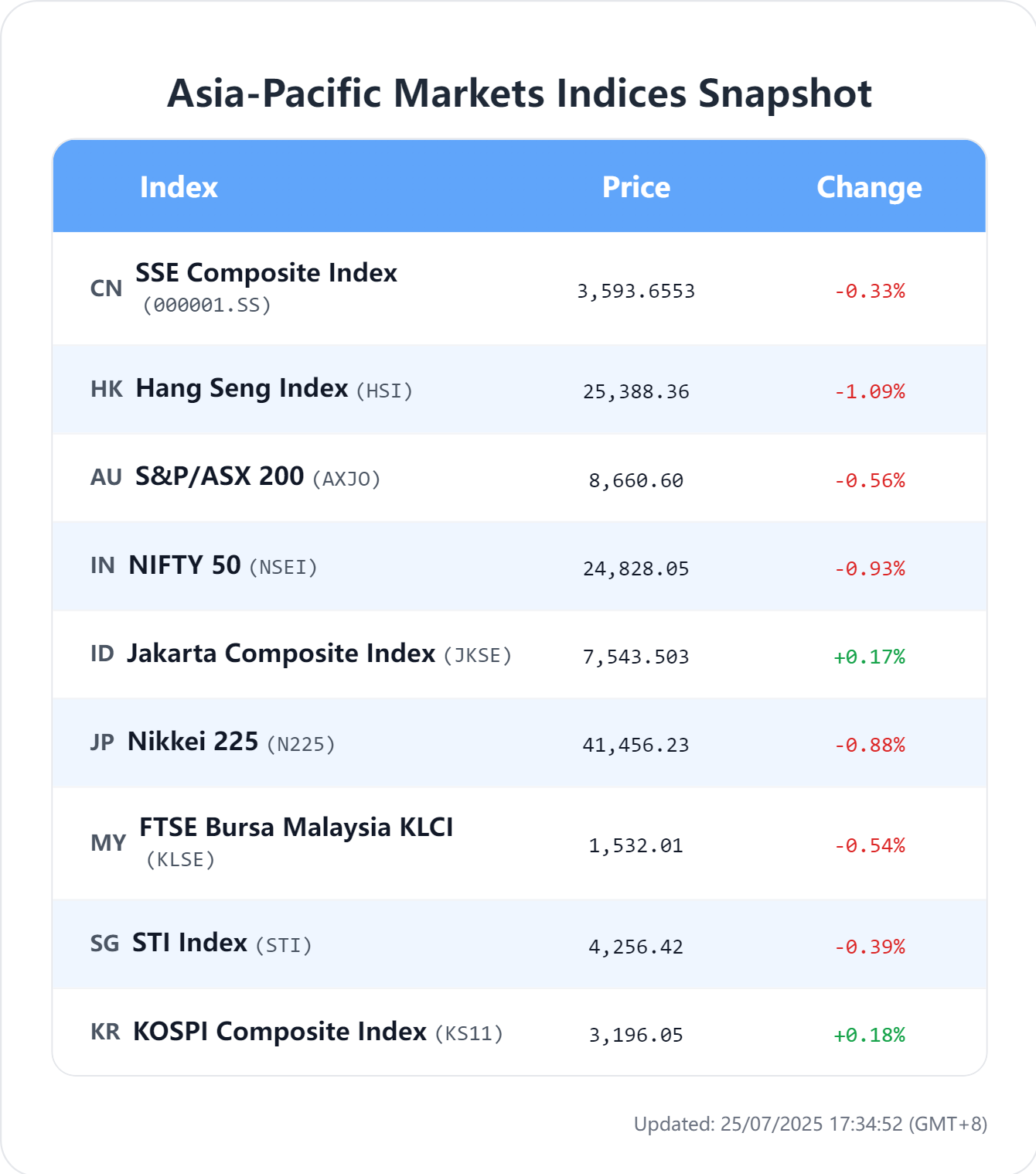
China: The three major indices closed slightly lower. The Shanghai Composite fell 0.33%, the Shenzhen Component dropped 0.22%, and the ChiNext Index declined 0.23%.
Sector performance: Multimodal AI, semiconductors, Huawei Ascend, and medical devices led gains, while Hainan Free Trade Zone, super hydropower, cement, and baijiu saw the largest declines.
Hong Kong: All three major indices fell, with the Hang Seng Index down 1.09%, the Hang Seng Tech Index down 1.13%, and the H-share Index down 1.16%.
Sector performance: Tech and internet stocks slumped, semiconductors rose, most solar energy stocks fell, and pharmaceutical stocks broadly declined.
Japan: The Nikkei 225 dropped 0.88%, or 370.11 points, to 41,456.23.
Sector performance: Warehousing, logistics, shipping, and mining sectors gained, while chemicals, transportation equipment, and steel sectors declined.
South Korea: The KOSPI rose slightly by 5.60 points, or 0.18%.
Sector performance: Aviation logistics and media sectors advanced, while biotechnology, packaged beverages, and hospitality led declines.
Australia: The S&P/ASX 200 fell 0.49% to 8,666.900.
Sector performance: Furniture, home construction, and apparel saw modest gains, while aerospace, diversified financials, and building materials posted larger declines.
Singapore: The Straits Times Index (STI) dropped 0.28% to 4,261.06.
Sector performance: Forestry products, furniture, and transportation saw slight gains, while cyclical retail, consumer goods packaging, and asset management led declines.
Malaysia: The Malaysia Index fell 0.43% to 1,533.76.
Sector performance: Communications, media, energy, and technology saw modest gains, while utilities, construction, and industrial products declined.
Key Events
Bank of Japan Considers Rate Hike Amid Reduced Uncertainty from U.S.-Japan Trade Deal
According to sources, following the U.S.-Japan trade agreement this week, Bank of Japan (BOJ) officials believe it may consider another rate hike this year.
The deal reduces a major source of uncertainty for Japan’s economy and businesses, allowing the BOJ to focus on monitoring the actual impact of tariffs on upcoming economic data. If the agreement’s 15% tariff rate remains unchanged, officials expect sufficient data by year-end to assess the appropriateness of a rate hike.
The BOJ will also closely monitor Japan’s price trends and progress in other countries’ trade negotiations.
Thai-Cambodia Armed Conflict Enters Second Day; U.S. Calls for Immediate Ceasefire
The armed conflict between Thailand and Cambodia entered its second day, with both sides using rockets and artillery to target disputed border areas.
The U.S. and other nations have called for an immediate ceasefire. Thailand estimates 14 deaths, including one soldier, in the worst conflict in over a decade, with over 20 injuries, some severe. Cambodia has not yet reported casualty figures.
Trump Praises Australia for Easing U.S. Beef Import Restrictions
U.S. President Donald Trump commended Australia’s decision to lift restrictions on U.S. beef imports during trade negotiations, previously citing biosecurity measures as unfair trade barriers.
In a Truth Social post on Thursday, Trump wrote, “Though we are good friends, they’ve effectively banned our beef for too long.
Now we’ll sell huge amounts to Australia, as it’s undeniably proven that U.S. beef is the safest and highest quality in the world.”
Institutional Views
Citi Warns: Singapore MAS Policy Tightening May Curb STI Gains in H2
Citi’s latest report suggests that the Straits Times Index (STI) rally may face resistance in the second half due to the Monetary Authority of Singapore (MAS) potentially narrowing its exchange rate policy band.
A flatter forex policy could dampen capital inflows driven by SGD appreciation, impacting market momentum.
The prolonged low-interest environment may further weigh on financials, a key STI component. However, Citi raised its H2 STI target from 4,200 to 4,400, citing optimism about MAS liquidity injections boosting the market.
Goldman Sachs: RBA’s Easing Cycle “Slow and Weak,” but Policy Risks Remain
Goldman Sachs’ chief economist Andrew Boak notes that the Reserve Bank of Australia’s (RBA) current easing cycle is notably slower and milder compared to historical cycles.
Past cycles saw ~215 basis points of cuts over 15 months, while this cycle is expected to deliver only 125 basis points over 13 months.
Boak attributes the weaker easing need to resilient asset prices supporting the economy via wealth effects, reducing reliance on rate cuts.
Barclays: Asian Emerging Market Central Banks Slow Easing Pace, Eye Fed’s Trade Policy
Barclays’ economists and FX strategists maintain that major Asian emerging market central banks will continue monetary easing but at a more cautious pace than previously expected, with policymakers closely watching U.S. Federal Reserve trade policy developments.
Barclays predicts the Bank of Korea may cut rates in October 2024 and again in February 2026.
Goldman Sachs Survey: Investors Bullish on U.S. “Magnificent 7,” Bearish on USD
Goldman Sachs’ latest QuickPoll (July 1-2, 800 valid responses) shows surging investor confidence in U.S. stocks, particularly the “Magnificent 7” tech giants, while bearish sentiment on the USD hits a 10-year high.
Risk appetite has returned to levels seen in January 2025, driven by “U.S. exceptionalism,” though capital is now more diversified, with USD assets being sold off and inflows into Europe and other developed markets.