
Is This the Perfect Buffett Discount?

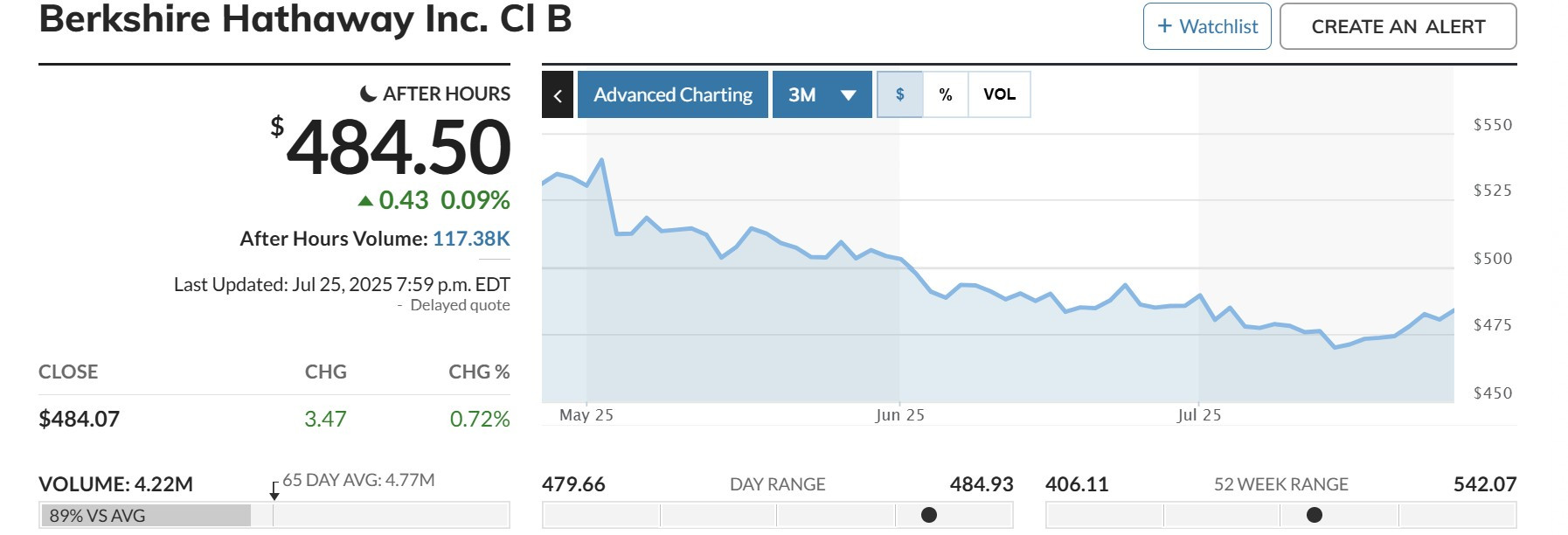
Since Warren Buffett’s May 3 announcement that he will step down as CEO by year-end, Berkshire Hathaway’s share price has slid more than 10%, lagging the S&P 500 by over 20 percentage points.
Yet the conglomerate still boasts industry-leading insurance, utilities, energy and rail franchises, along with a fortress balance sheet holding $330 billion in cash.
Trading at roughly 1.6 times book value and 24 times 2025 EPS—and nearer 20 times on a look‑through basis—Berkshire may finally be shedding its “Buffett premium,” creating an opportunity for investors who believe its free cash flow engine and potential deal catalysts can reignite growth.
Key Points
- 10% Slide: $BRK.B shares are down over 10% since May 3, trailing $SPX by 20 points.
- Valuation Dip: The “Buffett premium” is fading amid CEO succession uncertainty.
- Strong Core: Insurance, utilities, energy and rail continue to deliver steady cash flows.
- $330 Billion Cash: One-third of Berkshire’s $1 trillion market cap sits in cash, ready for deals or buybacks.
- Catalyst Potential: Targets include CSX, Occidental Petroleum and a Kraft Heinz swap.
- Attractive Multiple: Trading at ~1.6× book and ~24× 2025 EPS (≈20× on a look-through basis).
- Succession Clarity Needed: Roles under CEO‑elect Greg Abel remain undecided.
What’s Behind the Share Slide?
Since the annual meeting, investors have fretted over Buffett’s imminent departure. The “Buffett premium”—the added valuation ascribed to his capital‑allocation prowess—has waned, prompting a re‑rating of the shares.
Concurrently, concerns that property and casualty insurance underwriting is cyclically peaking have pressured earnings expectations. A broader market rotation away from defensive, conglomerate‑style stocks has only deepened the sell-off.
Core Operations: The Unshakable Foundations
Berkshire remains one of the world’s largest property and casualty insurers, with premium rate increases still in the 4-5% range—even as growth moderates. Geico, once a profit sinkhole, now leverages technology improvements to deliver strong underwriting margins.
Berkshire Hathaway Energy invests $10 billion annually across regulated utilities, renewables, transmission networks and pipelines, positioning it to benefit from rising power demand driven by AI and electrification trends.
BNSF Railway, Berkshire’s rail flagship, and Union Pacific control western U.S. freight. The strategic option to bid for CSX could unite eastern and western franchises, creating a true transcontinental network—a deal UBS estimates would boost per-share EPS by 8% by 2026, despite steep regulatory hurdles.
Could Cash and Catalysts Turn the Tide?
With $330 billion in cash—one-third of its $1 trillion valuation—Berkshire has firepower for transformative transactions. A 25% premium bid for CSX might require $80 billion, while a full Occidental Petroleum takeover could run $45 billion.
Alternatively, a share‑swap to regain 100% control of Heinz via Kraft Heinz could consolidate an iconic consumer brand. Each scenario offers potential to re‑ignite share gains and undercut negativity around inactive capital deployment.
Resuming share repurchases—paused since May 2024—would signal management’s conviction that the stock trades below intrinsic value. Even a modest 2% dividend would align Berkshire with large-cap peers and attract yield-seeking investors, illustrating flexibility beyond Buffett’s traditional repurchase-only stance.
Valuation Metrics: A Rare Entry Point
At roughly 24 times 2025 EPS forecasts, Berkshire‑B trades in line with the broader market. On a non-GAAP “look-through” basis that credits profits of its listed equity stakes in Apple, Coca-Cola and Bank of America, its effective P/E falls to about 20 times.
Book value multiples under 1.6 times harken back to trough valuations seen during past market dislocations, yet today’s high-multiple environment makes this discount particularly noteworthy.
UBS analyst Brian Meredith maintains a “buy” rating on A‑shares with a $892,120 target price—23% above current levels—citing unchanged intrinsic value before and after Buffett’s CEO exit.
With operating earnings of roughly $45 billion per year, tangible book value per share could reach $525,000 by 2026, implying a 1.4 times book forward multiple and reinforcing the margin of safety.
What’s Next for Management and Strategy?
While Buffett will continue as chairman through 2026, the distribution of responsibilities under CEO-elect Greg Abel remains the market’s greatest unknown.
Investors await clarity on whether Ajit Jain, the 73-year-old insurance czar, will retain his role, and how Todd Combs and Ted Weschler—co-managers of about 10% of Berkshire’s equity portfolio—will integrate under the new regime. Capital-allocation guidelines post-Buffett will also be pivotal to restoring confidence.
CFRA strategist Cathy Seifert warns that until these succession details are publicly laid out, the “Buffett discount” will likely persist. A definitive roadmap on leadership, combined with proactive deployment of the $330 billion cash cushion, could catalyze the next leg of appreciation in what remains one of the world’s most undervalued multi-business conglomerates.