Has the Yen Really Weakened?

Recently, the Nikkei 225 index has again approached its historical high, with foreign capital continuing to flow in while the yen is depreciating significantly. Since June, the Nikkei 225 has surged 9.2%, reaching 41,826 points at one point, just a step away from the historical high of 42,224 points on July 11, 2024. The booming Japanese stock market has been attracting foreign capital inflows. Since June, foreign purchases of Japanese stocks have further accelerated, with a total inflow of $5.11 billion as of July 23; in terms of net inflow, there was an additional 3 trillion yen. However, against this backdrop, the yen's performance has been relatively weak, depreciating by 2.4% since June.
The divergence between stocks and currency is not uncommon in Japan, with reasons behind it including the improvement in Japanese stock earnings due to depreciation. Historically, while in most countries stocks and currencies show a more positive correlation, Japan's stock market and currency have long been negatively correlated, with a high negative correlation coefficient of -0.49. The recent divergence in Japan's stock and currency markets continues this pattern. This result is mainly due to Japan's export-oriented economic structure. Currently, overseas revenue accounts for 42% of the listed companies on the TOPIX index, and depreciation is beneficial for exports and increases foreign exchange gains from overseas income. Therefore, during the yen depreciation cycle since 2013, industries with higher proportions of overseas income have seen larger gains in the stock market.
What's relatively unusual is the yen's weakness amid a weak dollar; in most cases, the yen tends to be strong when the dollar is weak, but recently the yen's trend has clearly diverged from other non-dollar currencies. Since June 2025, while the dollar index has fallen by 1.8%, most currencies have appreciated against the dollar, with the Mexican peso, Danish krone, Swiss franc, yen, and Australian dollar appreciating by 4.5%, 3.5%, 3.5%, 3.5%, and 2.1% respectively. However, the yen has depreciated significantly by 2.4% against the dollar. This situation is rare, as historically, the yen has tended to be strong during periods of dollar weakness, but since June, the yen's trend has clearly diverged from the euro.

What exactly has led to the yen's weakness?
Firstly, weak inflation stickiness and lower-than-expected inflation have led to a cooling of rate hike expectations, which is one reason for the yen's recent weakness. On one hand, the divergence between nominal and real wage growth in Japan has intensified, limiting the inflationary momentum driven by domestic demand. The current rise in Japan's core CPI is more dominated by imported factors, indicating weak inflation stickiness. On the other hand, since May 30, Bloomberg's Inflation Surprise Index has continuously declined from 2.07 to 1.31, also showing that the recent inflation rise is within market expectations and less than anticipated. Against this backdrop, market expectations for the number of rate hikes by the Bank of Japan this year once dropped from 0.66 times on May 30 to 0.59 times on July 22, leading to the yen's weakness.
Secondly, the unsuccessful multiple rounds of U.S.-Japan trade negotiations earlier also led the market to worry about the impact of high tariffs on the Japanese economy, further affecting the yen exchange rate. Since April 16, the U.S. and Japan have conducted eight rounds of trade negotiations, but the first seven rounds had significant disagreements on issues such as agricultural products and auto tariffs. Since May, market expectations for reaching an agreement by July/August have been declining. Against the backdrop of insufficient domestic demand, the potential impact of escalating trade frictions has intensified market concerns about the Japanese economy and exacerbated the yen's weakness.
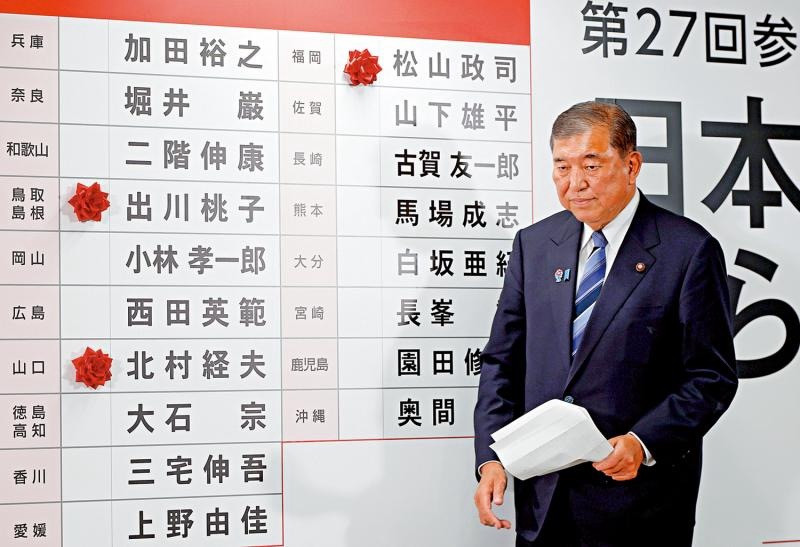
Lastly, the "political vortex" of the Upper House election has led to market concerns about further "loosening" of Japan's fiscal policy, which has also resulted in the yen's weakness and an increase in the term premium of Japanese government bonds. On July 20, Japan held its triennial Upper House election; as a result, the Liberal Democratic Party lost 13 seats, and together with the Komeito party, the ruling coalition only secured 122 seats, losing control of the Upper House. To stabilize the government and seek cross-party support, the ruling coalition may need to accept proposals from opposition parties such as fuel tax exemptions and small-scale consumption tax reductions, potentially expanding the scale of Japan's fiscal stimulus in the second half of the year. Amid concerns about debt issues, Japanese government bond yields have risen along with the probability of Shigeru Ishiba's resignation; worries about fiscal discipline have also exacerbated the yen's weakness.