
APAC Market Wrap - 28 Jul

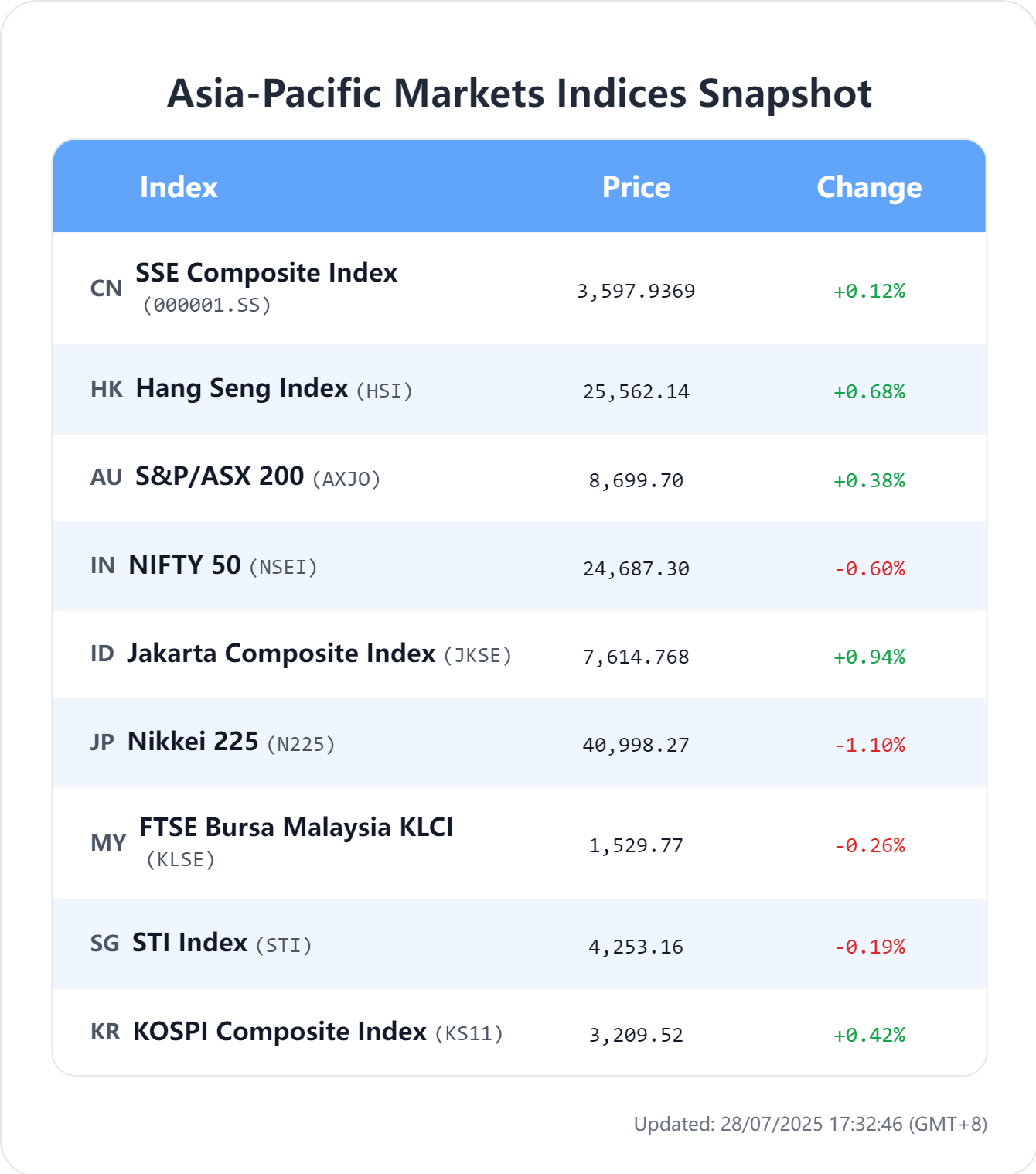
China: At close, the Shanghai Composite rose 0.12%, Shenzhen Component up 0.44%, and ChiNext up 0.96%. Top-performing sectors included PCB, film, CPO, and military equipment, while coal, steel, Hainan Free Trade Zone, and precious metals lagged.
Hong Kong: The major indices showed mixed results, with the Hang Seng Index up 0.68%, Hang Seng Tech Index down 0.24%, and the State-owned Enterprises Index up 0.29%. Sector-wise, tech stocks were mixed, pharmaceutical stocks shone, insurance stocks rose, and biotech stocks gained.
Japan: The Nikkei 225 fell 1.10%, closing at 40,998.27 yen, down 457.96 yen from the previous day. Eight sectors, including transportation equipment, textiles, services, and precision machinery, rose, while 25 sectors, such as banking, info-comms, electronic equipment, and shipping, declined.
South Korea: The KOSPI edged up 13.47 points, or 0.42%. Sectors like semiconductors, electrical equipment, power, and panels advanced, while credit cards and banking led the declines.
Australia: The XJO S&P/ASX 200 rose 0.36%, closing at 8,697.700 points. Furniture, agriculture, and apparel sectors saw slight gains, while forestry products, alcoholic beverages, and steel sectors dropped significantly.
Singapore: The Straits Times Index fell 0.47%, closing at 4,241.14 points. Software, agriculture, and cyclical retail sectors saw modest gains, while forestry products, medical distribution, and oil & gas sectors declined notably.
Malaysia: The FTSE Malaysia KLCI dropped 0.29%, closing at 1,529.38 points. Business trusts and plantations saw slight gains, while utilities, tech, and telecom & media sectors fell.
Key Events
South Korea’s Eco-Friendly Car Registrations Surpass 3 Million
Data released Monday by the South Korean government shows eco-friendly car registrations, driven by rising demand for hybrids and EVs, have crossed 3 million for the first time.
As of June, the national vehicle tally reached 26.41 million, up 110,000 from year-end 2024, a 0.4% increase.
Japan: Only 1-2% of $550B U.S. Investment Pledge Is Actual Investment
Japan’s chief trade negotiator Ryuji Akazawa said only 1-2% of its recently agreed $550 billion U.S. investment pledge will be actual investment, with the rest as loans. He noted the trade deal with the U.S. will save Japan about ¥10 trillion ($68 billion) in tariffs.
Akazawa told NHK Saturday that the $550 billion framework includes investments, loans, and loan guarantees from Japan-government-backed institutions, with the investment portion at 1-2%. Profits will be split 90:10 with the U.S., down from Japan’s initial 50:50 proposal.
Samsung and Tesla Ink $16.5B Multi-Year Chip Deal
Samsung and Tesla have agreed to a $16.5 billion multi-year chip manufacturing deal.
Samsung earlier announced a 22.8 trillion won ($16.5 billion) chip production contract with a major global client—likely a semiconductor foundry win—equating to 7.6% of its 2024 revenue, though details were undisclosed.
Institutional Views
BofA economists suggest the Bank of Japan might signal a less dovish stance this week. While the 0.5% policy rate is expected to hold, the recent U.S.-Japan trade deal—cited as a delay factor for tightening—could prompt a firmer tone.
Haitong Securities: Still Bullish on Hong Kong Market, Tech Sector Offers More Upside
Haitong Securities’ report remains optimistic on Hong Kong market opportunities, with the Hang Seng Tech Index seen as having greater recovery potential. It recommends focusing on sectors with improving sentiment and low valuations.