
APAC Market Wrap - 29 Jul

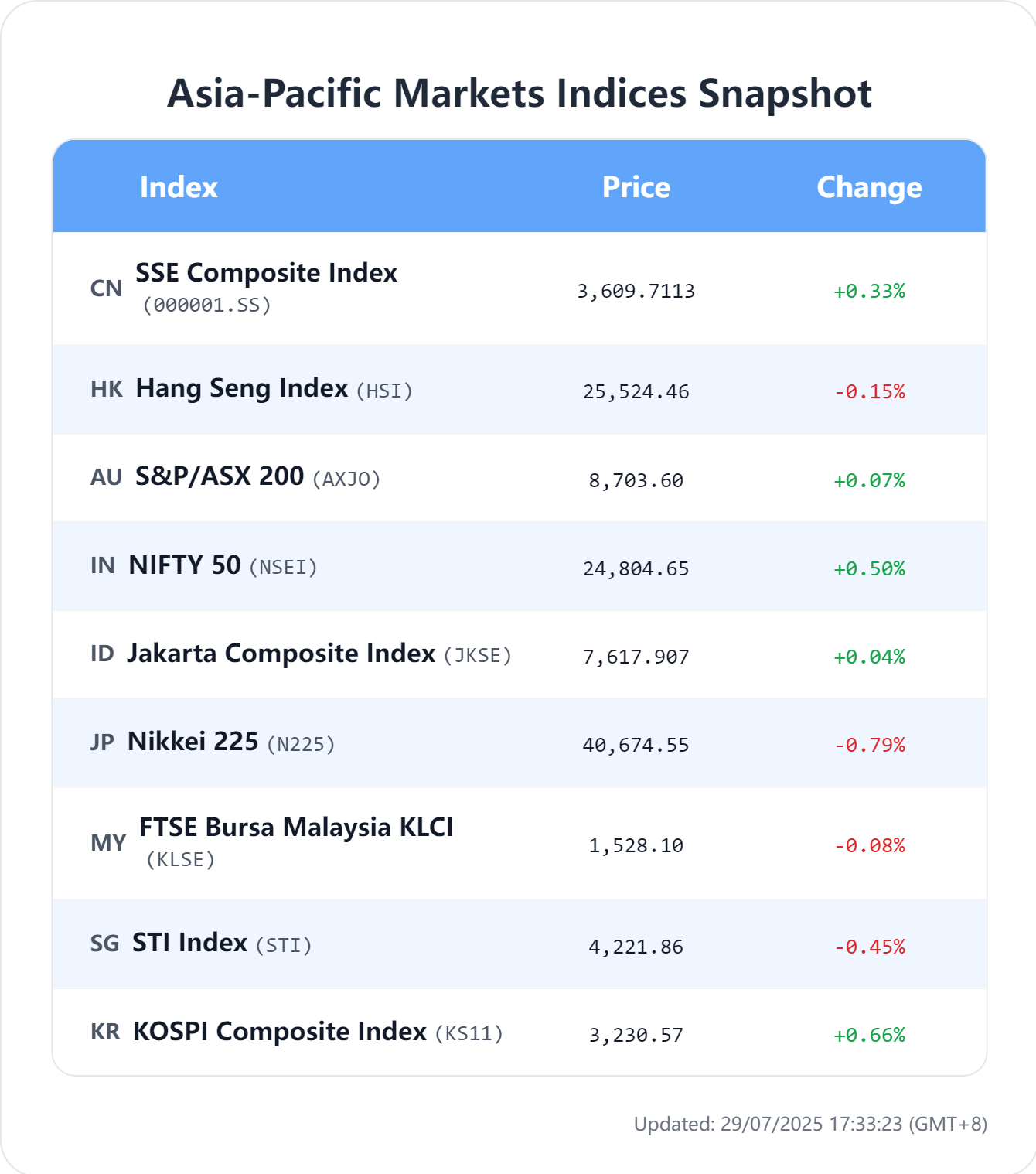
China: At close, the Shanghai Composite rose 0.33%, Shenzhen Component up 0.64%, and ChiNext up 1.86%.
Market focus was scattered, with more stocks declining than rising—over 3,000 fell. Sectors like CRO, steel, CPO, and advanced packaging led gains, while insurance, pork, banking, and agriculture lagged.
Hong Kong: All three major indices fell, with the Hang Seng Index down 0.15%, Hang Seng Tech Index down 0.35%, and State-owned Enterprises Index down 0.34%.
Tech stocks dipped, but innovative drug and casino/gaming stocks rose, alongside apple concept and oil stocks, with most solar PV shares up.
Japan: The Nikkei 225 fell 0.79%, closing at 40,674.55 yen, down 323.72 yen.
Seven sectors, including mining, oil & coal, services, and non-ferrous metals, rose, while 26, like transport machinery, securities/futures, and precision machinery, declined.
South Korea: The KOSPI edged up 21.05 points, or 0.66%. Publishing, telecom equipment, defense, and machinery sectors gained, while health management, electronics, and airlines led losses.
Australia: The XJO S&P/ASX 200 rose 0.08%, closing at 8,704.600 points. Forestry products, oil, and gas saw slight gains, while semiconductors, industrial distribution, and dining sectors dropped significantly.
Singapore: The Straits Times Index fell 0.28%, closing at 4,229.41 points. Forestry products, healthcare, and oil & gas edged up, while transportation, business services, and beverages saw larger declines.
Malaysia: The FTSE Malaysia KLCI dropped 0.36%, closing at 1,528.82 points. Industrial goods, energy, and construction rose slightly, while plantations, healthcare, and telecom & media fell.
Key Events
Australia Expands Flagship Clean Energy Plan by 25% to Double Renewable Power by Decade’s End
Australia will boost its key clean energy initiative by 25% to meet an ambitious goal of more than doubling renewable energy generation by 2030.
The “Capacity Investment Scheme” offers price guarantees to project builders, adding 3 gigawatts of capacity—enough for 10 million households.
South Korea Central Bank Minutes: Most Members Favor Further Rate Cuts
Minutes from the July 10 policy meeting, released Tuesday, show most Bank of Korea members support rate cuts, citing U.S.-Korea trade talks as key to timing.
Though the benchmark rate held at 2.50%, many hinted at cuts in the next three months, warning of “significant” economic uncertainty from U.S. tariffs.
Thailand Sees 6.18% Drop in Foreign Tourists This Year
Thailand’s Tourism Department reported a 6.18% decline in foreign visitors from January 1 to July 27, totaling 18.98 million.
China led with 2.64 million tourists. Last month, the central bank revised its 2025 forecast down from 37.5 million to 35 million, compared to a pre-pandemic 2019 peak of nearly 40 million.
Institutional Views
UBS Global Financial Markets China head Dongming Fang said since positive macro policy shifts in China last September, global interest in A-shares and Hong Kong stocks has grown.
He noted Hong Kong’s appeal versus U.S. assets, driven by improving Chinese firm fundamentals, valuation recovery, and the pegged HKD-USD rate.
Fang believes A-shares could catch up with Hong Kong’s depth and valuation edge. “We’ve long argued China assets won’t stay underweighted by global investors,” he added.
Strategist Michael Wilson at Morgan Stanley sees the S&P 500 reaching 7,200 by mid-2026, a 12.5% rise, supported by strong blue-chip earnings and macro trends.
In a report, he pegs total per-share earnings at $319 with a 22.5x P/E ratio.
ING analyst Chris Turner noted limited forex market reaction to the U.S.-EU trade deal due to prior expectations.
With the Fed’s decision looming, the euro is under pressure. ING forecasts EUR/USD could drop to 1.16 if the Fed resists political pressure to cut rates, with markets seeing no cut before October.
UniCredit economists said an asymmetrical U.S.-EU agreement is preferable to no deal, though the higher U.S. tariffs on the EU may not favor Europe.
“It’s likely enough for European markets and the economy, easing trade tension escalation risks,” they noted. The deal won’t shift the macro outlook or ECB policy, and tariffs haven’t yet dented market, business, or household confidence significantly.