
Figma: The Logic Behind the U.S. Stock Market’s Hottest IPO?


I’ve been flooded with Figma IPO hype these days, with pitches like: “Missed Circle? No worries, the year’s biggest tech IPO is here!”
It’s set to list on July 31, a deliberately chosen date for market momentum.
Figma, simply put, is a “collaborative design platform” that’s taken the designer and product development world by storm, essentially rivaling Adobe and the entire traditional design tool stack.
It moves fragmented product design, development, and delivery processes to the browser, redefining how digital products are created with real-time, multi-user collaboration.
You might not know Figma, but you’re likely using products it shaped daily: Google Maps, Uber, Netflix, LinkedIn, Airbnb, Duolingo, even Claude. Those seamless interfaces and refined interactions? Built with Figma.
In September 2022, Adobe proposed a $20 billion acquisition (split as $10 billion in stock + $10 billion in cash + $6 million CEO earnout), but it fell apart in December 2023 due to U.S. and EU antitrust scrutiny. 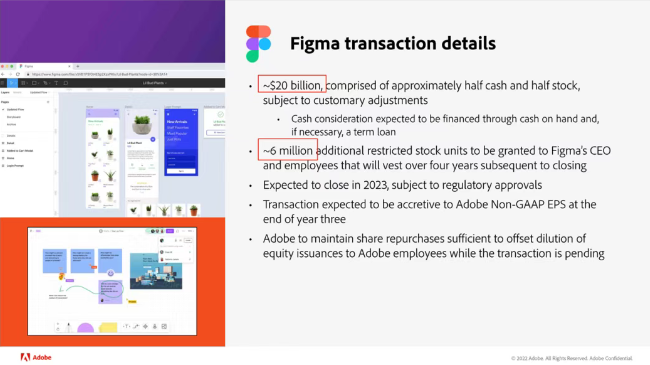
Why This IPO Is Turning Heads
Figma’s long-standing “celebrity status” in design and product circles, especially during the pandemic when its “cloud-native + multi-user collaboration” features were widely adopted, making it a go-to tool for tech teams from UX/UI to PMs, engineers, and ops.
Timing at the end-of-July funding peak, leveraging trading momentum: Backed by Morgan Stanley, Goldman Sachs, Allen & Co., and JPMorgan, the July 31 listing coincides with the busy U.S. earnings season.
As tech giants and SaaS firms release mid-year results, active fund rebalancing and post-earnings profit-taking could redirect high-risk capital to IPOs like Figma.
SaaS Hits an ‘AI+ New Narrative’ Turning Point
Since 2022, U.S. high-growth SaaS stocks have faced valuation corrections as the “Rule of 40” (balancing growth and profitability) regained focus. Post-2023, the GenAI wave—led by OpenAI, with GPT 5.0 launching in August—revived market imagination for software narratives.
Tech alone isn’t enough; capital markets need a compelling story. Figma smartly positions itself in the “AI + SaaS” paradigm, mentioning “AI” 150 times in its prospectus to brand itself as an “AI + collaborative design platform.” It’s staking a claim in the “AI + platform” narrative.
AI Phase 2 focuses on practical application. Why isn’t AI a bubble? AI trading Phase 2 is producing super-winners…
Figma builds momentum with products like Figma Make (AI-generated prototypes), Dev Mode (collaborative development), and Slides (AI-assisted presentations), crafting a narrative from “design to product OS.”
Figma’s IPO playbook is a classic investment bank strategy:
- Listing during a fund-switching window (late July) with earnings season liquidity.
- Solid fundamentals (95% Fortune 500 clients, 48% growth, 134% NRR) as narrative anchors.
- Heavy roadshows by top banks to set emotional anchors and media buzz.
What Is Figma?
Figma, a U.S. software firm founded in 2012 in California, offers a browser-based UI/UX design and collaboration platform.
Its core feature lets designers, product managers, and developers co-edit, prototype, share components, and brainstorm in real-time, streamlining the software interface design process.
Think of it as “Google Docs for interface design.” For instance, users can access thousands of web template libraries (see image), dragging and modifying modules with team collaboration for version updates.
Figma aims to build a platform created by designers, for design and product pros. Its prospectus reads like a portfolio—muted colors, professional layouts, clear graphics—more like a Medium feature than an SEC filing.
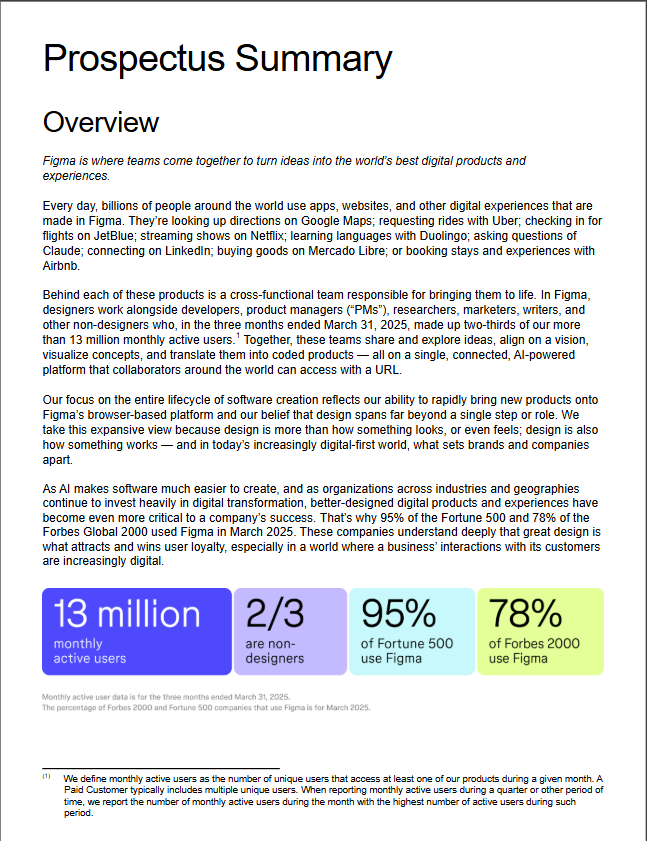
Goldman CEO David Solomon noted at a Cisco AI summit: “AI is doing 95% of the work on an IPO prospectus.” Yet Figma’s prospectus retains a human touch (low AI reliance), blending data with product philosophy, tested for AI content in select paragraphs.
Does the AI Narrative Hold?
Figma’s AI story ties to Dev Mode and Make, with structural innovations (MCP protocol, code integration) and features (AI prototypes, auto-summaries, layer naming). It avoids hyping model power, focusing on AI embedded in workflows as an app-layer player.
Dev Mode: A developer-focused space to fix the design-engineering “disconnect.” Traditional handoffs lead to rework; Figma uses structured info, auto-comments, and code generation, plus the MCP protocol.
MCP acts as a cross-tool “language,” letting AI agents in VS Code interpret designs and generate accurate code, bridging editors and drafts.
Figma Make: Aims to let anyone create web/app prototypes via prompts, no design or coding skills needed.
This narrative leans on “storytelling” over proven tech (relying on general models), but demos suggest potential for PMs, entrepreneurs, and marketers.
Figma targets markets beyond Sketch and Adobe XD, eyeing Slack, Notion, Google Slides, and GitHub use cases. Its user base—over 13 million MAUs in Q1 2025, two-thirds non-designers—marks it as a “cross-team collaboration platform.”
Pricing Update: $25-28 to $30-32
Top price $32, 37M shares, ~$1.2B raised. Bloomberg notes over 30x oversubscription (vs. Circle’s 25x), reflecting market heat.
At $32, valuation hits ~$18.8B, with Q1 2025 revenue $228M (run rate $912M), a 19.9x 2025E revenue multiple—high vs. SaaS average 11x. AI winners like Palantir, Cloudflare, and CrowdStrike set precedents.
IPO first-day pops are certain: SaaS averages 40% day-one, 52% week-one gains, with top performers like nCino (195%), Snowflake (112%), and Elastic (94%).
U.S. SaaS Cycle Phases:
- Phase 1 (2014-2019): Golden era—Salesforce, Shopify, Zoom, etc. SaaS as the “perfect model” (NRR >120%, 40%+ growth).
- Phase 2 (2020-2021): Pandemic peak—Zoom, Snowflake hit PS >100x, Figma’s $20B Adobe bid. Growth and TAM stories drove premiums.
- Phase 3 (2022-2023): Valuation reset—Fed rate hikes to 5.5% shifted focus to cash flow, Rule of 40, few IPOs.
- Phase 4 (2024-now): AI narrative—split into “AI winners” vs. “losers,” favoring healthy growth + cash flow, with platform and AI depth as valuation drivers.
In short, For Figma, a solid stock + narrative + hype (30x oversubscription, designer buzz, AI clarity) suggests retail appeal.
Its $69.5M Bitcoin ETF stake (March 31) and $30M Bitcoin plan (May 8) add crypto intrigue.