
APAC Market Wrap - 30 Jul

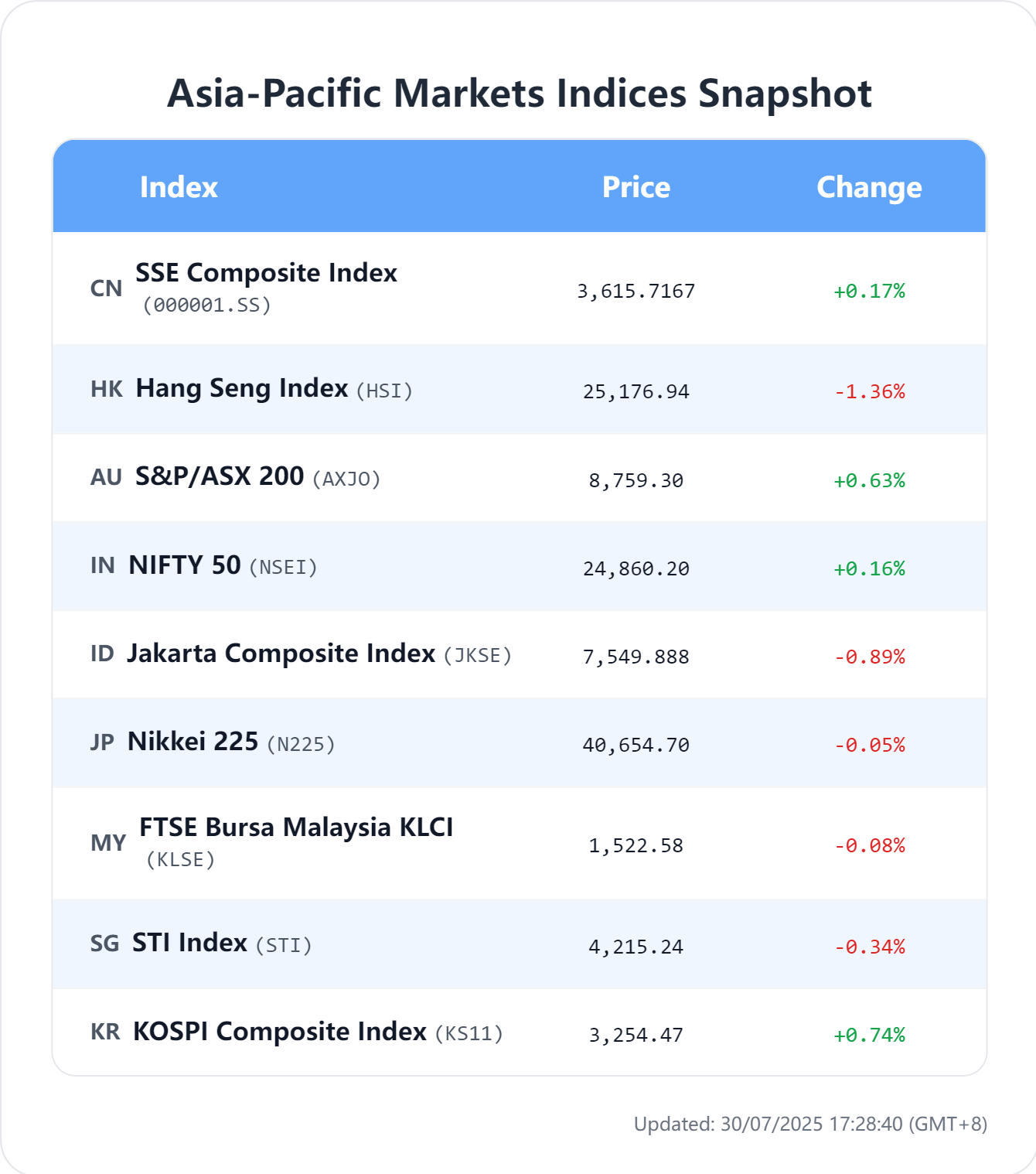
China: At close, the Shanghai Composite rose 0.17%, while the Shenzhen Component fell 0.77% and the ChiNext Index dropped 1.62%.
Sector-wise, film, oil and gas, infant products, and food sectors led gains, while stablecoins, solid-state batteries, software development, and rare earth magnets saw the largest declines.
Hong Kong: All major indices fell, with the Hang Seng Index down 1.36%, the Hang Seng Tech Index down 2.72%, and the State-Owned Enterprises Index down 1.18%.
Sector performance showed weakness in tech stocks, auto stocks, lithium battery stocks, semiconductor stocks, and Apple-related stocks, while oil stocks stood out positively.
Japan Stock Market: The Nikkei 225 fell for the fourth straight session, dropping 0.05% to close at 40,654.70 yen (down 19.85 yen).
By sector, 26 industries including non-ferrous metals, textiles, shipping, and real estate rose, while 7 sectors like air transport, services, pulp and paper, transportation equipment, and precision instruments declined.
South Korea Stock Market: The KOSPI index edged up 23.90 points, a 0.74% gain.
Sectors such as electronic equipment, automotive and parts, semiconductors and equipment, and wireless communication services advanced, while energy equipment, leisure gear, aerospace and defense, and utilities led losses.
Australia Stock Market: The XJO S&P/ASX 200 rose 0.60% to 8,754.400 points. Sectors like non-alcoholic beverages, aerospace, agriculture, and building materials saw modest gains, while semiconductors, medical diagnostics, and software posted notable declines.
Singapore Stock Market: The Straits Times Index fell 0.24% to 4,219.41 points. Furniture, oil and gas, software, and industrial products edged up, while forestry products, automotive parts, and cyclical retail saw larger drops.
Malaysia Stock Market: The Malaysia Index rose 0.04% to 1,524.50 points. Industrial products, real estate, and communication and media sectors saw slight gains, while closed-end funds, transportation and logistics, and construction sectors declined.
Key Events
Thailand Finance Minister: A Trade Deal With The U.S. May Be Finalized On Wednesday.
Finance Minister Pichai expects the agreement to be sealed, having responded to U.S. proposals on Tuesday. He noted that border conflicts with Cambodia have not impacted trade talks with Washington.
Japan Pre-CBO Decision: Option Traders Are Bracing For Further Yen Depreciation.
Over the past three months, the yen has lagged all major currencies, with political risks and potential U.S. tariffs possibly slowing the Bank of Japan’s rate hikes, aligning with bearish strategist views.
Indonesia to Raise Crypto Tax from Next Month
Starting August 1, Indonesia will increase crypto transaction taxes, applying higher rates to trades hosted by overseas exchanges, per a new finance ministry rule.
Crypto is a popular investment in this Southeast Asian economy, legally tradable but not usable as payment. Regulatory data shows 2024 transaction value doubled to 6,500 trillion rupiah (~$396.7 billion), with over 20 million exchange users, surpassing stock market investors.
Singapore Holds Monetary Policy Steady, Warns of Slower H2 Growth
The Monetary Authority of Singapore (MAS) kept policy unchanged Wednesday, addressing trade concerns from the Trump administration in this export-reliant city-state. MAS maintained the S$NEER slope, width, and midpoint, cautioning that GDP growth is expected to slow in the second half of 2025 compared to a strong first half.
Institutional Views
Morgan Stanley: CoWoP Unlikely for Nvidia’s Next-Gen GPU
Despite market buzz around Chip-on-Wafer-on-Package (CoWoP) tech, Nvidia’s Rubin Ultra is unlikely to adopt it. Per Chase Trading Desk on July 30, Morgan Stanley research suggests Nvidia will stick with ABF substrate tech due to CoWoP’s significant technical hurdles and supply chain risks.
While large-scale adoption is improbable short-term, parallel CoWoP development isn’t ruled out.
Morgan Stanley: Autonomous Driving to See Explosive Growth
A recent report predicts a $200 billion global autonomous driving market by 2030, with analysts Adam Jonas and Tim Hsiao forecasting AI-driven adoption to reach 28% of car sales. By 2035, smart driving could generate $300-400 billion in revenue for related firms.
BlackRock: Australian Bonds May Outperform U.S. Treasuries
BlackRock Australia’s fixed-income head Craig Vardy said Tuesday during a webinar that, amid fiscal risks, Australian bonds could outperform U.S. Treasuries. He noted higher term premiums in U.S. long-term bonds and potential RBA rate cuts.