
Apple Q3 Earnings Preview: Tariff Headwinds, AI Lag, and a Chance to Reclaim Momentum

Shearing sheep
July 31, 2025
GoGPT Summarizes Articles
Apple ($AAPL) will report its fiscal Q3 earnings after the U.S. market closes on Thursday, July 31. Wall Street expects revenue of $88.96 billion, up 3.71% year-on-year, and EPS of $1.42, a modest 1.51% increase.
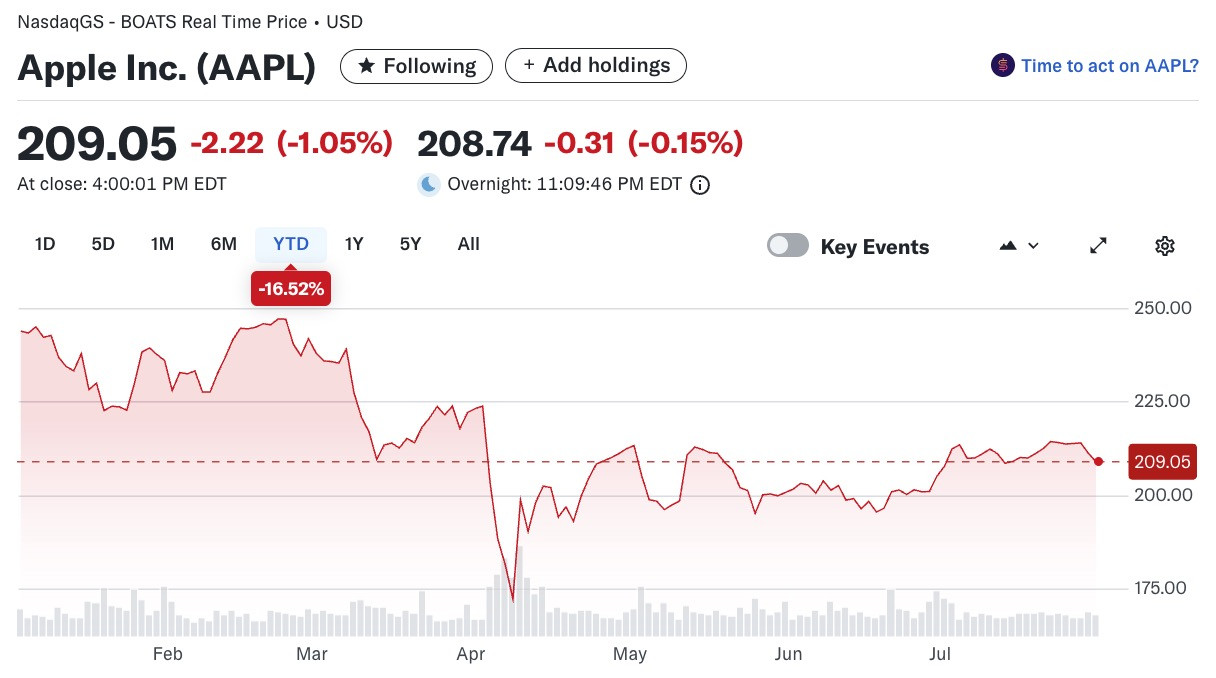
Yet while the headline numbers seem stable, the underlying story is more complex. Apple’s stock is down about 16% YTD, making it one of the weakest performers in the Magnificent Seven—behind only Tesla. This earnings report could be a crucial turning point.
iPhone Growth: Slowing Down?
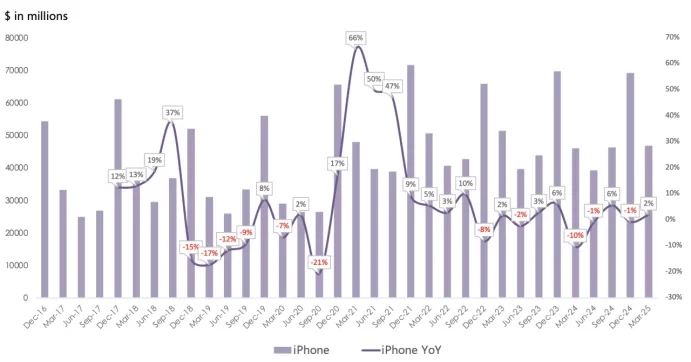
iPhone revenue still makes up the bulk of Apple’s business, but growth is losing steam. In last quarter’s report, iPhone sales rose just 2% YoY—marking the 12th straight quarter with revenue changes stuck in a narrow -10% to +10% range.
According to Canalys, Apple shipped 13.3 million iPhones in the U.S. in Q2 2025, down 11% YoY. By contrast, Samsung grew 38% to 8.3 million units, and Motorola also expanded slightly. The pullback comes despite many brands ramping up shipments ahead of potential tariff hikes.
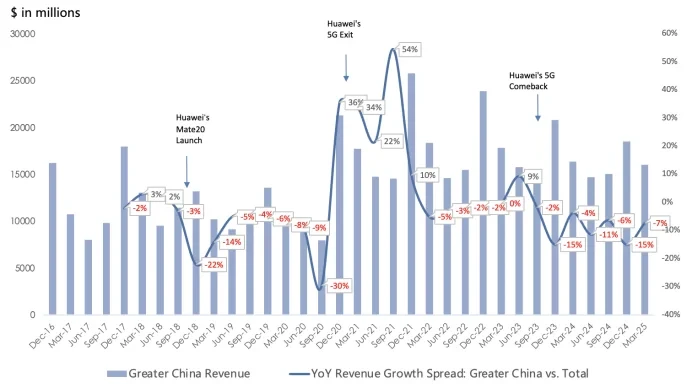
China remains a soft spot. Apple’s revenue from Greater China has lagged its overall growth rate for seven straight quarters. Shipments in mainland China fell about 9% YoY in the first five months of 2025, per data from CAICT—though the pace of decline eased to 4% in April–May, an improvement from Q1’s 13% drop.
Services: Still the Bright Spot?
Apple’s services segment has been its most reliable growth engine in recent years. Since Q4 2018, services revenue has grown YoY every quarter, with the last six quarters showing double-digit gains. Its high-margin nature also shields it from direct tariff exposure.
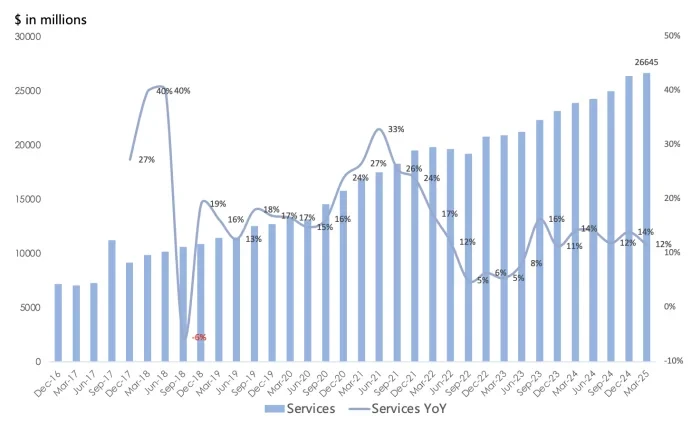
But momentum may be slowing. The “1 billion paid subscriptions” milestone hasn’t been updated in over six quarters. And notably, Apple declined to provide forward guidance for services growth in the previous earnings call—something that hasn’t gone unnoticed.
Investors will be watching closely to see whether Apple can continue leveraging its massive installed base to keep services on a strong growth trajectory.
Tariff Risks: Looming Larger
Trade tensions are another wildcard. Apple is arguably one of the most exposed companies to U.S. tariff policy, especially under the uncertainty surrounding Trump’s tariff policies.
CEO Tim Cook previously estimated that Q3 tariffs would add $900 million in costs, assuming current rates hold. In the last earnings call, he shocked many by revealing that “most” iPhones sold in the U.S. would soon be made in India, while other products would shift to Vietnam.
Trump responded swiftly, saying he had warned Cook that iPhones sold in the U.S. should be made in the U.S.—or face up to 25% tariffs.
Now Apple faces tough choices: absorb margin pressure, raise prices, or accelerate its costly supply chain diversification.
AI Strategy: Still Catching Up
Apple’s AI efforts—under the branding “Apple Intelligence”—are expected to be a major topic during the earnings call. Investors want to hear whether AI features will drive hardware upgrades and pricing power.
Critics say Apple is playing catch-up. Its WWDC showing underwhelmed compared to peers, and many analysts believe Apple has fallen behind in the generative AI race. That said, Morgan Stanley argues the market may be underestimating Apple’s long-term AI plans. Instead of battling Google in AI search, Apple is quietly building a local LLM platform centered around Siri, powered in part by third-party technologies.
Still, the bank doesn’t expect any meaningful AI monetization—or China rollout details—before 2026.
Regulatory Overhangs
Beyond tariffs, Apple is facing regulatory scrutiny. Antitrust pressure on its App Store continues to build, and the U.S. DOJ's case against Google Search—which could impact Apple’s lucrative search deal—is set to receive a verdict by late August.
What Are Analysts Saying?
-
Jefferies upgraded Apple to “Hold” with a target of $188.32. They expect iPhone sales in Q3 to beat expectations, but flagged concerns over weak demand in H2 and limited upside in services.
-
Citi remains bullish with a $240 target. They attribute strong June-quarter sales to tariff delays and aggressive promotions, but see risks from delayed AI features and unresolved U.S. trade decisions. Citi forecasts iPhone shipments of 226 million and 234 million units in calendar 2025 and 2026 respectively—implying flat growth this year and modest gains next.
Bottom Line
Apple’s Q3 earnings could mark a critical test. The company faces slowing iPhone momentum, rising geopolitical risk, and an AI narrative that hasn’t fully convinced investors. But with services still growing and hardware transitions underway, it’s not all bearish. A solid beat—especially on iPhone and services—might help stabilize sentiment.
What’s Your Estimate?
Will Apple’s Q3 results surprise to the upside—or confirm the slowdown? Join our prediction challenge and submit your estimate for total iPhone revenue this quarter.
#Q2 Earnings Hunter: Share Your Stories#$Apple Inc.(AAPL)