
Holding 24K BTC, Powering an IPO

Remember the stablecoin giant Circle’s IPO debut, which sparked a 9x surge myth?
On July 19, cryptocurrency exchange Bullish officially filed with the SEC for an IPO, planning to list on the NYSE under the ticker "BLSH." This marks the first crypto IPO since Trump signed the GENIUS Act on June 17.
Incubated by blockchain firm Block.one, with Silicon Valley venture capitalist Peter Thiel as a backer and former NYSE President Tom Farley as CEO, this opportunistic IPO company is drawing significant attention.
An Exchange with 24K BTC Heads to IPO
Speaking of Peter Thiel, he’s a household name in VC circles. A globally renowned venture capitalist and entrepreneur, he founded or co-founded notable investment firms like hedge fund Clarium Capital and venture capital fund Founders Fund.
However, Thiel is best known in the market for his role as a PayPal co-founder. Alongside Max Levchin and others, he drove PayPal’s user base growth through an aggressive “growth” strategy, eventually selling it to eBay for $1.5 billion, making him and his team overnight millionaires.
In the Facebook investment case, Thiel was the first external investor. Though the initial terms weren’t fully met, his keen insight into social networking’s potential led him to back Zuckerberg’s venture, yielding a hefty return—earning him about $1 billion after Facebook’s IPO.
This time, Thiel’s bet on Bullish capitalizes on the favorable IPO environment for crypto firms post-GENIUS Act and Bullish’s own potential.
In fact, this isn’t Bullish’s first attempt at listing. In its founding year, it tried a SPAC merger to go public but failed.
As for Bullish itself, its credentials are impressive. It holds over 24,000 BTC, and at current market value, this asset could place it among the top five global listed companies by Bitcoin holdings.
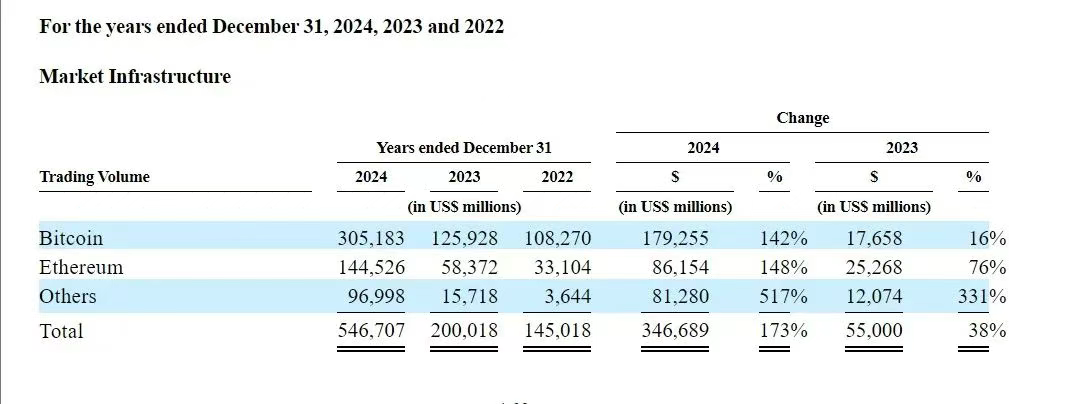
Since its 2021 launch, Bullish has recorded a cumulative trading volume exceeding $12.5 trillion, with a daily average of $25 billion. In 2024, its total trading volume for Bitcoin and Ethereum reached approximately $3.051 trillion and $1.445 trillion, respectively.
In 2023, Bullish acquired the renowned crypto media outlet CoinDesk in a cash-plus-stock deal, led by former NYSE President Tom Farley. Post-acquisition, Bullish instantly bolstered its “media + data” business segment, enhancing its industry influence.
By the end of Q1 this year, Bullish’s real-time professional data and research served 171,000 global users. Meanwhile, its media website attracted 55 million unique visitors in 2024.
Notably, Bullish also has an investment arm. Bullish Capital led the A-round for ether.fi and actively participated in funding rounds for Bitcoin staking protocol developer Babylon.
Shunning ‘Tech Narrative,’ Playing the ‘Compliance Premium’ Card
After Circle’s successful IPO and surge, crypto exchanges seem to have found a new survival path—avoiding offshore regulation and pursuing a “compliance premium.”
When stablecoins are pegged 1:1 to traditional currencies like the USD, value stability becomes their hallmark, and issuers must hold compliant licenses.
On July 17, the U.S. House passed the “Guidance and Establishment of National Innovation for USD Stablecoins Act” (GENIUS Act) and the “2025 Digital Asset Market Clarity Act” (CLARITY Act), ushering crypto into a new regulatory framework.
Shortly after its IPO—less than a month—Circle applied for a banking license, aiming to build a new digital monetary system.

Riding this wave, Peter Thiel, alongside Anduril co-founder Palmer Luckey and 8VC founder Joe Lonsdale, is backing another crypto bank, Erebor. This shows capital giants are legally staking claims in crypto’s new blue ocean.
As a top-five global exchange, Bullish is following this path. Unlike Binance, Bullish has learned from Circle, securing compliance licenses in Germany and Hong Kong, opening doors to European and Asian markets.
In January 2025, Bullish subsidiary Bullish DE Custody GmbH received a BaFin license from Germany’s Federal Financial Supervisory Authority (BaFin), enabling crypto custody, proprietary trading, and prime brokerage.
In February 2025, Hong Kong’s Securities and Futures Commission granted Bullish a Virtual Asset Trading Platform (VATP) license.
Bullish’s CEO revealed that Hong Kong will be its largest office, with 110 of its 260 global employees based there. Should Bullish’s IPO succeed, its stock could mirror Circle’s trajectory, sparking a new rally.
VC Giants Keep Betting on Crypto
However, Bullish faces risks. In Q1 this year, a Bitcoin price pullback led to a $246 million impairment, turning a $80.2 billion digital asset sales quarter into a $348 million net loss, compared to a $104 million profit in the same period last year.
Yet, Circle also reported losses for two quarters before its IPO. Recent data shows Bitcoin surpassing $120,000 for the first time, with crypto asset manager Bitwise predicting a potential rise to $200,000 this year.
In the crypto space where Bullish operates, VC giant Peter Thiel remains a key player.
In crypto, Thiel has backed projects like Paxos, Avantis, and Caldera, covering compliant infrastructure, DeFi infrastructure, and Layer-2 scaling. Among them, Paxos, invested in by Founders’ Fund in 2024, is a regulated stablecoin issuer.
In 2025, Thiel doubled down, joining the seed round for Ubyx, a stablecoin clearing startup aiming to build a global clearing system akin to Visa’s network.

Additionally, through BitMine, Bullish, and Erebor, he’s constructing a full crypto finance empire. BitMine focuses on Bitcoin and Ethereum mining, Bullish runs the exchange, and Erebor serves as a digital bank, forming a complete upstream-downstream chain.
With the GENIUS Act’s passage, policy will open the stablecoin market to broader participants. It sets standards for U.S. banks and financial firms issuing stablecoins and managing reserves in cash and U.S.
Treasuries, while regulation becomes essential. The GENIUS Act mandates oversight by the Office of the Comptroller of the Currency for larger issuers.
The more comprehensive “CLARITY Act” includes tokenization provisions, paving the way for U.S. companies to launch blockchain versions of bank deposits, stocks, and bonds.
As these bills progress, the crypto industry is moving toward greater regulation and transparency. As a VC giant, Peter Thiel has sniffed out the opportunity, and his investment story may just be beginning.