
Worst Nonfarm Ahead?

Today, the U.S. Labor Department will release July nonfarm employment data, marking the final act of the “life-or-death 48 hours” from Wednesday to Friday in the U.S. financial markets…
Despite a three-day pullback in U.S. stocks, the strong earnings from most tech giants and the “hawkish” Federal Reserve have created a delicate balance between bulls and bears. Will this equilibrium hold through tonight’s nonfarm night? Investors might want to keep a close eye!
From a macro perspective, Thursday’s unexpectedly high U.S. PCE price index served as a perfect “endorsement” for the Fed’s firm decision not to cut rates under Trump’s pressure the previous day. However, the Fed’s “dual mandate” includes two responsibilities—maintaining price stability and promoting job growth.
This means tonight’s nonfarm data could also become a major “battleground” between Trump and Powell.
What are the expectations for this nonfarm data?
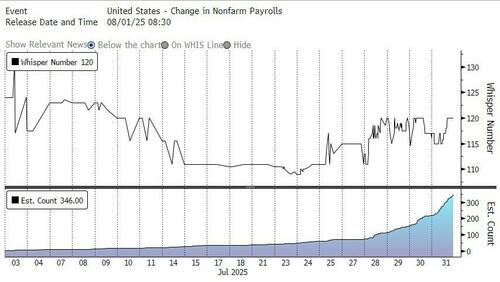
According to the median economist forecasts compiled by the industry, July nonfarm job growth is expected to slow further to 110,000 (with some media surveys at 104,000), the unemployment rate may rise from last month’s 4.1% to 4.2%, and wage growth is anticipated to see a slight increase.
How does Wall Street view tonight’s data?
With a flurry of major market events this week, industry attention to leading U.S. employment indicators has been relatively low in recent days.
Overall, since July nonfarm data is released on the “first day” of the month, some traditionally watched leading indicators (like ISM manufacturing and non-manufacturing employment indices) haven’t been released yet, adding difficulty to tonight’s data prediction.
Nevertheless, some industry voices remain cautious about tonight’s nonfarm performance. For instance, Bank of America has set an “extremely low” expectation—forecasting only 60,000 new nonfarm jobs in July.
Bank of America holds a dim view of Friday’s employment report, expecting July nonfarm employment to rise by 60,000, below the consensus expectation of 100,000.
“If this forecast holds true, the market’s knee-jerk reaction might lean dovish,” U.S. economist Aditya Bhave wrote in a Tuesday report. “However, we encourage investors to focus more on private-sector job growth and the unemployment rate.”
He noted that while government employment surged in June, this seems to be a seasonal distortion. He predicts the U.S. Bureau of Labor Statistics will show a total government employment decline of 25,000 in July.
Bhave said the real story lies in private-sector employment data. “We believe private-sector employment will accelerate from June’s +74,000 to July’s +85,000,” he wrote.
Additionally, he said the unemployment rate will be crucial for the market.
As usual, JPMorgan’s market intelligence team provided five scenario forecasts for “nonfarm night”:
- Nonfarm exceeds 140,000: Probability 5%, S&P 500 to rise 1%-1.5%.
- Nonfarm between 120,000-140,000: Probability 25%, S&P 500 to rise 0.5%-1.25%.
- Nonfarm between 100,000-120,000: Probability 40%, S&P 500 to rise 0.25%-0.75%.
- Nonfarm between 80,000-100,000: Probability 25%, S&P 500 to fall 0.5%-1%.
- Nonfarm below 80,000: Probability 5%, S&P 500 to fall 1.5%-2.5%.
JPMorgan market intelligence head Andrew Tyler believes, “The outcome leans positive, and the market will react favorably to any number above 100,000.”
Besides JPMorgan, Goldman Sachs trader Cullen Morgan also released his scenario forecasts, detailed as follows:
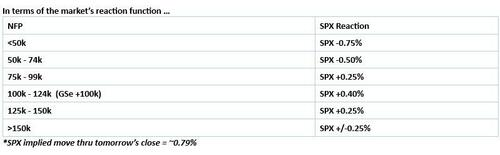
Goldman Sachs U.S. portfolio strategist Ryan Hammond noted that Friday’s employment report is a critical test for U.S. stocks. Over the past few weeks, stocks have hit record highs. Cyclical stocks have outperformed defensive stocks, and market valuations are near historical peaks, seemingly digesting a combination of strong growth expectations and Fed dovishness.
If the employment report aligns with market expectations, we expect stocks to continue rising, validating the current view that the worst growth outcomes will be avoided while the Fed may restart easing in September.
Hammond said current stock investor positioning remains neutral (Goldman’s sentiment indicator at -0.3), suggesting room for further stock accumulation.
However, if the employment report is too strong, it could cap stock gains as investors reassess Fed easing expectations. Conversely, an extremely weak report could test investors’ ability to overlook recent growth softness, potentially rekindling left-tail risks in the stock market.