
APAC Market Wrap - 1 Aug

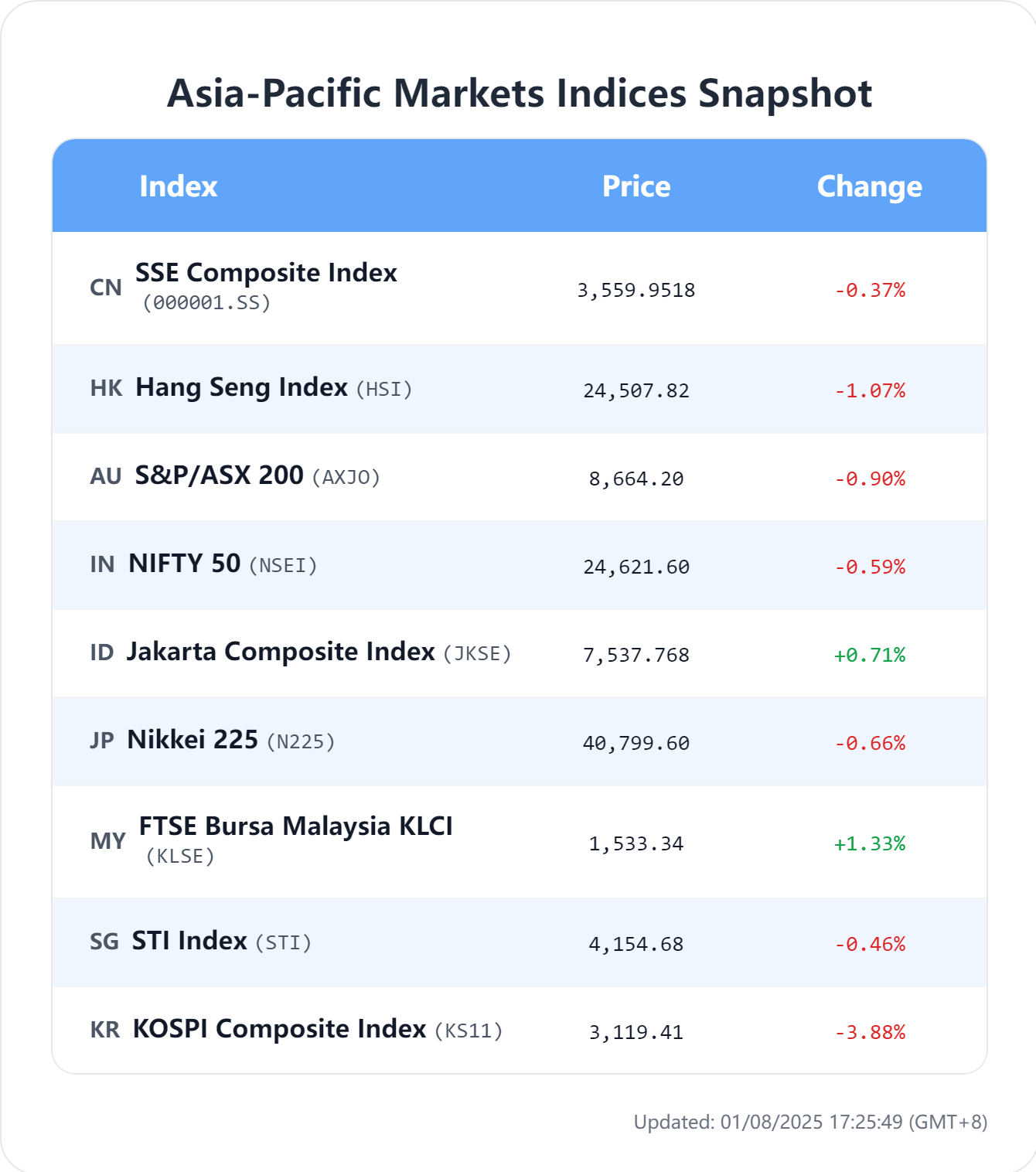
China: The market oscillated throughout the day, with the three major indices closing slightly lower. At close, the Shanghai Composite fell 0.37%, the Shenzhen Component dropped 0.17%, and the ChiNext Index declined 0.24%.
Market hotspots rotated quickly, with more stocks rising than falling, over 3,300 stocks gaining. Sectors like traditional Chinese medicine, power equipment, AI agents, and papermaking led gains, while China Shipbuilding, civil explosives, PCB, and CPO sectors saw the largest drops.
Hong Kong: All three major indices fell, with the Hang Seng Index down 1.07%, the Tech Index down 1.02%, and the State-Owned Enterprises Index down 0.88%.
Logistics performed strongly, photovoltaic solar stocks gained against the trend, while tech stocks broadly declined, pharmaceutical stocks pulled back, oil stocks dropped across the board, stablecoin-related stocks mostly fell, and biotech stocks also declined.
Japan Stock Market: The Nikkei 225 fell 0.66%, closing at 40,799.60 yen.
By sector, 24 industries including electric power and gas, land transport, construction, and real estate rose, while precision instruments, electronic equipment, shipping, and glass/earth sectors (9 in total) declined.
South Korea Stock Market: The KOSPI index dropped sharply, falling 126.03 points or 3.88%. Nearly all sectors declined, with other financials down over 15%, and non-ferrous metals, oil and gas, electric utilities, and biotech sectors dropping more than 6%.
Australia Stock Market: The S&P/ASX 200 (XJO) fell 0.92% to 8,662.000 points. Hardware, diversified financials, furniture, and education sectors saw slight gains, while apparel, aerospace, industrial distribution, and biotech sectors experienced larger declines.
Singapore Stock Market: The Straits Times Index dropped 0.42% to 4,156.19 points. Apparel and accessories, building materials, and chemicals saw modest gains, while oil and gas, defensive retail, business services, and industrial products sectors fell notably.
Malaysia Stock Market: The FTSE Malaysia KLCI rose 1.33% to 1,533.35 points. Construction, financial services, and real estate sectors saw slight gains, while closed-end funds, business trusts, and communication/media sectors declined.
Key Events
Korea Stock Crash! Lee Jae-myung Govt’s Surprise Tax Plan Angers Investors
South Korea’s stock market faced a “Black Friday,” with its benchmark index plunging nearly 4% to lead Asian losses, dragging down giants like Samsung Electronics and SK Hynix.
Just two months into office, the Lee Jae-myung government unexpectedly rolled out a tax hike plan, slashing the capital gains tax threshold, raising securities transaction tax, and increasing the top corporate tax rate. Investors are furious, with over 30,000 signatures opposing the capital gains tax proposal.
The “5,000-point” campaign promise still echoes, but this tax plan triggered a brutal market sell-off. The new government’s surprise tax move after just two months has shaken markets, halting a globally watched stock rally.
Bank of Japan Warns: U.S. Tariffs May Hit Corporate Profits, Delay Capex
The Bank of Japan stated Friday that U.S. tariffs could reduce Japanese corporate profits this year, potentially delaying capital expenditure plans. This highlights concerns over export-reliant Japan’s vulnerability.
The bank’s quarterly outlook noted automakers are absorbing tariff-induced cost increases rather than passing them to U.S. consumers, evident in a ~20% export price drop since April.
Thailand: Tariff Deal to Protect Export Base, Boost Competitiveness
Thailand said the U.S.’s 19% tariff on its products will help maintain its export base and long-term economic stability. A government spokesperson hailed the negotiated trade deal as a win-win, reinforcing Thailand’s potential on the global trade stage amid shifting policies.
Institutional Views
Ex-JPMorgan Chief Strategist Warns: U.S. Stocks Near ‘Bubble Peak’!
Former JPMorgan chief strategist Marko Kolanovic warned of an expanding market bubble in U.S. stocks, driven by oversized tech giants.
He said recent valuation spikes distort true market strength, with big tech gains inflating overall market cap. Kolanovic noted, “When the biggest tech firms (like MSFT, NVDA) surpass entire U.S. industry groups or major indices in a night, or hit the S&P small-cap total in three months (e.g., NVDA), we’re nearing a bubble peak.”
Goldman Sachs: APAC Markets Face Tariff Pressure Short-Term
APAC markets may face short-term pressure from Trump tariff uncertainty, especially for export-driven economies.
However, if tonight’s nonfarm data falls short, a September Fed rate cut could draw funds to Asian emerging markets. Goldman highlights China’s policy stimulus may offset some negatives but warns of inflation risks.
Morgan Stanley: Japan, Australia Show Resilience
Despite mixed APAC stock performance, Japan and Australia remain resilient due to resource and semiconductor demand, though valuations warrant caution.
Morgan Stanley notes July’s PCE (2.6%) signals lingering inflation risks, with potential adjustments ahead amid Trump’s tariffs on Canada and Brazil. Long-term, India and Southeast Asia’s digital shift supports growth.