
APAC Market Wrap - August 4

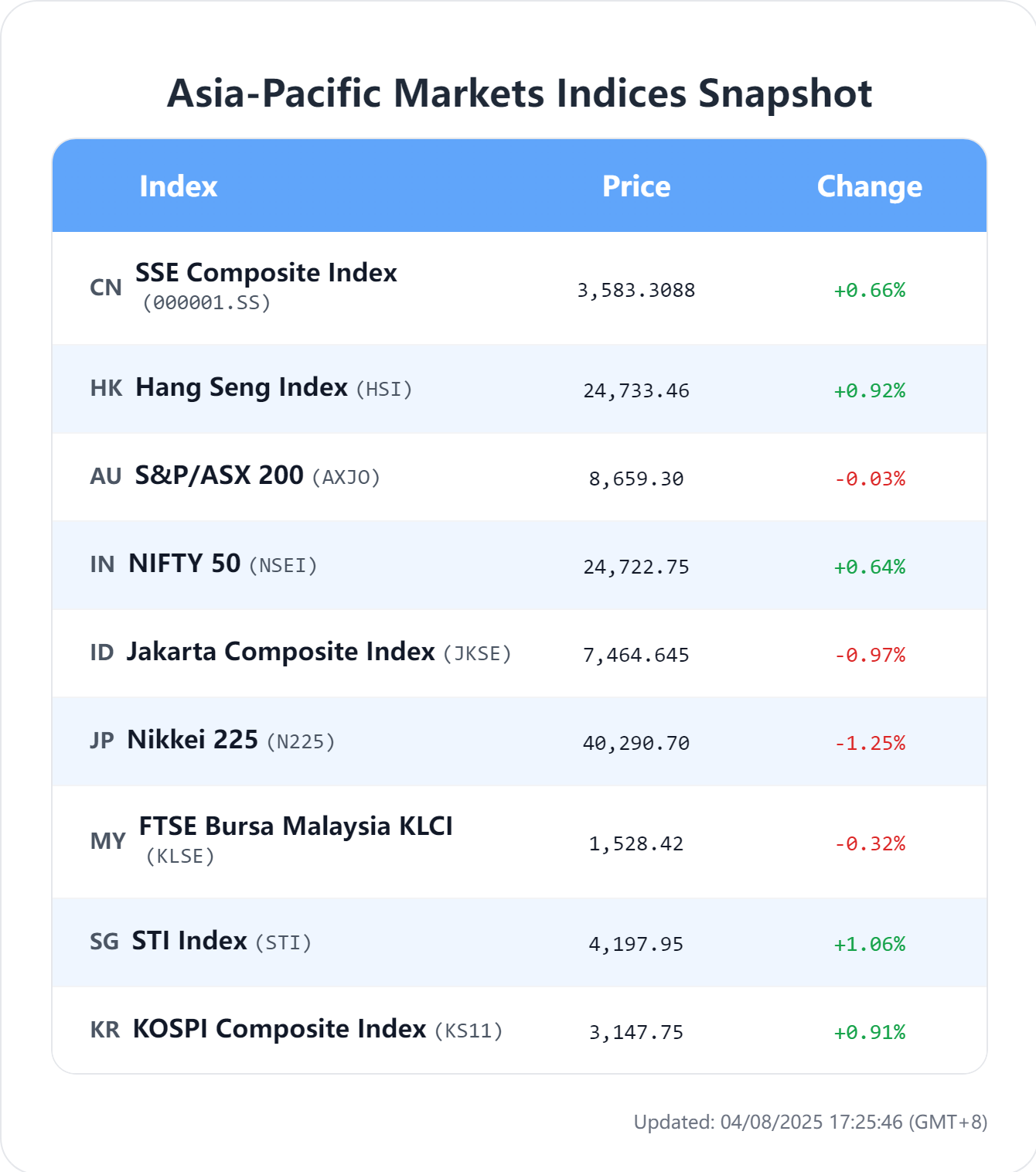
China: Markets opened lower but rebounded with volatility, with the three major indices posting modest gains. By the close, the Shanghai Composite rose 0.66%, the Shenzhen Component Index gained 0.46%, and the ChiNext Index was up 0.5%.
Sector-wise, military, precious metals, humanoid robots, and commercial aerospace led the gains, while insurance, film, photovoltaic, and snack sectors saw the largest declines.
Hong Kong: The three major indices opened lower but closed higher, with the tech index leading with a 1.55% gain. By the close, the Hang Seng Index rose 0.92%, the Hang Seng Tech Index climbed 1.55%, and the State-Owned Enterprises Index increased 1.01%.
Among sectors, tech stocks mostly rose, semiconductors shone, gold stocks strengthened, coal stocks rallied, and non-ferrous metals advanced.
Japan Stock Market: The Nikkei Average continued its significant decline, falling 1.25% to 40,290.70 yen, down 508.90 yen (with a trading volume of approximately 2.01 billion shares).
By industry, five sectors including other products, real estate, and precision machinery rose, while 28 sectors, including banking, mining, services, insurance, and oil and coal, fell.
South Korea Stock Market: The KOSPI index saw a slight uptick, rising 28.34 points or 0.91%.
By sector, tobacco, leisure equipment, construction materials, and utilities led the gains, while other financials, display panels, steel, and trading companies lagged.
Australia Stock Market: The XJO S&P/ASX 200 rose 0.02% to 8,663.700 points.
Sectors like aerospace, alcoholic beverages, defensive retail, and semiconductors saw modest gains, while furniture, apparel, agriculture, and diversified financials experienced larger declines.
Singapore Stock Market: The Straits Times Index rose 1.08% to close at 4,198.74 points. Sectors such as construction, non-alcoholic beverages, business services, and industrial products posted slight gains, while apparel, industrial distribution, diversified media, and oil and gas saw notable declines.
Malaysia Stock Market: The Malaysia Index fell 0.42% to 1,526.98 points. Sectors like transportation and logistics, real estate investment, consumer goods, and utilities saw modest gains, while energy, tech, business trusts, and financial services declined.
Key Events
Malaysia Agrees to Boost U.S. Tech and LNG Purchases
Malaysia’s trade minister announced on Monday a $150 billion investment over five years to buy equipment for semiconductors, aerospace, and data centers from U.S. multinationals, part of a tariff reduction deal with the U.S.
The U.S. last week announced a 19% tariff on Malaysian goods starting August 8, down from the previously threatened 25%.
Serbian President: I’ll Visit China Sept 1-5, Putin and Trump May Attend
Citing TASS and Russia’s Sputnik, Serbian President Vučić said on August 3 in Bački Petrovac that he will visit China from September 1-5, noting Putin will attend and Trump might, though unconfirmed.
A major leaders’ dinner is scheduled for September 5, but the host’s identity remains undisclosed for security reasons.
South Korea Official: $350B U.S. Investment Fund Mostly Loan Guarantees, Less Than 5% Direct Equity
The policy chief to South Korea’s president stated that the $350 billion pledged under a U.S. trade deal is primarily loan guarantees, not direct investment, addressing domestic concerns about scale and risk.
Kim Yong-beom clarified Seoul’s equity commitment will stay below 5%, targeting commercially viable, pre-vetted U.S. projects.
Emerging Market Funds Adjust Bets, ‘Short Dollar’ Trade Loses Appeal: July’s dollar rebound has led some emerging market investors to expect further gains in the coming months. T. Rowe Price favors U.S. dollar-denominated emerging market bonds over local currency bonds as a tactical play.
Barclays advises against shorting the dollar against Asian currencies, while Fidelity International notes the allure of borrowing dollars for carry trades has waned due to prolonged high U.S. rates.
Institutional Views
Citi Raises Short-Term Gold Price Forecast to $3,500/oz
Citi has lifted its three-month gold price forecast from $3,300 to $3,500 per ounce, with a trading range adjusted from $3,100-3,500 to $3,300-3,600, citing worsening U.S. growth and inflation outlook. The bank notes: “U.S. growth and tariff-related inflation concerns will intensify in H2 2025, alongside a softer dollar, driving gold to new highs.”
Barclays: ECB May Opt for December Rate Cut
Barclays now sees the European Central Bank potentially cutting rates in December rather than September, as predicted earlier. Economist Mariano Sinal cites weaker H2 economic activity, dragged by persistent trade policies and earlier U.S. front-loading of imports.
Jefferies: Global Copper Output Rose Slightly in Q2, to Slow Ahead
Based on filings from miners accounting for 62% of global output, Jefferies reports a 4.7% quarter-on-quarter and 2.5% year-on-year rise in Q2 copper production. Declines at Glencore and Freeport were offset by gains at Codelco, MMG, and Rio Tinto.
The firm expects global copper mine growth to taper as existing reserves deplete.
Morgan Stanley: Tariffs to Lift U.S. Prices by ~1% in Coming Months
U.S. May import data showed an effective tariff rate of 8.3%, below Morgan Stanley’s 10-15% baseline, but June and July are expected to align with forecasts. Delays in shipping, higher-than-expected imports from Mexico and Canada under USMCA, and a sharp drop in emerging market imports drove the lower rate.
ANZ: Trump Firing BLS Chief Undermines U.S. Economic Safe-Haven Status
Amid Trump’s dismissal of Labor Statistics Bureau chief McEntaffer, accused of data manipulation, and ongoing government attacks on Fed independence, markets are uneasy.
ANZ’s report calls the move “another blow to the U.S.’s status as a global economic safe haven,” highlighting the market’s reliance on data integrity.