
Hedge Funds Offload U.S. Stocks for Four Consecutive Weeks


Despite the S&P 500 hovering near all-time highs, Wall Street’s savviest capital continues to adopt a bearish stance.
According to Goldman Sachs’ prime brokerage latest report, hedge funds are maintaining the cautious strategy seen during the April tariff turmoil, offloading U.S. stocks for the fourth consecutive week.
The pace of selling in technology, media, and telecom stocks has reached its fastest in a year. The rate of stock sales has outpaced short covering, a trend particularly evident ahead of the tech sector’s earnings season.
In stark contrast to hedge funds’ caution, retail investors have net bought stocks for 23 consecutive trading days. The market’s most seasoned players are exiting at record highs, potentially signaling severe seasonal adjustment pressure for U.S. stocks amid lingering trade war concerns.
The Federal Reserve held interest rates steady this week, with Chair Powell reiterating that officials need more time to assess the impact of tariffs on inflation before easing policy.
Goldman’s trading desk believes retail demand won’t fade unless significant changes occur in economic outlook or employment data. However, amid ongoing tariff worries and elevated valuations, hedge funds’ cautious stance may be validated in the upcoming seasonal adjustment.
Strategic Retreat of Smart Money
Wall Street’s most sensitive capital has begun systematic deleveraging.
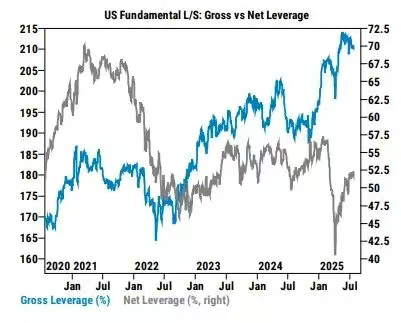
Goldman Sachs’ prime brokerage data shows hedge funds have net sold U.S. stocks for four straight weeks, unwinding exposure to tech, media, and telecom stocks at the fastest pace in a year. This sell-off occurs as the market hits record highs, reflecting institutional investors’ deep skepticism about current valuation levels.
U.S. institutions are participating with historically high total leverage, yet their net positions remain low, indicating a “leveraged plus heavy hedging” approach to inject liquidity. Should a sudden negative shock hit, this structure could trigger severe passive deleveraging.
Deutsche Bank data raises further concern: CTA and quant fund stock long positions have climbed to the 94th percentile, the highest since January 2020. A 3%-5% drop in the index could force programmatic selling, accelerating a downward trend.
Cautious Strategy Dodges Market Volatility
In late March, anticipating Trump’s tariff announcement, hedge funds reduced stock exposure and increased short positions. This strategy proved wise, especially for those who also boosted global equity allocations, as global markets outperformed U.S. stocks.
Jonathan Caplis, CEO of hedge fund research firm PivotalPath, said: “Managers remain quite cautious as many potential risks have not dissipated.” He highlighted macroeconomic uncertainty as the primary concern.
Caplis added: “Hedge funds haven’t experienced the same drawdowns as the market because they reduced leverage early. They haven’t felt that pain, so they’re not forced to join the rally.”
Missing the Rally, But Strategy May Pay Off
Admittedly, hedge funds have missed this rally. The S&P 500 has risen about 25% from its April low, heading toward its longest monthly winning streak since September.
Per PivotalPath’s equity diversification index, hedge funds have had a mediocre year, with a 7.8% return as of June, ranking in the 72nd percentile across all six-month periods since January 2000.
Seasonal Factors Amplify Market Risks
However, if seasonal patterns hold, their strategy might pay off in the short term. August and September are typically the weakest months of the year. Coupled with high valuations and tariff deadline pressures, this could spell trouble for the S&P 500.

UBS data shows that, considering presidential term factors since 1950, these two months look even worse.
Aaron Nordvik, UBS’s macro equity strategy head, wrote in a report: “In the first year of a president’s term (inauguration year), these months perform particularly poorly.
If this pattern holds, a strong year-end rally is expected, but a tough two months are likely starting around August 4.”