
Q2 Unveiled: Will MI308’s Return and AI Forecast Spark AMD’s Upswing?

$AMD ’s Q2 2025 earnings, due after U.S. markets close on August 5, set the stage for critical strategic insights. Consensus expectations—$7.43 billion revenue (+27% YoY) and non-GAAP EPS of $0.47—closely match $AMD ’s internal guide.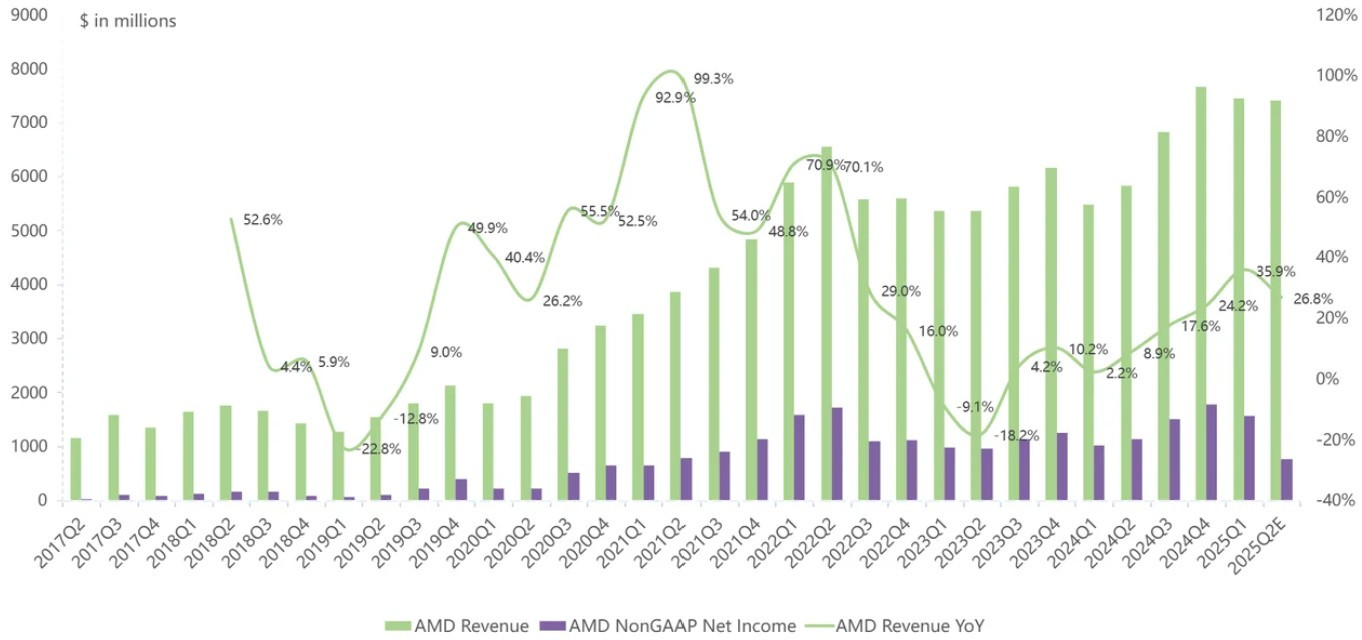
Yet, investors are fixated on four catalysts: the MI308 ban lift’s revenue timing, clarity on full-year AI targets, signs of FPGA recovery, and $AMD ’s ability to surpass Intel in PC profit margins. Management’s commentary, not just headline numbers, will dictate $AMD ’s share trajectory into Q3 and beyond.
Key Points:
- Consensus vs. Guidance: Wall Street expects $7.43 billion revenue, up 27% YoY, in line with AMD’s $7.40 billion guide. Non-GAAP gross margin is forecast at 43%, down 6.1 pp YoY, reflecting MI308-related charges. Excluding those charges, margin would be 54%.
- Earnings Detail: GAAP EPS is set to flip to a $0.047 loss, while non-GAAP EPS of $0.47 implies $760 million net profit, down 32% YoY. Stripping out an $800 million MI308 charge boosts non-GAAP EPS to $0.90, equating to $1.47 billion profit (+31% YoY).
- Data Center: Sequential CPU growth offset by GPU and FPGA deferrals related to MI308 timing.
- Client & Gaming: Desktop and notebook CPU revenue up high-teens % QoQ; gaming GPU sales rise double digits on refreshed GPU lineup.
- Embedded: FPGA and automotive chip sales flat sequentially, pending broader China recovery.
- Options Sentiment: Implied volatility near the 85th percentile and a put/call ratio of 0.64 reveal bullish skew, with traders bracing for ±33% post-earnings swings.
Will MI308’s China Reauthorization Reignite Growth?
AMD accrued an $800 million reserve and recognized a $700 million revenue shortfall for Q2, tied to China’s MI308 sales ban. That ban lifted on July 15—after Q2’s end—shifting actual revenue upside into Q3 and Q4.
Investors will demand specifics: will MI308 restocking ramp quickly, or will inventory absorption extend into year-end? Management’s guidance on inventory build, channel fill rates, and margin dilution will determine whether MI308 catalyzes a sharp rebound or a gradual recovery.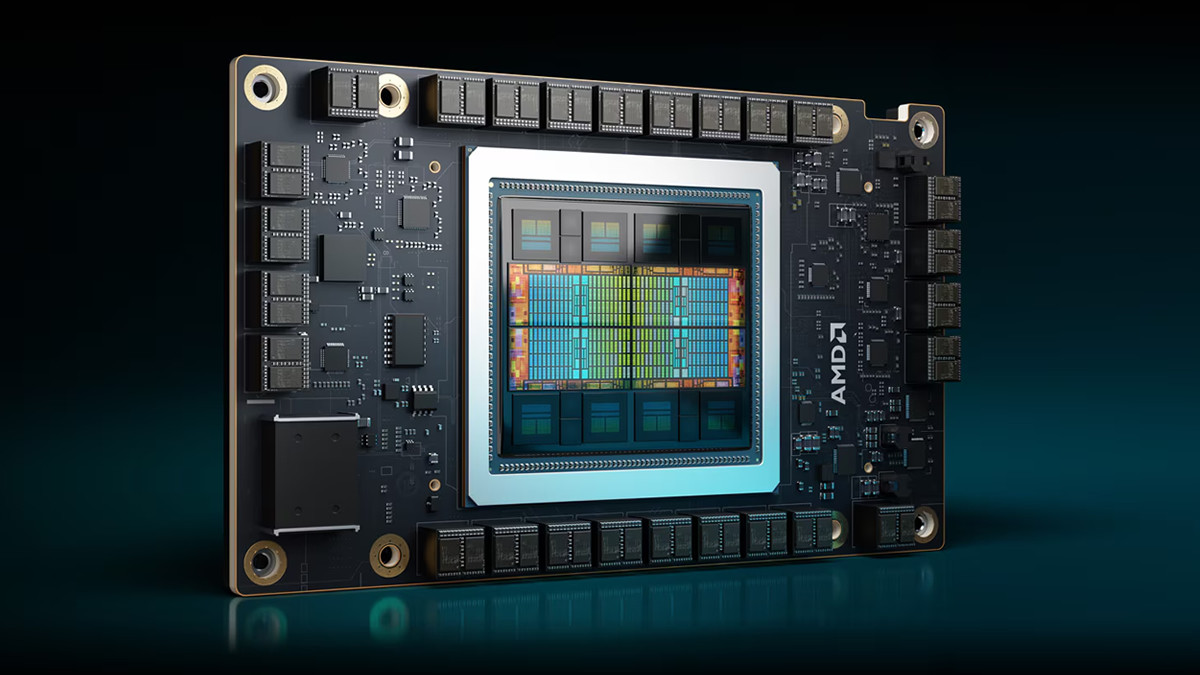
Can AMD Deliver Concrete AI Revenue Guidance?
In 2024, AMD sequentially raised quarterly data center GPU targets—from “$2 billion+” in Q3 to $5 billion in Q4—providing transparency and confidence. However, Q1 2025’s report offered only “high-teens percentage growth” for full-year AI revenue, with H1 flat YoY and growth hinged on MI350 adoption in H2.
As AI demand and competitive dynamics with NVIDIA evolve, investors are eager for precise 2025 AI revenue figures. A definitive target—e.g., $18 billion or 30% YoY growth—would bolster credibility and guide valuation expectations.
Is FPGA Set for a Comeback?
Xilinx’s FPGA business, once AMD’s profit engine, has lagged amid subdued embedded demand. Rival Intel’s Altera arm—soon to be divested—reported $450 million in Q2 FPGA revenue, up 24% YoY and 22% QoQ, marking its first double-digit growth in years.
If AMD’s FPGA division can capture a slice of that resurgence—through automotive, 5G, and industrial end markets—it could unlock incremental operating profit. Key indicators include design wins, backlog growth, and pricing trends in emerging AI accelerators.
Could AMD Finally Outpace Intel in PC Margins?
AMD’s client CPU market share has surged, driven by Zen 5 architecture gains and OEM adoption in laptops and desktops. Eight consecutive quarters of high-teens YoY client revenue growth have narrowed AMD’s margin gap with Intel.
Meanwhile, Intel’s Q2 client segment operating margin reportedly dipped below 30%. If AMD posts a non-GAAP operating margin above that threshold—perhaps reaching 32%—it would mark the first time AMD eclipses Intel in PC profitability. Investors will parse segment-level margin data for confirmation.
Options Traders Bet on Volatility Crackdown
With implied volatility at the 85th percentile, straight option purchases are costly. Active traders may deploy volatility-selling strategies—like iron condors or short strangles—to capitalize on the typical IV crush following earnings.
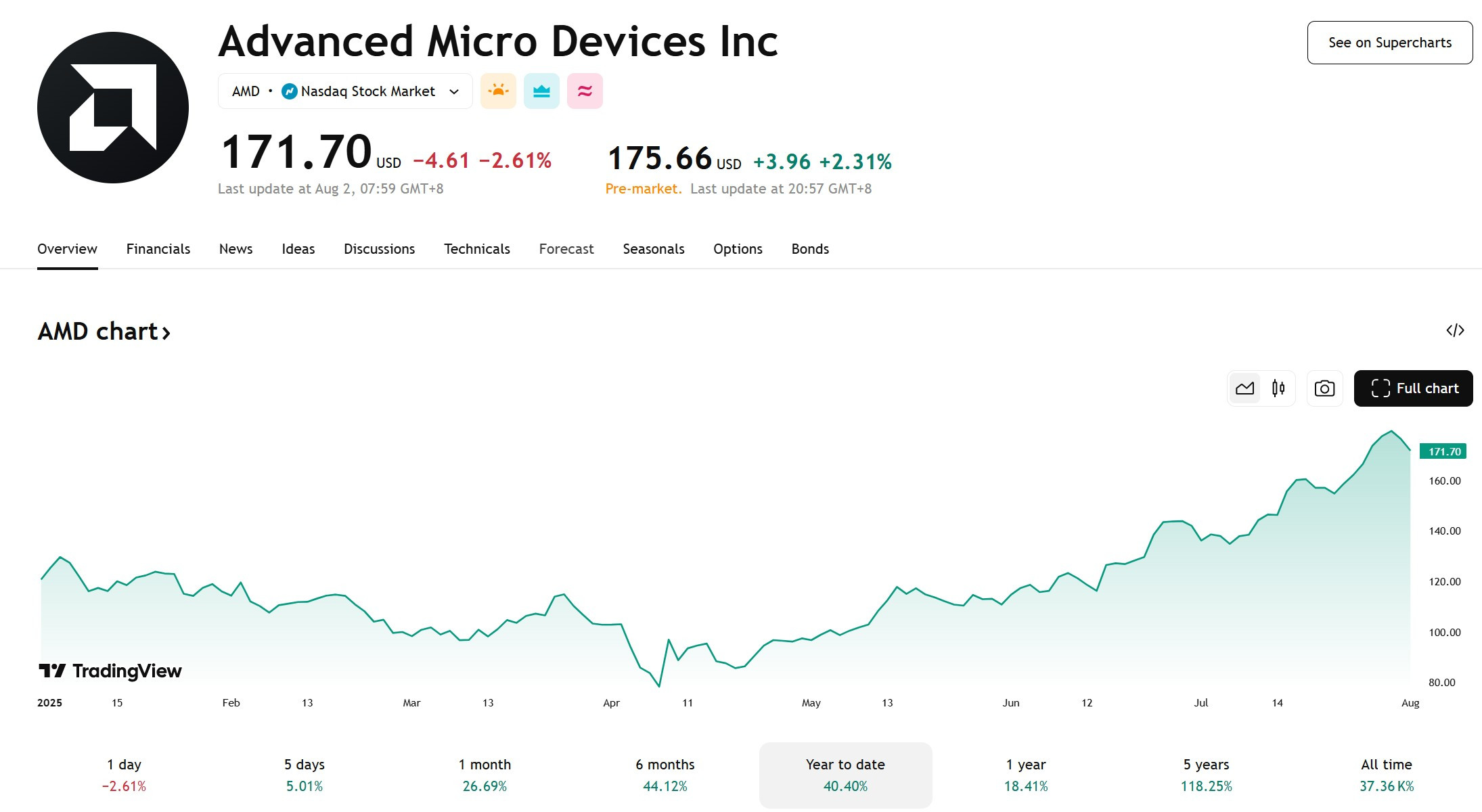
A ±8.33% expected move implies a roughly $13 range around the $156 share price, guiding strike selection. Management’s tone and Q3 guidance, more than raw results, will drive post-report trading dynamics.
Beyond Tomorrow: Why Guidance Matters Most
With Q2 figures largely anticipated, AMD’s forward-looking commentary holds the key. Investors will scrutinize how MI308 flows through the P&L in H2, whether a specific AI revenue target is unveiled, signs of FPGA momentum, and PC margin targets relative to Intel. CEO Dr. Lisa Su’s precision—and willingness to quantify—will either cement confidence in AMD’s growth narrative or inject caution into Q3 trading. Tune in after the close on August 5 for the full story.