
Williams' Net Income Soars 36% on Strong Second Quarter Results

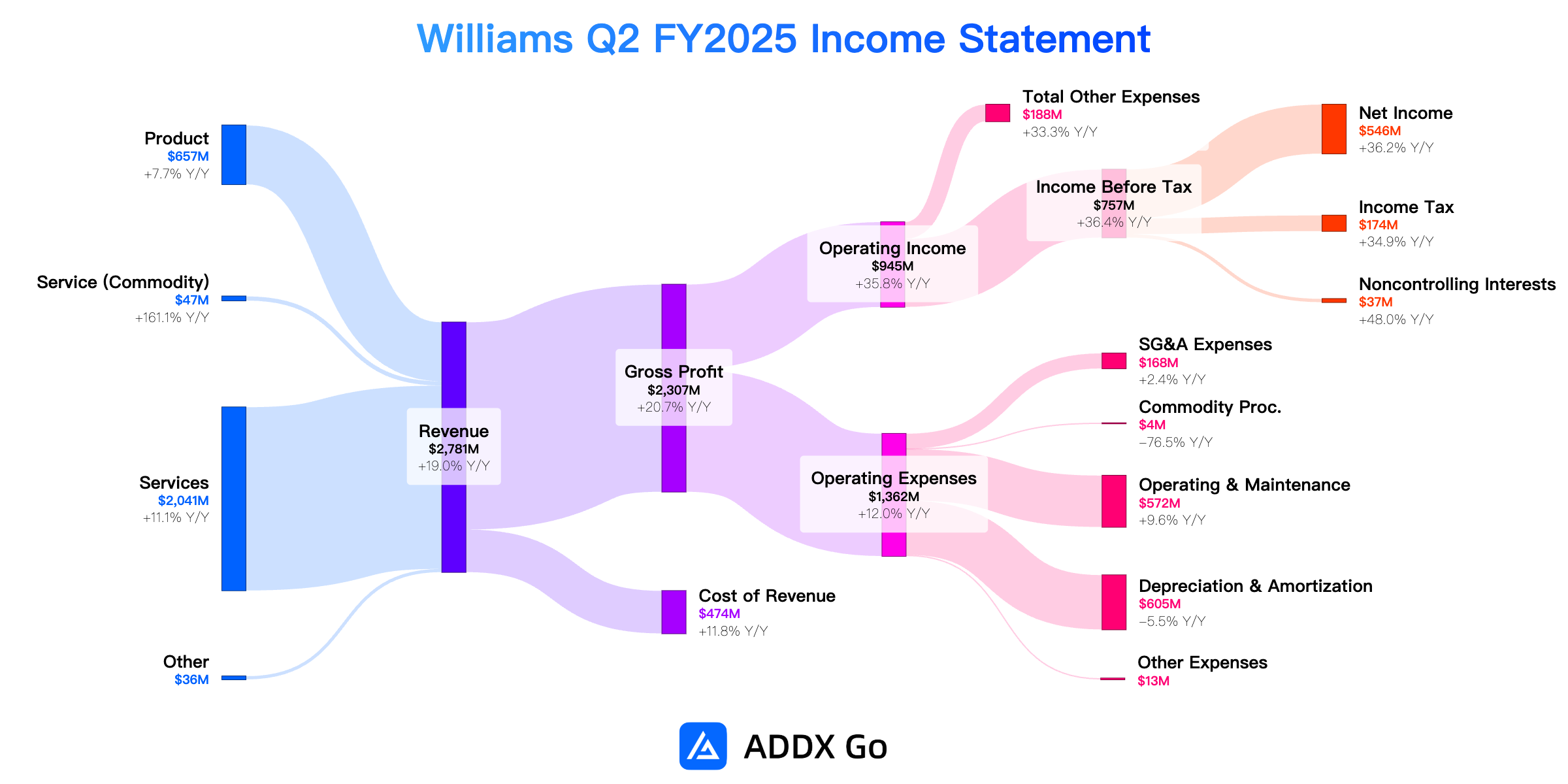
Williams (NYSE: WMB) reported a significant increase in its financial performance for the second quarter of 2025. The company's net income rose to $546 million, marking a 36% increase from $401 million in Q2 2024. Revenue also saw substantial growth, reaching $2,781 million, up 19.05% from $2,336 million in the prior year's second quarter. Compared to analyst estimates of $2,731.46 million for revenue and $0.49 for EPS, Williams surpassed revenue expectations but fell slightly short on diluted EPS of $0.45.
Key Business Drivers
The robust financial results were primarily driven by strong performance across several key segments. The Transmission & Gulf of America segment saw improved Modified and Adjusted EBITDA due to Transco expansion projects and new Gulf volumes. The Northeast G&P segment also experienced an increase in Modified and Adjusted EBITDA, mainly attributed to higher gathering and processing volumes from Ohio Valley Midstream, Cardinal, and Bradford.
Furthermore, the West segment’s Modified and Adjusted EBITDA increased due to higher volumes in the Haynesville area and new volumes from the 2025 Rimrock and Saber acquisitions. The company also highlighted the in-service placement of Transco's Texas to Louisiana Energy Pathway and Southeast Energy Connector expansion projects, as well as accelerated timelines for other key projects, contributing to the overall positive performance.
Management Outlook
Chad Zamarin, President and Chief Executive Officer, noted the continued strength of the base business and the recent acquisition of Saber Midstream, which is expected to build earnings growth in the second half of the year. As a result, Williams has raised the midpoint of its 2025 Adjusted EBITDA guidance by another $50 million, now projected between $7.6 billion and $7.9 billion, with a midpoint of $7.75 billion. The company also affirmed its 2025 growth capital expenditure forecast of $2.575 billion to $2.875 billion, and maintenance capital expenditure of $650 million to $750 million, excluding emissions reduction and modernization initiatives.