
BofA Research Report: How Low Can UnitedHealth’s Profit Bottom Be?

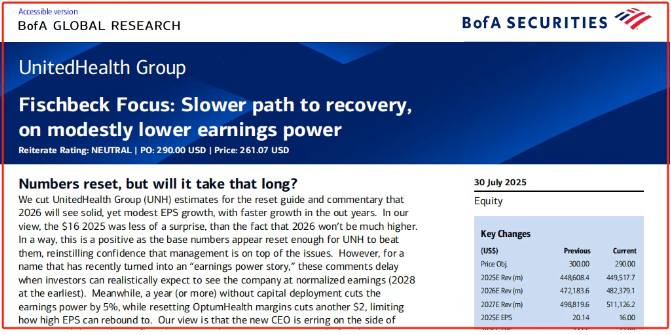
On July 30, 2025, BofA Securities released its latest research report on UnitedHealth Group (NYSE: UNH).
Once a cornerstone asset in the U.S. healthcare sector with a high weighting in institutional portfolios, the company has seen market confidence waver after consecutive quarters of downward profit guidance revisions.
This time, BofA boldly cut its 2025 EPS forecast from $20.14 to $16 and warned investors that a return to “normal profitability” might not occur until 2028.
I. Astonishing Profit Cuts, Worst May Be Priced In
At last December’s Investor Day, UnitedHealth promised a 2025 EPS of $29.75, but the revised guidance now stands at $16—a near halving. Key adjustments include:
- A nearly 49% cut in profit guidance for the Health Benefits segment;
- A 38% reduction in Optum (especially Optum Health);
- Overall profit margin slashed from an expected 8.5% to 4.9%;
- Dividend payout ratio rising to 54% and debt-to-capital ratio hitting 43%, limiting stock buybacks or other capital deployment in the coming year.
However, BofA suggests this “expectation reset” could be a silver lining—such a low baseline makes future “beat-and-raise” scenarios more achievable.
II. Core Issue: Medical Costs Severely Underestimated, Optum Hit Hard
The report highlights a 68.2% drop in Optum Health’s profit forecast, driven by its risk-bearing value-based care (VBC) business. Accelerating patient visit frequency and complex patient profiles have exposed an underestimation of overall risk.
The company has paused expansion of some risk contracts and plans to drop 200,000 PPO patients by 2026 to shrink high-risk exposure.
Optum Health’s 2025 profit margin target is 3%, far below the prior 6%-8% long-term goal, with no short-term rebound in sight.
III. Business Breakdown: Widespread Pressure
BofA remodeled UnitedHealth’s segments, with key findings:
- Medicare (Medicare Advantage): Medical trend adjusted from 5% to 7.5%, profit margin at 2%-2.5%;
- Commercial (Commercial Insurance): 2025 margin at 6%-6.5%, slightly below the 7%-9% long-term target, with improvement expected in 2026;
- Medicaid: 2025 at break-even, potentially -1.7% in 2026, well below the 2%-4% long-term goal;
- Optum Insight (Data and Software): Margin slightly down to 18.7%, still in a healthy range long-term;
- OptumRx (Pharmacy Benefit Management): Stable, margin from 4.4% to 4%.
Currently, Commercial and OptumRx contribute nearly 50% to EPS.
IV. Profit ‘Normalization’ May Wait Until 2028
BofA’s projected path is:
- 2025 EPS at $16;
- 2026 EPS rising to $17;
- 2027 EPS recovering to $19;
- Theoretically, above $20 by 2028.
Compared to the market’s 2024 consensus expecting $30 EPS by 2027, this is a significant downgrade.
BofA notes that if medical costs stabilize and Optum recovers faster, 2027 EPS could exceed $20, but this would require “several quarters of outperformance” to justify a higher valuation.
Final Thoughts
This “profit reset” for UnitedHealth is essentially a delayed response to structural changes in healthcare utilization post-pandemic.
Institutional views are clear:
- The company retains “long-term profitability”;
- But lacks a clear short-term path or certainty;
- EPS recovery will be gradual;
- Most business margins have lost their “buffer,” with recovery hinging on execution.
BofA assigns a “Neutral” rating, lowering the target price from $300 to $290, based on a 2027 EPS of $19 and a 15.3x P/E.
Amid sector-wide cost pressures, policy uncertainty, and tighter Medicare regulations, even giants like UnitedHealth struggle to stand alone.
Capital markets now care less about whether you can still make money and more about—can you return to your former self?