
APAC Market Wrap - August 6

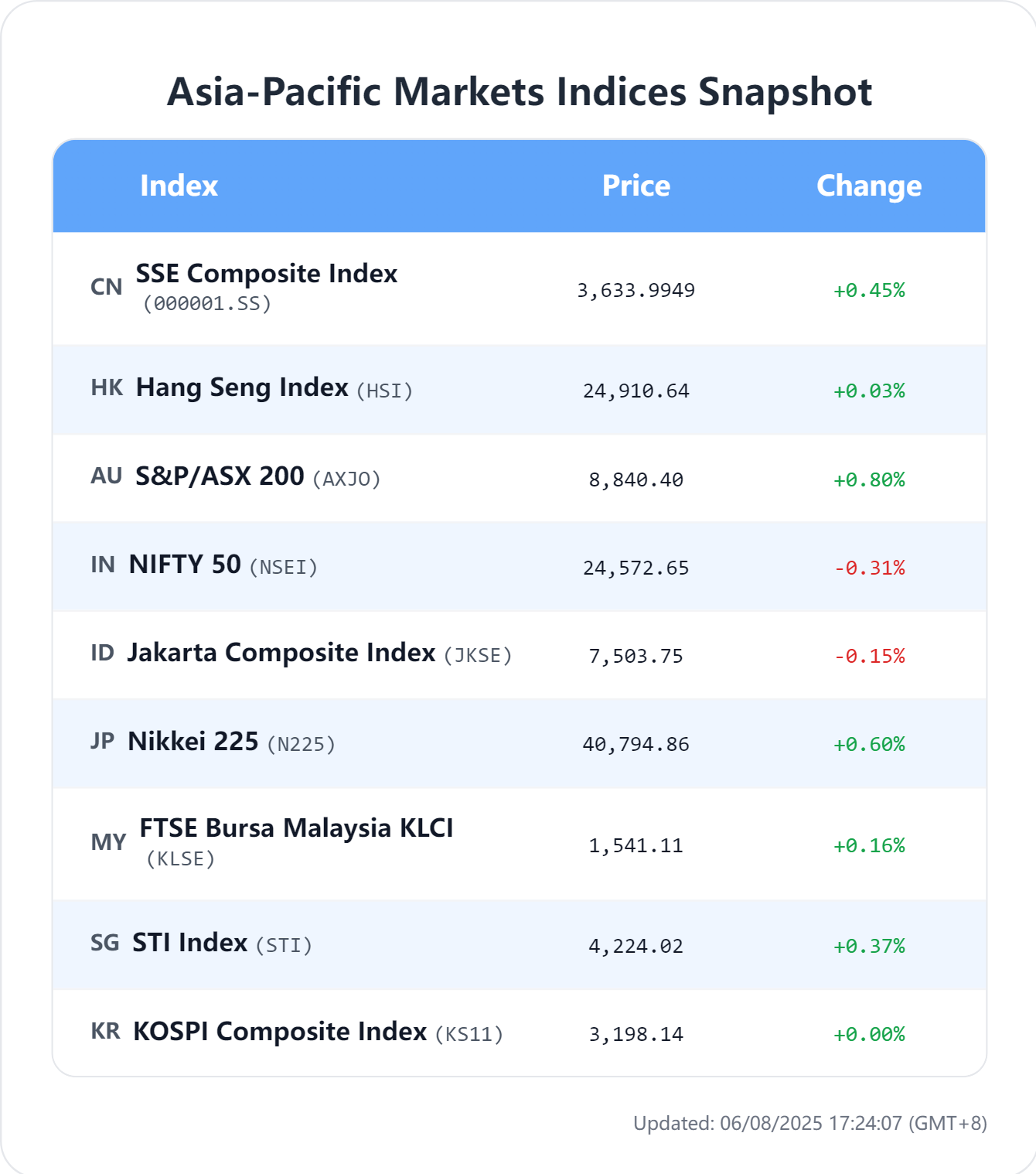
China: Markets oscillated upward throughout the day, with all three major indices posting modest gains. By the close, the Shanghai Composite rose 0.45%, the Shenzhen Component Index gained 0.64%, and the ChiNext Index increased 0.66%.
Sector-wise, PEEK materials, military, humanoid robots, and lithography machines led the gains, while traditional Chinese medicine, Tibet, innovative drugs, and tourism lagged.
Hong Kong: Hong Kong’s three major indices showed mixed performance. The Hang Seng Index rose 0.03%, the Hang Seng Tech Index gained 0.20%, and the State-Owned Enterprises Index ($800100.HK) fell 0.21%.
Sector-wise, catering stocks mostly declined, new consumption concept stocks rebounded, coal stocks strengthened, Apple concept stocks rose, and sports equipment stocks weakened.
Japan Stock Market: The Nikkei Average continued its rise by 0.60%, closing up 245.32 yen at 40,794.86 yen (trading volume around 280 million shares). On the Tokyo Stock Exchange’s main board, over 1,200 stocks rose, accounting for nearly 80% of the total.
By sector, 32 industries except services saw gains, with real estate, construction, mining, and oil and coal particularly strong.
South Korea Stock Market: The KOSPI index closed nearly flat, up 0.14 points.
Sector-wise, electric utilities, aviation and shipping, public utilities, and cosmetics led the gains, while aerospace defense, semiconductors, and electronic equipment lagged.
Australia Stock Market: The XJO S&P/ASX 200 rose 0.84% to 8,843.700 points.
Sectors like education, industrial distribution, and building materials saw significant gains, while waste management, telecom services, and medical devices posted slight declines.
Singapore Stock Market: The Straits Times Index rose 0.30% to close at 4,211.17 points.
Education, credit, and construction sectors saw modest gains, while agriculture, industry, and semiconductors experienced larger declines.
Malaysia Stock Market: The Malaysia Index rose 0.18% to 1,541.48 points. Financial services and transportation logistics posted slight gains, while technology, industrial goods, and real estate declined.
Key Events
Record Trading Volume, Over 10 Million Accounts! Vietnam’s Bull Market Won’t Stop?
On August 5, Vietnam’s stock market hit a record single-day trading volume of nearly 860 trillion VND (approximately 23.88 billion RMB), the highest ever.
Behind this milestone lies an unrelenting rally to new highs: the VN Index briefly touched a historic peak of 1,585.98 points on Tuesday, with a year-to-date gain of over 22%, further fueling retail investor enthusiasm.
Driven by fears of missing out, Vietnam’s stock market has become Southeast Asia’s hottest this year. Industry data shows global funds are returning, with $298 million in net foreign buying in July, one of only two inflow months in the past year.
Japan’s Heatwave May Worsen Nationwide Rice Crisis: Drought-Hit Rice Regions Face Pest Outbreaks
Japan is experiencing unprecedented high temperatures and drought this summer.
The Japan Meteorological Agency reports that the average temperature for June and July hit record highs, with 4,565 locations exceeding 35°C in July—the most since comparable data began in 2010.
Meanwhile, summer rainfall has hit a historic low, as strong high-pressure systems block rain cloud formation. Data shows rainfall in many regions is below half the average, with key rice-growing areas in the northeast and Hokuriku receiving only 13% and 8% of normal levels, respectively. This has raised serious concerns about rice yields.
A Japanese rice farmer said he’s irrigating seven hectares with plastic tanks from a waterway 1.5 km away, but considers this a temporary fix.
South Korea’s Nongshim Chairman Shin Dong-won Indicted
South Korea’s antitrust regulator announced on Wednesday it has referred Nongshim Co.’s chairman Shin Dong-won to prosecutors for allegedly omitting major affiliates from required disclosures to avoid classification as a large conglomerate and benefit from SME incentives.
India Central Bank Holds Rates Steady, Wary of Trump Tariff Threats
Facing rising tariff threats from U.S. President Trump, the Reserve Bank of India kept its policy rate unchanged at 5.5% on Wednesday.
This aligns with economist expectations, following a 50-basis-point cut in June. RBI Governor Sanjay Malhotra said the decision was unanimous, noting that while global trade challenges persist, geopolitical uncertainty has “eased somewhat.”
Institutional Views
HSBC: Raises S&P 500 Year-End Target to 6,400
HSBC raised its year-end S&P 500 target by over 800 points to 6,400 on Tuesday, citing AI-driven optimism and reduced U.S. policy uncertainty. Other firms like Goldman Sachs and BofA Global Research made similar moves last month.
“AI trading is driving tech/AI stocks (about half of the S&P 500) higher, while reduced policy uncertainty (e.g., tariffs) is lifting other sectors,” HSBC strategists wrote.
Morgan Stanley: Foreign Inflows into China Stocks Accelerate in July, Passive Funds Join ‘Anti-Internal Competition’ Wave
Morgan Stanley reports foreign funds accelerated net inflows into China stocks in July, with $3.9 billion from passive funds and $1.2 billion outflows from active funds.
Passive funds entered late in the month, coinciding with multiple “anti-internal competition” policy releases. Total foreign inflows reached $2.7 billion, up from $1.2 billion in June.
Jefferies: Fed May Reshape Stock Dynamics, Small Caps Could Outpace Big Tech
A Jefferies strategist suggests the Fed could trigger a stock market shift, with small-cap performance outpacing large-cap tech. Andrew Greenebaum, senior VP of equity research products, notes data since 1990 shows equal-weighted S&P 500 indices outperform market-cap-weighted benchmarks during Fed rate cuts.
Wells Fargo: Investors Likely to Sell Dollar on Rallies in Foreseeable Future
“We’ve been trading in a U.S. exceptionalism environment—undoubtedly the world’s strongest economy. In my view, that’s changed,” said Erik Nelson, Wells Fargo’s G10 FX strategy head. “There are structural concerns—Fed independence, data quality, you name it.
All these are moving in the wrong direction economically. In the foreseeable future, people will likely sell the dollar on rallies.”
Commerzbank: Copper Market Awaits Direction, Chile Quake and Supply Tightness Key Supports
After Trump’s tariff policies, LME copper prices edged up Tuesday, seeking clear direction.
Commerzbank FX and commodities research head Thu Lan Nguyen noted that initial market expectations of COMEX inventory returns faded as Trump limited tariffs to copper semi-finished goods, while increased supply from non-U.S. regions due to high tariffs didn’t materialize, supporting prices. Chile’s recent strong quake, halting major copper mines, adds new momentum.