
Facing Tariff Threats, Apple Pledges $100 Billion to Boost U.S. Manufacturing

Shearing sheep
August 7, 2025
GoGPT Summarizes Articles
On Wednesday, Apple ($AAPL) announced a new $100 billion investment in U.S. manufacturing, raising its total commitment in the country to $600 billion over the next four years. The move comes amid mounting trade tensions and looming tariffs that could significantly affect the tech giant’s global supply chain.
In a statement, CEO Tim Cook said, “Over the next four years, we’re increasing our U.S. investments to $600 billion and launching our new ‘American Manufacturing Program’ (AMP), which includes broader partnerships with 10 companies across the country.”
The AMP initiative aims to relocate more of Apple’s supply chain and advanced manufacturing processes to U.S. soil. The initial group of partners includes Corning, Coherent, GlobalWafers, Applied Materials, Texas Instruments, Samsung, GlobalFoundries, Amkor, Broadcom, and MP Materials.
As part of the plan, Apple will invest $2.5 billion with Corning to expand production of cover glass for iPhones and Apple Watches at its Kentucky facility. Apple pledged that all cover glass for those devices will be made in the U.S.
The company also signed a multi-year supply agreement with Coherent to produce laser components for Face ID modules. Apple stated that its U.S.-based silicon supply chain will manufacture over 19 billion chips this year, including chips from TSMC’s Arizona plant, wafers from GlobalWafers, and components from Texas Instruments.
In addition, Apple will work with Texas Instruments to install new production equipment at its Utah and Texas factories, while GlobalFoundries will manufacture wireless charging and power management components in New York.
Although Apple’s long-term goal is to establish an “end-to-end” domestic silicon supply chain, the company stopped short of committing to full iPhone assembly in the U.S. When asked about this, Cook emphasized that many key components are already made in America: “A large number of semiconductors are made here, the glass is made here, and the Face ID module is also manufactured here.”
A Major Win for Apple Amid Trade Pressures
Later that day, President Trump formally unveiled a new tariff plan: a 100% import tax on semiconductor products, with exemptions for companies that manufacture—or are building manufacturing facilities—within the United States.
“If you’re building in America, you won’t be taxed,” Trump said. “Even if production hasn’t started yet—if the factory is under construction—you’re safe.”
The policy is widely seen as a strategic victory for Apple, which had faced growing pressure from the Trump administration to localize its supply chain. The timing of Apple’s AMP announcement, just hours before Trump’s statement, appeared aimed at securing exemption from the new tariffs.
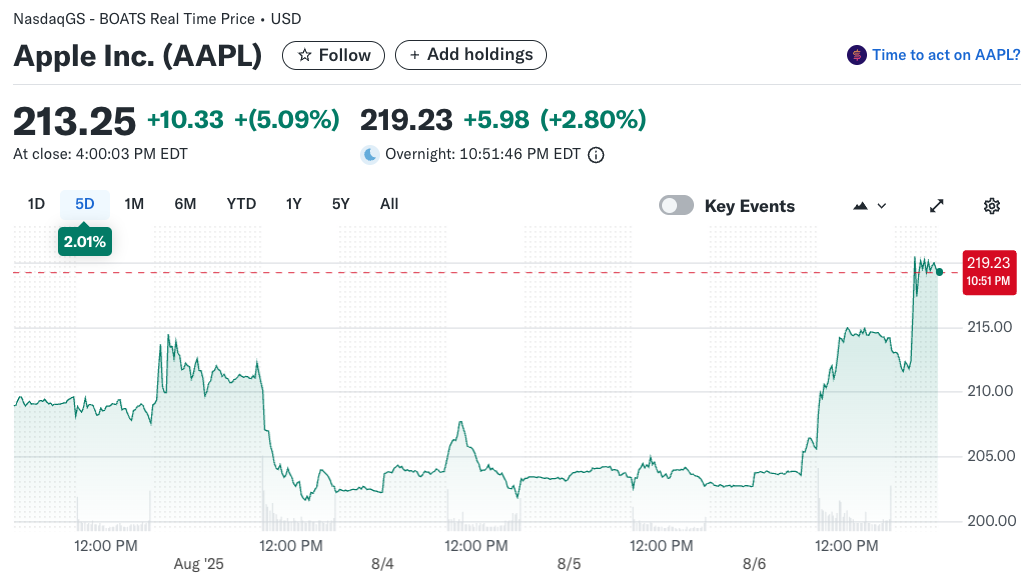
Investors responded positively: Apple shares rose 5.09% on the day and continued gaining in after-hours trading.
Cost, Capacity, and Supply Chain Realities
While the initiative supports domestic jobs and earns regulatory goodwill, analysts caution that reshoring production will increase operating costs. Labor, energy, and environmental compliance are all more expensive in the U.S. than in Asia. Apple estimates the new investment will create around 1,000 jobs annually, along with expansions to its Houston server facility and a supplier training center in Michigan.
The announcement also comes as Trump intensifies pressure on India, one of Apple’s key assembly hubs. A new executive order will impose a combined 50% tariff on Indian imports. Vietnam, another crucial production center for Apple, is already facing a 20% tariff.
Despite its investment pledges, most iPhones sold in the U.S. are still assembled in India, while Apple Watches, iPads, and MacBooks primarily come from Vietnam. Economists have questioned whether the job creation and capital deployment promised in such announcements will ultimately match their headlines.
Strategic Shift or Political Optics?
Since Trump won the 2024 presidential election, high-profile CEOs, including Tim Cook, have made frequent visits to the White House and Mar-a-Lago, often accompanied by billion-dollar investment commitments. However, many of these projects were reportedly in planning stages before the election, raising questions about whether they reflect real strategic change or political choreography.
Still, the scale and timing of Apple’s latest announcement suggest a deliberate effort to navigate an evolving trade and political environment.
Ultimately, Apple’s $100 billion expansion represents a pragmatic response to shifting trade winds—not a complete overhaul of its global manufacturing model. While it strengthens Apple’s domestic footprint and offers protection from new tariffs, it stops short of fulfilling the Trump administration’s broader aim: assembling iPhones entirely in the United States.
As Cook noted during Apple’s latest earnings call, “We’re committed to doby billion-dollar investment commitments. However, many of these projects were reportedly in planning stages before the election, raising questions about whether they reflect real strategic change or political choreography.
Still, the scale and timing of Apple’s latest announcement suggest a deliberate effort to navigate an evolving trade and political environment.
Ultimately, Apple’s $100 billion expansion represents a pragmatic response to shifting trade winds—not a complete overhaul of its global manufacturing model. While it strengthens Apple’s domestic footprint and offers protection from new tariffs, it stops short of fulfilling the Trump administration’s broader aim: assembling iPhones entirely in the United States.
As Cook noted during Apple’s latest earnings call, “We’re committed to doing more in the U.S.” For now, Apple appears to be balancing political pressure with global supply chain realities—one calculated move at a time.
#Market Spotlight: The Stories Driving Today’s Trading#$Apple Inc.(AAPL)