
Is GPT-5 Finally Here? What OpenAI’s Big Tease Means for AI’s Future

Shearing sheep
August 7, 2025
GoGPT Summarizes Articles
OpenAI might be ready to unveil GPT‑5.
In a cryptic but deliberate move, OpenAI announced a livestream scheduled for Thursday 10AM PT (Friday 1AM SG time), stylizing the word "LIVESTREAM" as "LIVE5TREAM"—with the "S" swapped for a "5". The message is clear: this could be the long-awaited unveiling of GPT-5.
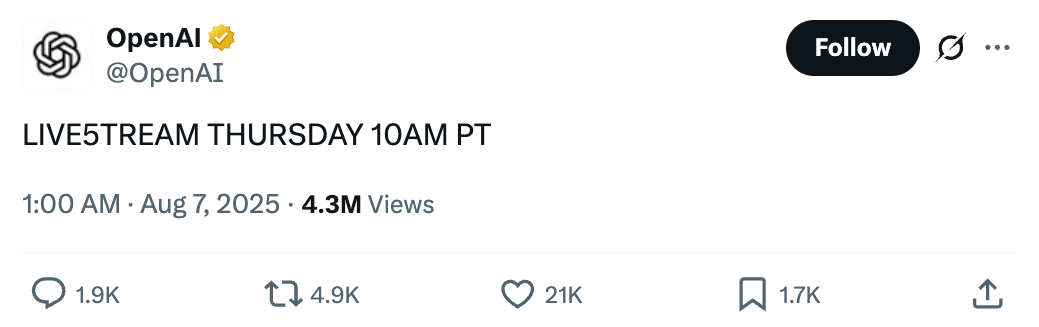
The event will be streamed on OpenAI's official website and YouTube.
This isn’t just internet speculation. OpenAI CEO Sam Altman has dropped several hints in recent months, including a screenshot showing “ChatGPT 5” in the UI.
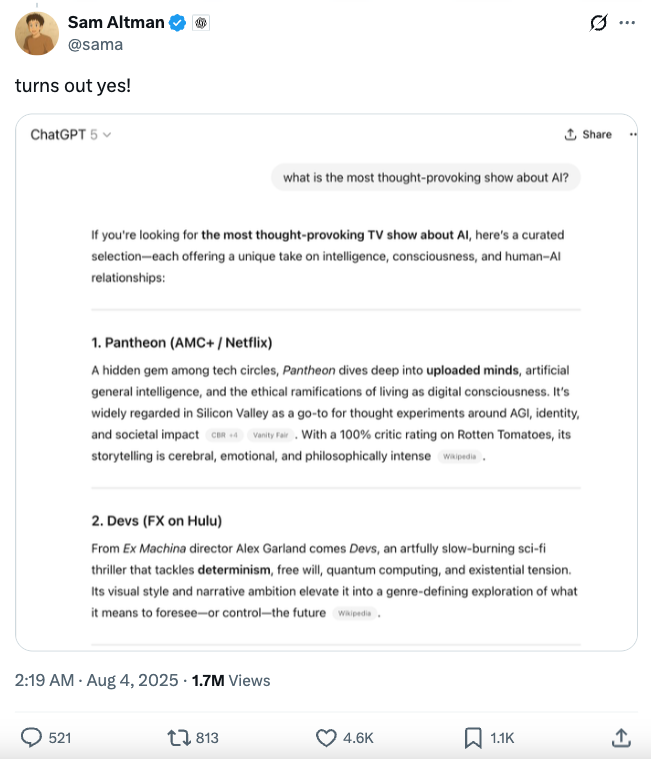
His team has also expressed excitement about the public’s response—further hinting that a new model is finally arriving.

Altman previously described GPT‑5 as “a system integrating many of our techniques,” combining GPT foundations with o‑series reasoning, rather than being a standalone model. The idea is to simplify OpenAI’s model lineup, making it more cohesive—and potentially more powerful.
Three Versions, One Ecosystem
According to early reports, GPT-5 will come in three versions:
-
Standard GPT-5 – the flagship model powering ChatGPT and API services.
-
GPT-5 Mini – a faster, more cost-effective version with solid performance for real-time applications.
-
GPT-5 Nano – designed for edge devices and embedded systems, enabling local inference.
This tiered structure looks like an attempt to cover all bases—from cloud AI tasks to on-device applications—while balancing performance and efficiency. Some have speculated that recent models seen on platforms like OpenRouter (e.g., Horizon Alpha and Horizon Beta) were early testbeds for these variants.
Meanwhile, earlier this week, OpenAI released gpt‑oss‑120b and gpt‑oss‑20b, its first open‑weight language models since GPT‑2. Offered under an Apache 2.0 license, these models enable developers to download, run, customize, and deploy them on local hardware—including consumer laptops—without API constraints.
-
gpt‑oss‑120b (~117 billion parameters) matches or exceeds the reasoning ability of OpenAI’s o4‑mini model and runs on a single high-end GPU.
-
gpt‑oss‑20b (~21 billion parameters) delivers o3‑mini–level performance and can run on devices with just 16 GB memory, including some Macs.
These models support chain‑of‑thought reasoning, tool use (like web search or code execution), and are built with safety in mind—they passed OpenAI’s preparedness benchmarks, including adversarial fine‑tuning tests.
In short, OpenAI is betting on dual strategies:
-
Open‑weight democratization with gpt‑oss models—ideal for developers who want complete control and transparency.
-
Flagship innovation with GPT‑5 (if confirmed), perhaps focusing on integrated reasoning, multi‑modal capabilities, and streamlined model selection in APIs.
More Commercial Than Revolutionary?
While the buzz is real, expectations around technological breakthroughs are more tempered. Previous internal efforts, such as the so-called “Orion” model, reportedly fell short and were repackaged as GPT-4.5. GPT-5 may not bring the same leap in capabilities that GPT-4 delivered last year. Instead, the focus seems to have shifted toward commercial viability and applied utility.
Key upgrades may include stronger coding and math performance, and the rumored introduction of a “universal verifier”—a reinforcement learning system designed to auto-check and validate responses. This speaks directly to user concerns about factual accuracy and reliability in complex tasks.
Bigger Picture: An Evolving AI Arms Race
It’s not just OpenAI in the game. Google’s Genie 3 now allows for real-time generation of dynamic worlds at 24 FPS. Kimi launched its stronger K2 model for code-heavy tasks, and Zhipu’s GLM-4.5 is positioning itself in reasoning and agent performance.
In this landscape, GPT-5 isn’t just about keeping users excited—it’s about staying ahead. Despite strong metrics—500 million paid users and annualized revenue reportedly hitting $12 billion—OpenAI still lags behind Google in sheer user scale. For example, Google’s AI Overviews commands 2 billion monthly users.
Analysts from CITIC Securities believe that next-generation models like GPT‑5 could drive a new phase of AI adoption, thanks to improvements in reasoning, cost-efficiency, and real-world applicability. If accurate, that could open doors for real-world adoption in fields like healthcare, law, and enterprise productivity.
Final Thoughts
GPT-5’s release, if confirmed, won’t just be a product launch—it’ll be a strategic statement. Whether it truly advances the frontier of AI, or simply consolidates and commercializes what already works, depends on how the new versions perform in the wild.
With OpenAI opening up both ends of the stack—GPT‑oss for developers and possibly GPT‑5 for enterprise—this week could mark a turning point for how AI is built, accessed, and applied across industries.