
Deutsche Bank Report: Meta's AI has started to make a profit?

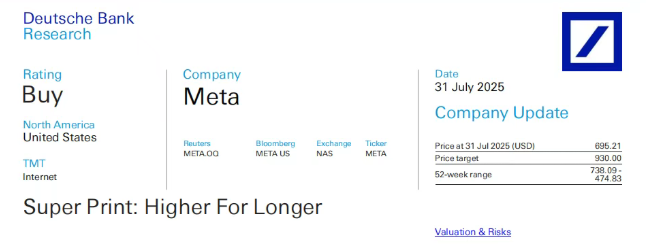
On July 31, 2025, Deutsche Bank released a report, analyzing Meta’s Q2 2025 earnings and future outlook.
The core conclusion is that Meta not only significantly exceeded revenue expectations but also saw its AI investments begin to benefit advertisers, widening and deepening the commercial moat of its ad platform.
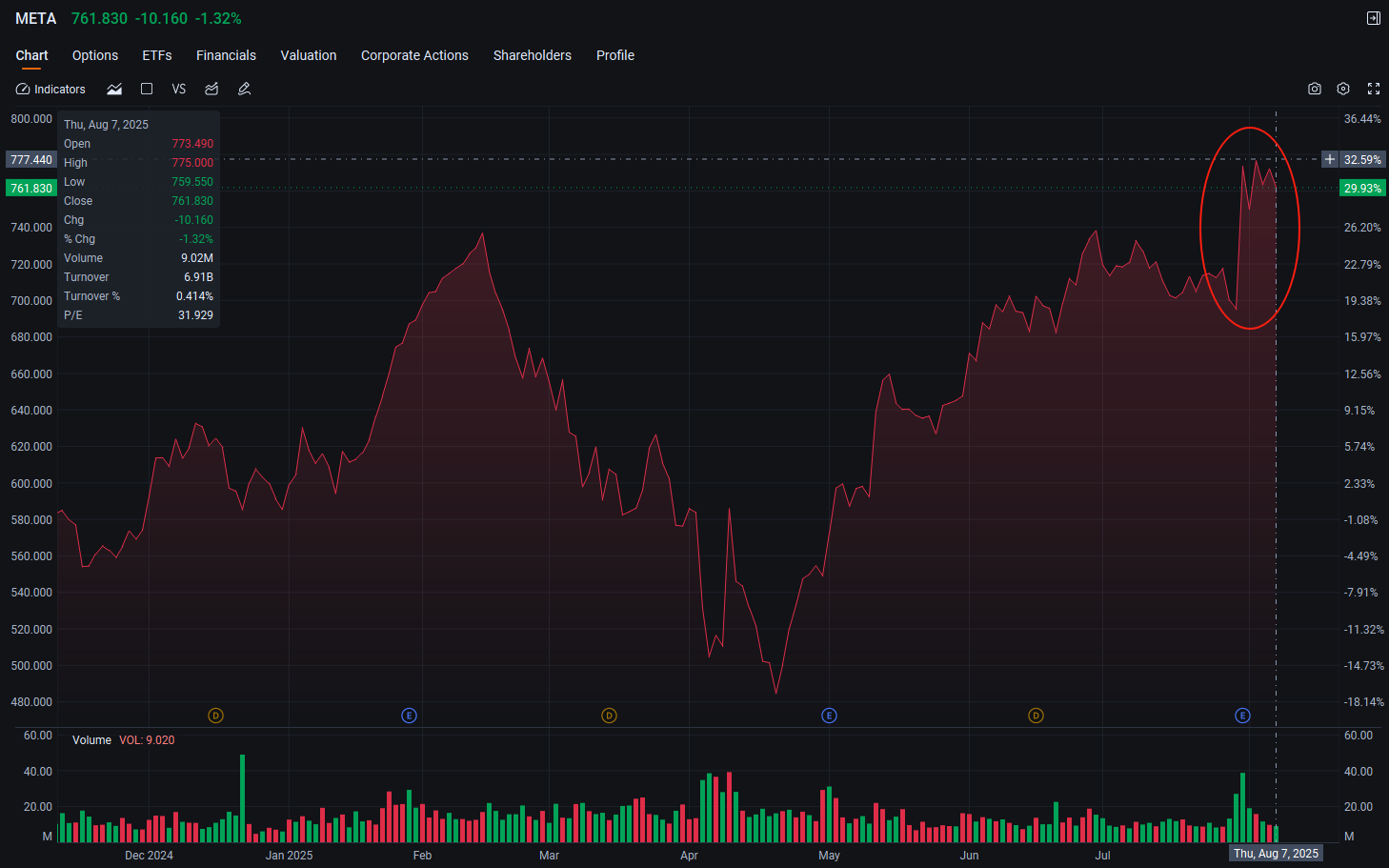
This quarter, Meta delivered an “exceptional” performance, explaining why its stock continues to climb despite already high levels.
I. Financial Data Far Exceeds Market Expectations
In Q2, Meta achieved total revenue of $47.5 billion, up 22% year-over-year, surpassing Wall Street expectations by 6%.
Advertising revenue reached $46.6 billion, up 21%, driven by strong growth in online e-commerce, professional services, and tech sector ad spending, particularly in Europe and regions outside North America.
Earnings per share were $7.14, exceeding market forecasts by 21%. Net profit hit $18.3 billion, with a profit margin of 38.6% and an operating margin of 43%, an improvement of 5 percentage points from the previous year.
Notably, despite increased AI investment, the company maintained such robust profitability, indicating tangible returns from AI spending.
II. AI Investment Pays Off: Stronger Ad Performance
Meta’s earnings call repeatedly highlighted the strategic value of generative AI:
- AI recommendation algorithms increased user time on Instagram and Facebook by 6% and 5%, respectively.
- AI-driven ad recommendation systems boosted Instagram ad conversion rates by about 5% and Facebook by about 3%.
- AI toolsets (e.g., Advantage+ auto-creative and image generation) are being rolled out widely, reducing advertiser costs, improving ROAS (return on ad spend), and driving budget increases.
- Business Messaging is testing AI Agents, allowing customers to interact directly with AI in ads, further enhancing conversion efficiency.
- The Meta AI standalone app has launched in 200 countries, reaching over 1 billion users, boosting engagement, discovery, and ad experiences.

In essence, AI is not just improving efficiency but serving as a growth lever for ad monetization.
III. Reality Labs Still Burning Cash, But Wearables Show Promise
This quarter, Reality Labs generated $370 million in revenue, up 5% year-over-year, though it fell short of market expectations.
While losses widened (exceeding $4.5 billion), demand for Ray-Ban smart glasses exceeded forecasts, positioning it as a bet on the future “computing platform.”
Zuckerberg emphasized that the integration of AI with hardware is a key strategy, with smart glasses potentially serving as the “entry point for AI in daily life.”
IV. Capital Expenditure Outlook Adjusted, Market Reaction Positive
Although Meta raised the lower end of its 2025 full-year operating expenditure ($114–118 billion) and capital expenditure ($66–72 billion) guidance, it did not trigger a “shock,” alleviating investor fears of uncontrolled AI spending.
Additionally, the company provided its first preliminary 2026 outlook, with spending expected to continue rising, particularly in AI infrastructure (including data centers and staff costs). However, with the revenue certainty from AI increasing, the market is willing to tolerate higher valuations.
Deutsche Bank raised its Meta price target from $770 to $930, based on a 2027 EPS of $36.53 and a 27x P/E multiple.
Final Takeaway from Deutsche Bank’s Report
Meta’s earnings confirm a fact: AI is not a costly future fantasy but a “performance booster” for its ad business right now.
Zuckerberg’s bet is that Meta can achieve AI integration across ads, hardware, and platforms simultaneously. The earnings suggest this bet is paying off—for now.
For investors, the question is whether the current valuation has fully priced in all AI benefits or if there’s room for further upside.