
APAC Market Wrap - 8 Aug

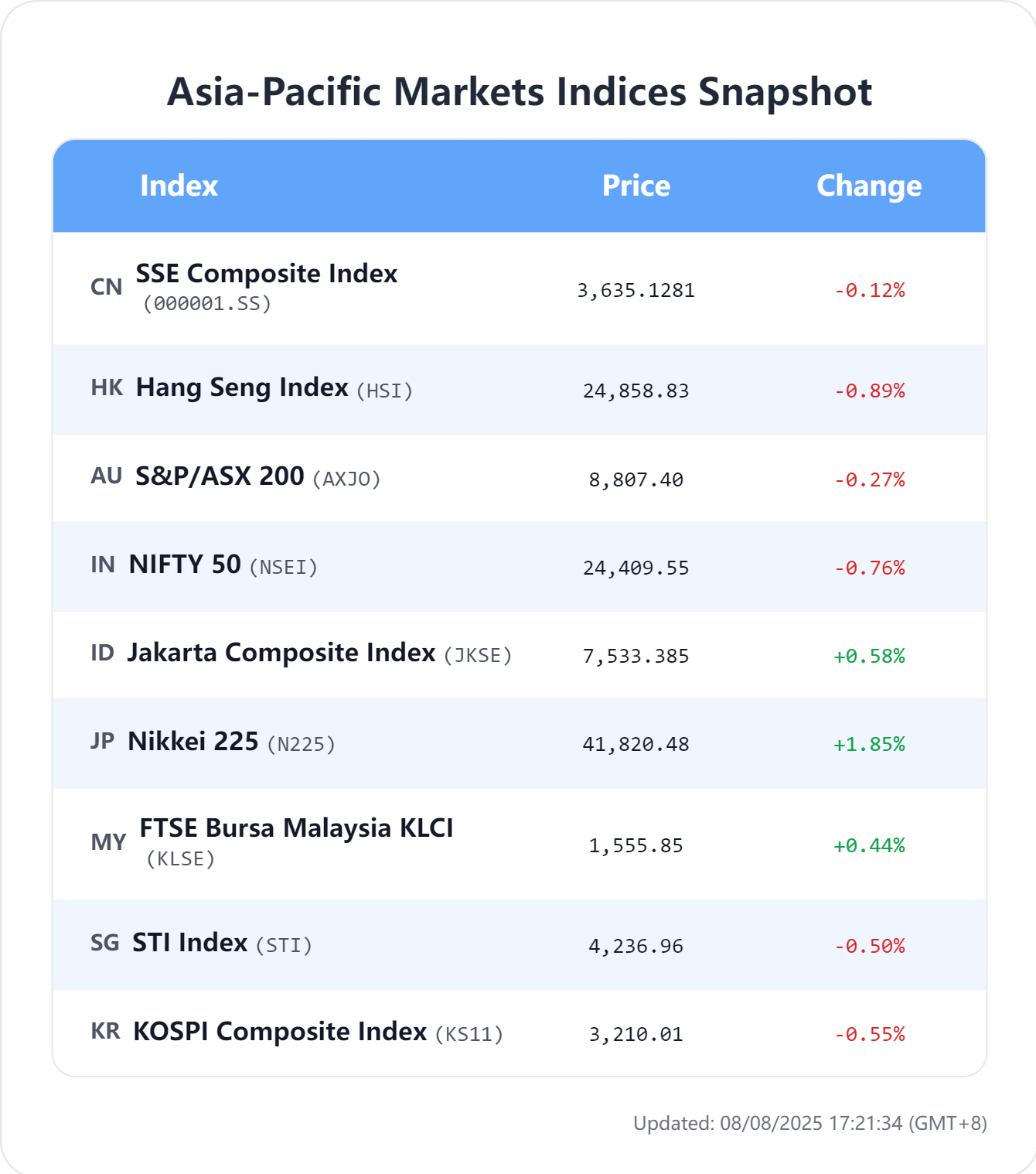
China: By the close, the Shanghai Composite fell 0.12%, the Shenzhen Component Index dropped 0.26%, and the ChiNext Index declined 0.38%.
Sector-wise, Xinjiang, high-speed rail, super hydropower, and power sectors led the gains, while multimodal AI, Huawei Ascend, semiconductors, and e-commerce sectors saw the largest declines.
Hong Kong: All major indices fell, with the Hang Seng Index down 0.89%, the Tech Index dropping 1.56%, and the State-Owned Enterprises Index declining 0.96%.
Sector performance showed tech stocks under pressure, with most semiconductor stocks falling, while non-ferrous metal stocks shone. Casino and gaming stocks weakened, gold stocks rose, and construction cement stocks bucked the trend with gains.
Japan Stock Market: The Nikkei 225 rose for the fourth consecutive trading day by 1.85%, closing at 41,820.48 yen, up 761.33 yen (with a trading volume of approximately 2.73 billion shares).
By sector, 29 industries including rubber products, precision machinery, other products, and transportation equipment saw gains, while textiles, pharmaceuticals, non-ferrous metals, and insurance were among the four declining sectors.
South Korea Stock Market: The KOSPI Index fell 0.55%, or 17.67 points. By sector, tobacco, broadcasting and entertainment, electronic equipment, and internet led the gains, while aerospace and defense, electric utilities, non-metallic minerals, and gaming entertainment lagged.
Australia Stock Market: The S&P/ASX 200 (XJO) declined 0.28%, closing at 8,807.100 points. Sector-wise, diversified financials, furniture and tools, and packaging and containers saw significant gains, while insurance and aerospace, healthcare services, and travel and leisure experienced slight declines.
Singapore Stock Market: The Straits Times Index fell 0.49%, closing at 4,237.10 points. By sector, diversified media, oil and gas, and waste management saw modest gains, while forestry products, conglomerates, and education posted larger declines.
Malaysia Stock Market: The FTSE Malaysia KLCI rose 0.51%, closing at 1,556.98 points. Plantation, construction, and communications and media sectors saw slight gains, while consumer goods and services, real estate, and technology sectors declined.
Key Events
UN FAO: Global Food Prices Hit Over Two-Year High in July
The United Nations Food and Agriculture Organization (FAO) reported on Friday that global food commodity prices rose to their highest level in over two years, driven by increases in international meat and vegetable oil prices.
The FAO Food Price Index, a global food price benchmark, averaged 130.1 points in July 2025, up 1.6% from June.
This marks the highest level since February 2023, though it remains 18.8% below the peak in March 2022 following the Russia-Ukraine conflict.
Yen Weakness Prompts Japanese Investors to Sell Overseas Stocks, Bonds Gain Favor in July
Japanese investors sold overseas stocks for the third consecutive month in July, opting to take profits amid soaring valuations, while a weakening yen boosted returns, driving significant inflows into high-yield overseas bonds.
Japan’s Ministry of Finance reported on Friday that Japanese investors net withdrew approximately 536.4 billion yen (about $3.64 billion) from overseas equities in July, following a 1.99 trillion yen sell-off in June.
Tata Consultancy’s Layoffs Signal AI Reshaping $283B Outsourcing Industry
Experts say the decision by Indian outsourcing giant Tata Consultancy Services (TCS) to lay off over 12,000 employees marks the start of a broader AI-driven trend. Over the next two to three years, this $283 billion industry could see approximately 500,000 jobs cut.
Short-Selling Balance in South Korea Stocks Exceeds 10 Trillion KRW Again
Data released on Friday showed that the value of short-sold South Korean stocks exceeded 10 trillion KRW (about $7.2 billion), raising concerns among experts about potential downward pressure on the Korean stock market.
According to the latest Korea Exchange statistics, the balance of borrowed stocks for short-selling reached 10.07 trillion KRW as of Tuesday (August 5).
Institutional Views
JPMorgan: Raises Fed Rate Cut Expectation to Three from One in 2025
JPMorgan stated in a Thursday report that it now expects the Federal Reserve to cut rates three times by 25 basis points each starting in September 2025, up from a previous prediction of one cut in December.
Due to signs of a slowing labor market and broader economy, JPMorgan now anticipates four 25-basis-point cuts over the next four meetings, bringing the policy rate to 3.5%.
Following U.S. President Trump’s nomination of economist Milan to replace Fed Governor Kugler, JPMorgan hinted at potential leadership changes, suggesting Milan’s appointment could pave the way for deeper institutional reforms.
ING: Raises 2025 Gold Price Forecast to $3,250/oz
ING U.S. economists now predict three Fed rate cuts for the remainder of 2025 and two more in early 2026, amid growing concerns over Fed independence, boosting gold’s safe-haven appeal. With strong buying from global central banks and ETFs, ING raised its 2025 average gold price forecast from $3,128/oz to $3,250/oz.
Commerzbank: BoE Likely to Remain Cautious
Commerzbank noted that with persistent inflation and divided opinions among rate-setters, the Bank of England (BoE) is likely to stay cautious. UK inflation remains elevated, potentially rising to 4% with increasing food prices, leading Commerzbank to believe the BoE will only continue to lower key rates at its next meeting.
MUFG: Trade Uncertainty Remains a Headwind for USD
MUFG stated that with Trump’s comprehensive tariffs taking effect on Thursday, U.S. trade uncertainty is set to rise further, posing a headwind for the dollar. Trump may exceed investor-expected tariff levels to generate needed revenue without excessive economic damage.
As trade uncertainty’s impact on the job market could be significant, investor sentiment may weaken, affecting the dollar and U.S. stocks.
JPMorgan Private Bank: Global Equities Remain an Option
JPMorgan Private Bank strategist Julia Wang said global equities remain a viable opportunity. They are raising year-end and 12-month S&P 500 targets, supported by strong earnings and improved valuations amid reduced macro tail risks.
They continue to recommend global diversification, favoring large caps over small caps, and focus on sectors benefiting from long-term growth trends and robust profits. Technology and finance remain preferred sectors. The base case S&P 500 target is 6,350-6,450 points by year-end and 6,650-6,750 points over the next 12 months.
TD Securities: Market Skeptical of U.S. Tariff Threats, Eyes Economic Data
TD Securities strategists noted in a report that market skepticism toward some U.S. tariff threats has shifted focus away from tariff announcements. The U.S. has announced a 50% tariff on India, 39% on Switzerland, 35% on certain Canadian imports, and tariffs on other trading partners.