
CPI Preview: A Chance to Ease U.S. Stock High Valuations?


Today, the entire market’s attention is fixed on the upcoming U.S. CPI (Consumer Price Index) data release.
It carries an extraordinary weight, serving as a critical gauge for U.S. consumer vitality, economic health, the real impact of Trump’s tariff policies on prices, and—most importantly—the Federal Reserve’s decision on whether to cut rates, especially after disappointing employment data.
CPI, Consumption, and Tariffs
To grasp CPI’s significance, we need to break down its driving factors, particularly the complex interplay between consumption, inflation, and tariffs.
First, consumption is the core driver of inflation. Bank of America’s CEO has emphasized that consumption growth is the primary engine of nominal GDP growth. Currently, the U.S. nominal GDP growth of about 4.5-5% is a combination of “real consumption growth (real GDP)” and “inflation.”
This shows that the strength of consumption directly affects inflation levels, explaining why markets are so focused on consumption data. Over the past four years, inflation has been a major headache for Americans, driven by a tangled mix of economic overheating, excess money supply, and tariffs with trade barriers.
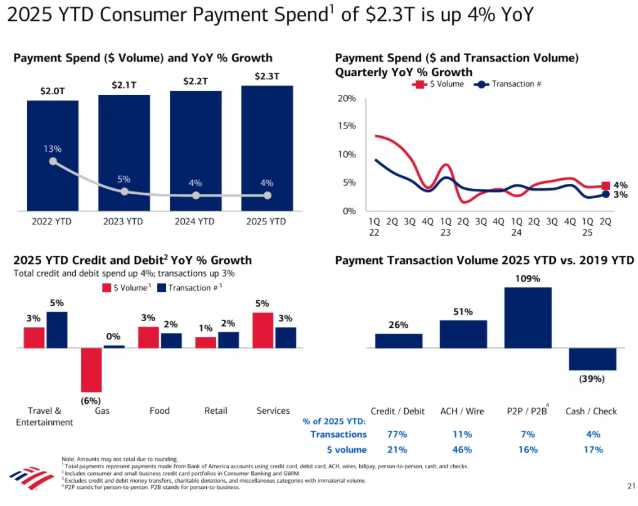
BoA 25Q2: Stable Consumption Growth
On the other hand, tariffs impact consumption and inflation in a dual and multi-layered way.
Economist Lacy Hunt has argued that the direct (first-order) effect of tariffs is to raise prices and fuel inflation. However, their second- and third-order effects could be deflationary, as tariffs suppress aggregate demand and ultimately weaken purchasing power.
The influence of tariffs is significant—Hunt notes that while U.S. corporate taxes totaled over $500 billion in 2024, the annualized tariff burden has reached $350 billion.
Currently, the full impact of tariffs hasn’t fully materialized. A J.P. Morgan report highlights that tariffs are gradually hitting industries reliant on imports (e.g., furniture, toys, and apparel), potentially driving up consumer prices further while eroding real purchasing power.
This dual pressure of rising costs and declining demand is weakening the fundamentals of some industry companies, impacting stock markets.
Shift: From Broad Increases to Targeted Strikes
In April, market feedback on the “all-out war” tariff policy strategy, which triggered massive trade friction, prompted a shift in Trump’s tariff approach (Taco). The U.S. has reached agreements with most major trading partners, ending the broad tariff war.
However, tariffs haven’t been abandoned; they’ve evolved into a “scalpel,” targeting specific sectors:
Semiconductor Industry: Citing national security, the Trump administration, under Section 232 of the 1962 Trade Expansion Act, is investigating imports of semiconductors and related equipment, planning high tariffs on foreign chips not manufactured in the U.S. On August 12, 2025, Trump announced a 100% tariff on imported semiconductors, effective as early as this month, though companies with U.S. plants (e.g., TSMC, Samsung, SK Hynix) are exempt.
Pharmaceutical Industry: Also citing national security, the administration is investigating imported drugs and active pharmaceutical ingredients (APIs) under Section 232, planning tariffs to bring pharma production back to the U.S. Trump stated initial tariffs will be “modest,” but could rise to 150% or even 250% within one to one-and-a-half years.
How Tonight’s CPI Will Impact
Now, let’s look at CPI’s influence on secondary markets:
A CPI exceeding expectations could trigger a market adjustment, offering a golden opportunity to release U.S. stocks’ current high valuations (and markets might be waiting for just such a dip).
If CPI reflects a mild tariff impact, it could boost August rate-cut expectations, making small-cap stocks, real estate stocks, and momentum leaders potential targets.
Finally, here’s a J.P. Morgan view on CPI:
- 5% probability: Core monthly CPI above 0.40%, S&P -2% to -2.75%;
- 25% probability: Core monthly CPI at 0.35%-0.40%, S&P -0.75% to -0.25%;
- 35% probability: Core monthly CPI at 0.30%-0.35%, S&P 0 to 0.75%;
- 30% probability: Core monthly CPI at 0.25%-0.30% (inflation easing), S&P 0.75% to 1.2%;
- 5% probability: Core monthly CPI below 0.25%, S&P 1.5% to 2%.