
Hong Kong Brokers Are Rushing to U.S. IPOs!

According to media reports, three Hong Kong brokers are planning to go public in the U.S. via IPOs.
On July 18, Beta Financial from Hong Kong publicly disclosed its prospectus with the U.S. SEC, aiming to list on Nasdaq with the ticker BTFT. In fact, it had secretly filed with the SEC on December 13 last year, with the prospectus going public in early June this year.
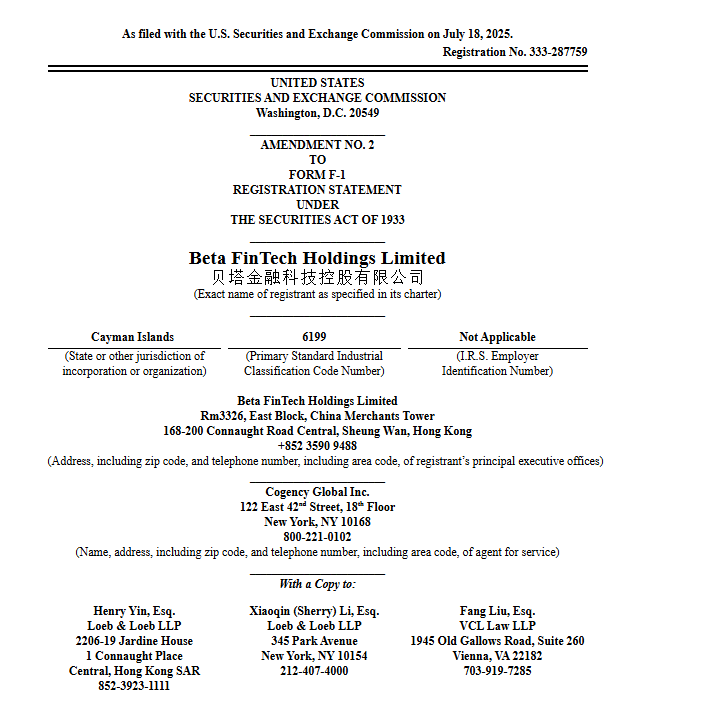
On August 4, Hong Kong-based broker Winbo Capital disclosed its prospectus with the SEC, also targeting a Nasdaq IPO with the ticker RNBW. Winbo had secretly filed on December 16 last year—three days after Beta Financial—and publicly disclosed its prospectus on February 14 this year.
On August 5, Hong Kong’s Sibo Holdings disclosed its prospectus with the SEC, planning a Nasdaq IPO with the ticker SIBO. Slightly later than the others, Sibo filed secretly on March 25 this year.
A comparison reveals that all three are brokers, hail from Hong Kong, and have chosen Nasdaq for their IPOs.
Hong Kong Brokers Making a Full Comeback
The collective “overseas push” by these three Hong Kong brokers is a rare occurrence, largely thanks to the Hong Kong IPO market rebounding from a low point to a boiling point.
Data shows that in the first half of 2025, the Hong Kong Stock Exchange launched 44 new listings, raising 107.1 billion HKD, a staggering 701% year-over-year increase.
This amount is 1.5 times the combined total of Nasdaq and NYSE during the same period.
With 107.1 billion HKD in fundraising, the Hong Kong Stock Exchange stands tall globally, leaving Nasdaq and NYSE with no room to argue— the gap is just too wide.
Among these, CATL, Hengrui Medicine, and Haitian Flavouring together raised 71.8 billion HKD, accounting for 67% of the total new IPO funds.

As of early August, about 200 companies are still queuing at the Hong Kong Stock Exchange, with strong future demand.
Rising tides lift all boats, and correspondingly, the brokerage and investment banking businesses of Hong Kong brokers have seen a boom, sprouting like “mushrooms after rain.”
According to the Hong Kong Securities and Futures Commission, as of the end of July 2025, the average daily turnover of Hong Kong stocks reached 262.9 billion HKD, up 167% from last year. For the first seven months of 2025, the average daily turnover was 243.7 billion HKD, a 124% increase year-over-year.
Even excluding the surge in July, the average daily turnover in the first half of 2025 hit 240.2 billion HKD, up 118% from the same period in 2010, setting a new high since then.

However, the industry’s Matthew effect remains evident, with the top 20 brokers still dominating underwriting and sponsorship revenue, while smaller brokers rely on price wars to secure projects.
Additionally, the Hong Kong SFC raised the minimum capital adequacy ratio from 1 million HKD to 3 million HKD in 2024, requiring compliance by 2026.
With the average net assets of small brokers below 100 million HKD, the urgent need for capital increases has made IPO financing their fastest “blood transfusion” channel, significantly boosting the overall momentum of Hong Kong brokers.
Why Skip Hong Kong Stocks for Nasdaq?
The Hong Kong market is currently on an uptrend.
One might wonder: with Hong Kong IPOs so hot, why would these local brokers opt for the far-off Nasdaq?
The answer is simple. As commercial entities, their top priority when pursuing an IPO is valuation.
It boils down to this: they’ll list where the valuation is highest. In this regard, the U.S. market, with its longer development history, is willing to offer a “story premium,” especially Nasdaq.
Brokerage is a business, and the “highest bidder wins” applies to IPO destination choices too.
Take Beta Financial as an example. Its prospectus shows a 2024 net profit of $340,000. If listed on the Hong Kong main board with a 10-12x PE ratio, its market cap would be just $3-4 million.
On Nasdaq, however, comparable firms like Up Fintech and Interactive Brokers trade at 28-35x PE, potentially valuing Beta Financial at $100 million—a nearly 30-fold difference.
Next, since they’re going public, these IPO candidates must consider future stock liquidity.
Hong Kong’s retail investors tend to focus on IPO subscriptions, while U.S. institutions lean toward long-term holding.
Data shows that 90% of Hong Kong’s small- and mid-cap brokers have daily turnover below 0.3% post-listing, lacking sustained liquidity. In contrast, Nasdaq hosts six small-cap broker ETFs with a total scale of $18 billion, offering a stable buyer base.
A Few Final Words
From the data, Hong Kong brokers’ overall profitability has returned to 2018 highs since 2024, but the big profits still go to the top players.
If small brokers fail to expand capital during this window, they’re likely to be acquired or phased out in the next 3-5 years.
Going public in the U.S. not only brings in dollar funding but also enhances brand value, liquidity, and merger chips. Market trends suggest Beta Financial, Winbo Capital, and Sibo Holdings may just be the first wave. Estimates indicate at least five more Hong Kong brokers are preparing SEC filings.