
AI Lending, Valued at Nearly $350 Million

There was once a saying in the venture capital world: the pinnacle of VC/PE is lending.

The logic behind this is straightforward: every industry needs financial support, and loans are the most direct, transparently priced financial tool.
At the same time, lending remains one of the most labor-intensive, outdated, and fragmented areas of financial services, with most institutions still relying on isolated systems, labor-heavy processes, and passive compliance methods.
Thus, top-tier VC/PE firms never shy away from lending.
It’s a way for PE to actively adapt to market shifts, especially as LPs pivot toward “reducing equity assets and increasing debt assets” in an economically unstable environment. Surprisingly, this adage still holds true in the AI era.
Recently, Salient, an AI Agent company focused on consumer lending, announced it raised $60 million in a funding round led by A16z, with existing investors Matrix Partners, Michael Ovitz, and Y Combinator participating. Post-money valuation reached $350 million.
A New Solution to an Old Problem
Salient’s story began in early 2023.
At that time, ChatGPT had just ignited global entrepreneurial enthusiasm, with many still reveling in the tech hype, making AI applications or AI Agents less of a priority.

From left to right are Malik and Tibrewala.
Founded by Ari Malik and Mukund Tibrewala—high school friends from Singapore with over a decade of friendship and a shared dream to start a company—Salient brought unique expertise.
Malik holds a bachelor’s in computer science and philosophy from Columbia University, with a career spanning finance, strategy, and investment, including roles at DST Global, Tesla (as head of finance, strategy, and operations), Temasek, and Goldman Sachs.
Tibrewala, with a simpler tech-focused background, developed three iOS and Mac apps by age 16 (one becoming Mongolia’s top education app) and later worked as a software engineer at Airtable after studying at Carnegie Mellon University.
Their entrepreneurial idea stemmed from a discovery Malik made at Tesla: existing loan services were expensive and outdated.
In an interview, he noted that while at Tesla, they offered loans to boost new car sales, even to high-credit-score Californians, yet managing these loans incurred high costs. Digging deeper, they found much of this work could be automated with AI.

Initially, Malik and Tibrewala aimed to build an AI-powered auto-dialing project, but soon realized current tech enabled a larger vision: a fully integrated, AI-driven loan platform. This platform integrates three core products: AI agents for omnichannel interaction, a compliance monitoring suite, and a service automation engine with advanced insights and fraud detection.
In essence, it’s a smarter, safer upgrade to AI customer service—via Salient’s product, clients can handle borrower interactions (voice, text, email, chat) with AI, automate collections, repayments, and insurance updates, and monitor for potential unfairness, deception, abuse, or violations.
Reports suggest Salient’s AI customer service rivals human agents and often outperforms them, efficiently organizing calls, dialing at optimal times, and handling any language.
Looking back, Tibrewala credits Salient’s timing luck to two factors: the emergence of models like GPT 3.5 for high-quality demos, and the availability of fine-tunable open-source models that scaled Salient from 100 daily calls to hundreds of thousands.
A Ten-Person Team with Over $10 Million in Annualized Revenue
Salient’s two funding rounds seem unusual for its AI track, but its top-tier backers signal star potential.
It has made over 6,000 collection calls in five languages, boosting payment completion by 22%, reducing hang-ups by 17%, and shortening call times by 14%. In auto loans, it’s contacted over 3 million independent borrowers, driving $1 billion in collections.
Starting with auto loans, Salient now manages consumer loans like credit cards and mortgages, partnering with Westlake Financial, EXAR Finance, American Credit Acceptance, and three major U.S. listed banks.
On annualized recurring revenue (ARR), it hit $14 million this year, yielding a 25x price-to-sales (PS) ratio at its current valuation—low compared to the 50-100x PS in hot AI sectors but top-tier in financial services for a ten-person team.
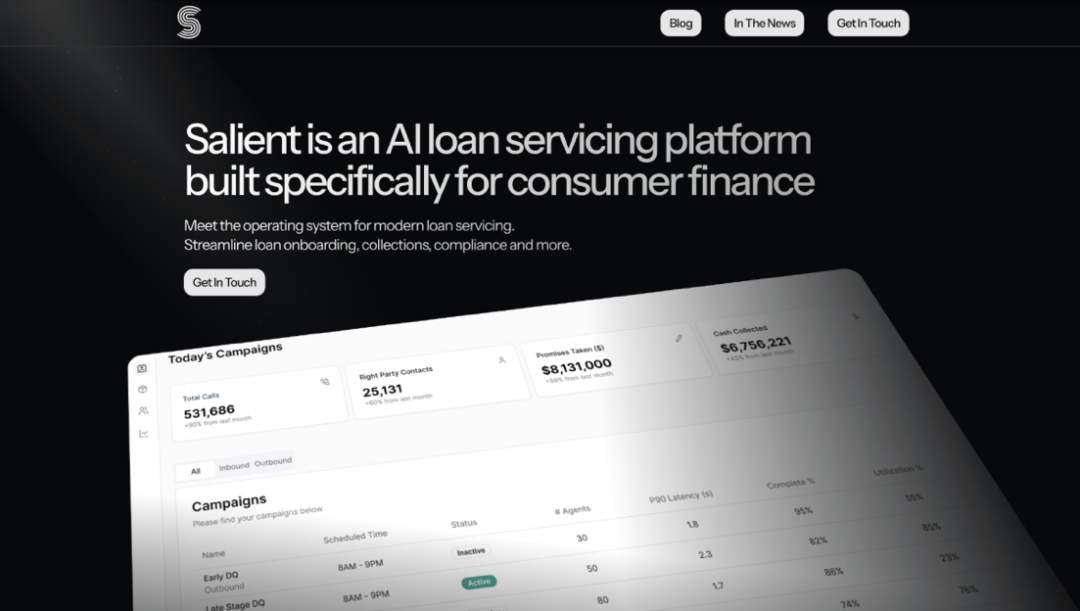
Commercially, Salient earned millions in its first year, doubling this year. Malik recalls his early days sending 500 emails daily from 8 AM to 9 PM, many unanswered, until a reply from Westlake Financial—a $25 billion auto loan giant—opened doors.
Seeing Salient’s tech potential, Westlake chose it despite other options, prompting Malik to relocate nearby. After over a year integrating with Westlake’s systems, Salient unlocked commercialization, with its ten engineers doubling as client managers and frontline deployers, liaising with CFOs and service VPs.
For the latest funding, Salient plans to expand its team, entering the “from one to hundred” phase where ten people can’t handle the market’s scale.
Salient’s bigger ambition is to become the record system for every U.S. loan, requiring future development of a CRM, accounting system, workflow automation tools, and AI call center—essentially an AI redo of popular SaaS software like CRM, RPA, and AI customer service, addressing the industry’s long-standing loan process cost burden with greater efficiency.
Final Thoughts
Last year, I noticed enterprise SaaS software gaining new life in the AI wave. Without needing to buy C-end traffic or rebuild customer bases, upgrading existing products with AI yields strong user feedback and improving revenue.
Take Figma, which recently set a U.S. stock record—a SaaS benchmark and PMF exemplar years ago, inspiring a wave of Chinese imitators. Even a standout like Figma struggled as SaaS cooled, pivoting to AI in 2023 to survive.
Indeed, “every SaaS deserves an AI makeover,” and the beneficiaries of this trend are growing.