
APAC Market Wrap - 13 Aug

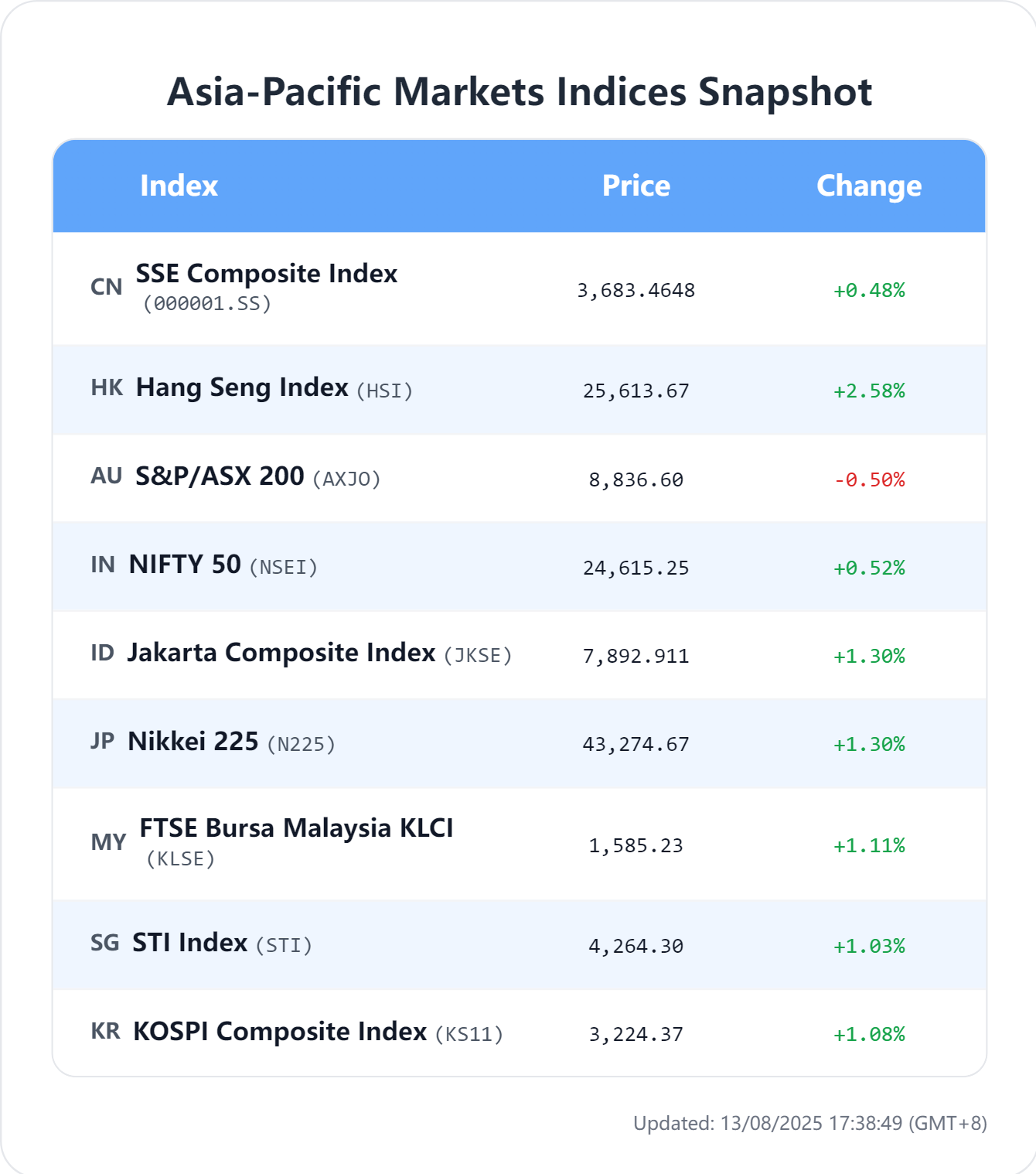
China Stock Market: The market oscillated upward throughout the day, with the Shanghai Composite breaking its October 8 high from last year to hit a near-four-year peak. At close, the Shanghai Composite rose 0.48%, the Shenzhen Component Index gained 1.76%, and the ChiNext Index surged 3.62%.
By sector, non-ferrous metals, PEEK materials, CPO, and lithography machine sectors led gains, while coal, banking, ports, and logistics sectors saw declines.
Hong Kong Stock Market: Hong Kong’s major indices opened higher and continued to climb, with the Tech Index leading with a 3.52% surge. At close, the Hang Seng Index rose 2.58%, the Hang Seng Tech Index gained 3.52%, and the State-Owned Enterprises Index increased 2.62%.
Sector-wise, tech stocks broadly rose, mobile gaming stocks rallied, biotech stocks advanced, cryptocurrency concept stocks climbed, apple pharmaceutical stocks gained across the board, and internet healthcare stocks strengthened.
Japan Stock Market: The Nikkei 225 rose sharply for the sixth consecutive trading day, up 1.30% or 556.50 yen, closing at 43,274.67 yen.
By industry, 29 sectors including other products, air transportation, non-ferrous metals, services, and machinery advanced, while mining, pulp and paper, food, and real estate were the four declining sectors.
South Korea Stock Market: The Kospi Index rose 1.08%, or 34.46 points. By sector, display panels, airlines, bioengineering, and electronics led gains, while gaming, broadcasting, home appliances, construction, and tobacco sectors saw declines.
Australia Stock Market: The S&P/ASX 200 (XJO) fell 0.60%, closing at 8,827.100 points. Sector-wise, industrial products, transportation, and biotech saw slight gains, while banking, healthcare services, and restaurants experienced minor declines.
Singapore Stock Market: The Straits Times Index rose 1.23%, closing at 4,272.76 points.
By sector, apparel, medical distribution, forestry products, and industrial goods saw slight gains, while packaging and containers, other energy, and apparel consumer goods posted larger declines.
Malaysia Stock Market: The Malaysia Index rose 1.19%, closing at 1,586.60 points. Communication and media, technology, and financial services sectors saw slight gains, while industrial products, energy, and real estate sectors declined.
Key Events
South Korea Plans National “Energy Highway” for AI Power Needs
South Korean officials announced on Wednesday plans to build a nationwide “energy highway” by the 2040s to meet the surging electricity demand from AI development and expand renewable energy use.
The “energy highway” refers to a government initiative to construct high-voltage direct current (HVDC) infrastructure, a next-generation power technology that reduces inefficiency in long-distance transmission and integrates renewable energy from diverse sources.
Thailand Central Bank Cuts Key Rate by 25 Basis Points to 1.50%
The Bank of Thailand lowered its key interest rate, marking the final monetary policy decision under outgoing Governor Sethaput Suthiwartnarueput, whose five-year term ends upon departure.
Following a rate cut in April, the Monetary Policy Committee unanimously voted to reduce the one-day repurchase rate by 25 basis points to 1.5%. Of the 23 economists surveyed by Bloomberg, 14 predicted a cut, while the rest expected no change.
Japan’s Actual Investment in $550B U.S. Fund May Exceed 2%
Japan’s chief trade negotiator, Akira Amari, said in a Wednesday interview that Japan’s actual investment in the $550 billion U.S. investment fund might exceed the initially mentioned 1-2%.
He noted on Asahi TV that Japanese investment could be withheld if the U.S. fails to honor commitments, explaining the fund— a key pillar of the July trade deal—where most of the $550 billion pledge will be loans and loan guarantees, with only 1-2% as direct investment.
Brazil Offers $5.5 Billion to Help Exporters Counter U.S. Tariffs
Brazilian President Lula announced Tuesday that the government will provide 30 billion reais (about $5.5 billion) in credit as part of a plan to support exporters affected by U.S. tariffs. In an interview with local media BandNews, Lula said this is the initial amount, with the package also including support via government procurement.
Institutional Views
BlackRock: Fed Likely to Start Rate Cuts in September, with 50 bps Possible
For weeks, investors have piled into swap contracts, options, and direct long positions in U.S. Treasuries, betting on slowing inflation allowing the Fed to lower borrowing costs in coming months.
This view gained initial validation Tuesday: post-July inflation data, short-term Treasury yields fell, and swap traders raised the September rate cut probability to 90%. BlackRock’s global fixed income CIO Rick Rieder said in a report, “Thus, we expect the Fed to begin rate cuts in September, with a reasonable case for a 50-basis-point reduction.”
Barclays: New Fed Governor Milan Could Be a Dark Horse for Chair
Barclays senior public policy analyst Michael McLean suggested that Stephen Milan, Trump’s nominee to replace Kugler, could emerge as a dark horse for the next Fed Chair.
If confirmed by the Senate, Milan could serve indefinitely post-term. Trump’s swift nomination of Milan, rather than leaving the seat vacant, signals a clear path forward.
Nomura: Fed May Deliver Three Consecutive Cuts by March Next Year: Nomura economists noted in their latest report that, following the CPI data release, the Fed may initiate a rate cut cycle in September with a 25-basis-point reduction, followed by similar cuts in December and March next year.
While the median analyst expectation for the next three months suggests a 25-basis-point cut, institutions differ on timing, with Nomura and some others seeing adjustments possibly delayed to year-end.
CITIC Securities: H-Share Performance in August Hinges on Interim Results
CITIC Securities’ report suggests that August’s H-share market trend will depend on the interim results period. Combined with the widespread and rapid impact of “anti-involution” policies, the market may shift from liquidity-driven to a resonance of performance-driven and policy-verified phases.
As focus moves from “expectations” to “delivery,” stocks with earnings beats or upward guidance revisions are likely to benefit, with “anti-involution” policy shifts becoming a core pricing variable for related sectors.