
Cisco Reports Strong Q4 2025 Earnings, Exceeding EPS Estimates Amidst Surging AI Infrastructure Orders

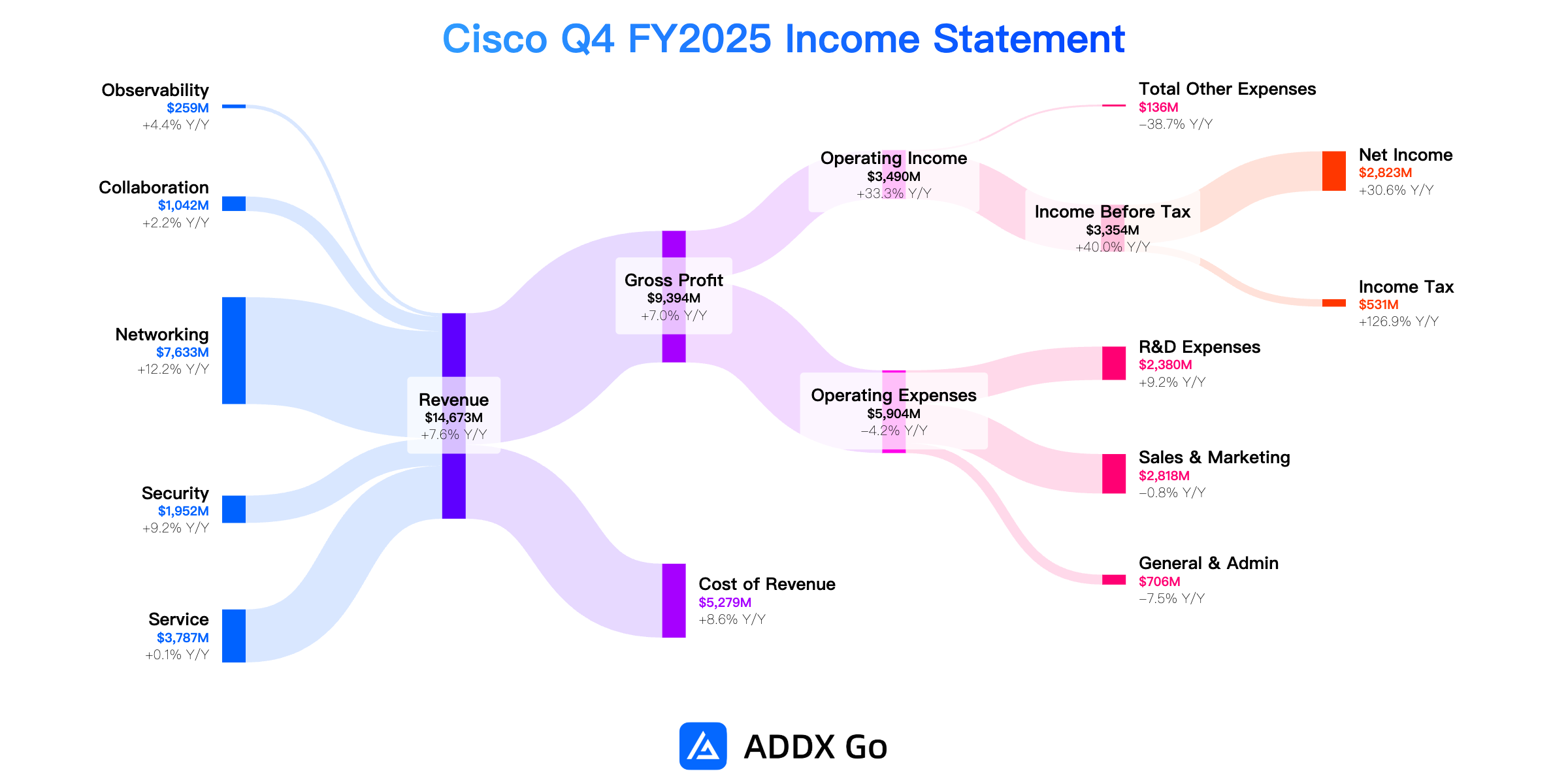
Cisco (CSCO.US) announced strong financial results for the fourth quarter and full fiscal year 2025, with Q4 revenue reaching $14.7 billion, an 8% increase year-over-year. Non-GAAP diluted earnings per share (EPS) for Q4 FY 2025 were $0.99, exceeding analyst estimates of $0.97. This strong performance marks a positive close to the fiscal year, demonstrating robust demand and efficient operations.
Key Business Drivers
The company's performance was significantly bolstered by strong product orders, which rose 7% year-over-year across all geographies, indicating robust demand for Cisco's technologies. Notably, AI Infrastructure orders from webscale customers exceeded $800 million in Q4, bringing the total for fiscal year 2025 to over $2 billion, more than doubling the original $1 billion target. Product revenue saw growth across all segments: Networking was up 12%, Security up 9%, Observability up 4%, and Collaboration up 2%.
Geographically, all segments contributed to revenue growth, with Americas up 9%, EMEA up 4%, and APJC up 7%. The company also maintained strong profitability, with a non-GAAP gross margin of 68.4%, at the high end of its guidance range. This comprehensive growth across products and regions highlights Cisco's strategic positioning and execution in key technology areas.
Management Outlook
Looking ahead, Cisco provided positive guidance for both the first quarter of fiscal year 2026 and the full fiscal year 2026. For Q1 FY 2026, the company expects revenue between $14.65 billion and $14.85 billion, with non-GAAP EPS projected to be between $0.97 and $0.99. This indicates continued confidence in demand for their offerings.
For the full fiscal year 2026, Cisco anticipates total revenue between $59.0 billion and $60.0 billion, and non-GAAP EPS in the range of $4.00 to $4.06. Management emphasized their focus on strategic investments in innovation to drive durable, profitable growth and deliver shareholder value, particularly as they lead the architectural shift and build critical infrastructure for the AI era.