
Corporate Coin Hoard Sparks Crypto Boom, BTC Hit New Highs

Bitcoin has once again hit a new high, with investors pouring unprecedented enthusiasm into these two major cryptocurrencies, and recent capital flows showing a tilt toward the latter.
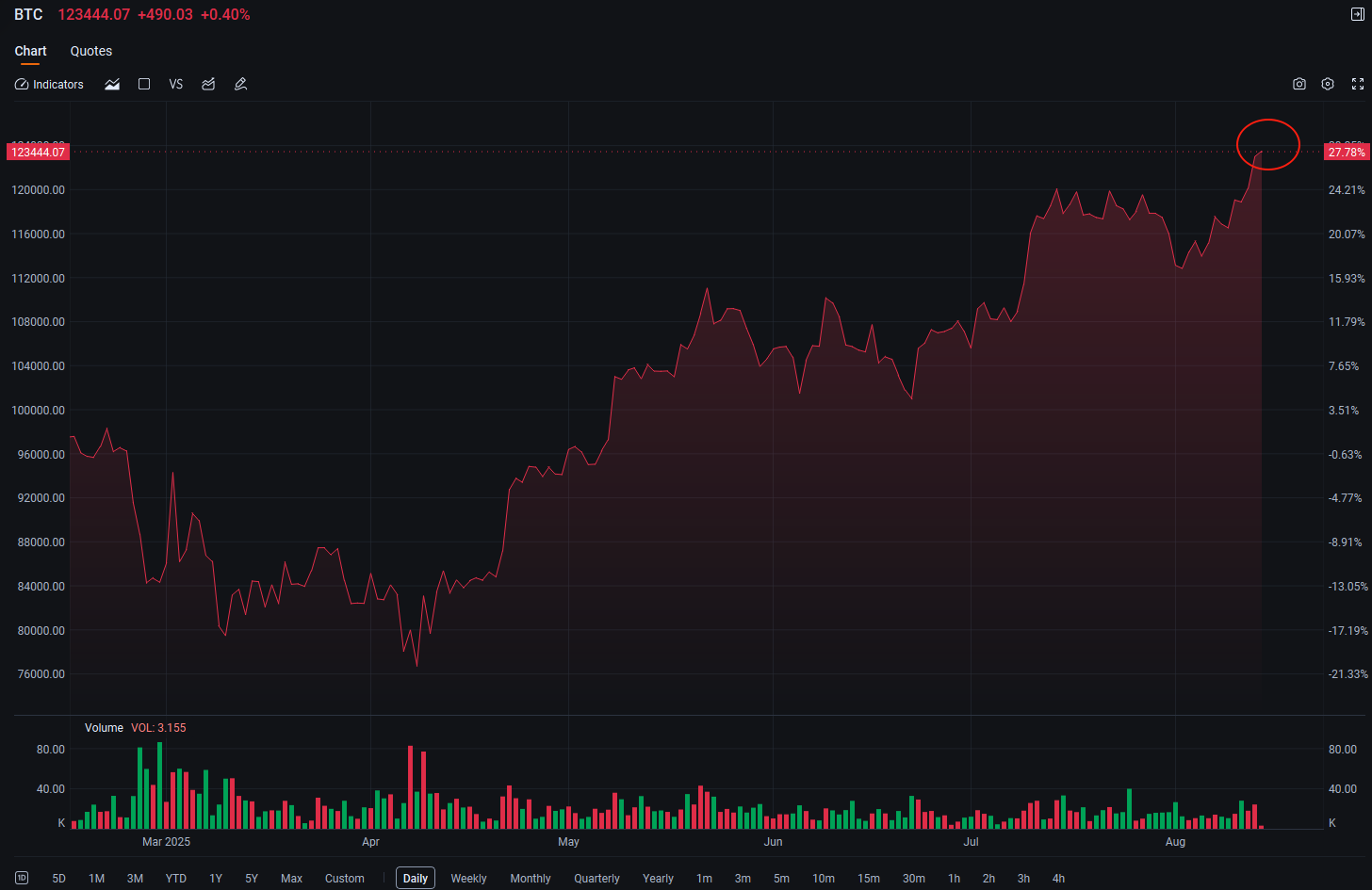
Just before this article was published, Bitcoin briefly surpassed the $124,400 mark, setting a new all-time high.
Meanwhile, after a rapid recent surge, Ethereum is now just $100 away from its historical peak of $4,861. According to CoinGecko data, as the second-largest cryptocurrency, Ethereum is leading the crypto market rally, pushing the total market capitalization to a record $4.2 trillion.
The world of Bitcoin is undergoing a silent revolution today.
While retail investors focus on price swings, global institutions are quietly waging an unprecedented “digital gold” battle. The latest on-chain data reveals that the U.S. holds nearly 10 million Bitcoin, accounting for 40% of the global circulating supply, with a value approaching $1 trillion—nearly one-fifth of Germany’s GDP last year.
In this bloodless war, corporations and governments take center stage, with traditional financial giants and tech newcomers competing side by side. Bitcoin is transitioning from a speculative game for retail investors into a strategic reserve asset for institutions.
U.S. Hegemony, Institution-Led Crypto New Order
The U.S.’s dominance in the Bitcoin space is staggering. According to the latest blockchain analytics report, U.S. entities collectively hold millions of Bitcoin, valued at hundreds of billions of dollars at current prices.
This figure reflects a systematic buildup by U.S. corporations and financial institutions.
MicroStrategy tops the list with hundreds of thousands of Bitcoin, followed by Marathon Digital Holdings with tens of thousands, and even the Trump Media Group with notable amounts, spanning diverse sectors from mining to social media.

In a single month this year, U.S. Bitcoin ETFs saw net inflows of billions, hitting a yearly high. Traditional giants like BlackRock and Fidelity indirectly hold over a million Bitcoin through ETFs. BlackRock’s buying spree stands out, with thousands of Bitcoin (worth hundreds of millions) purchased in a single day earlier this year, accumulating over 10,000 in a short period.
The U.S. Department of Justice holds around hundreds of thousands of Bitcoin, primarily seized from dark web cases and hacker ransom recoveries.
Coin-Hoarding Public Companies
Ethereum’s recent rise is driven by two key factors: record inflows into funds directly investing in the token and a surge of Ethereum-specific treasury institutions—public companies mimicking Michael Saylor’s Bitcoin hoarding strategy.
According to StrategicEthReserve.xyz, these firms have amassed $17 billion in Ethereum.
Among them, 180 Life Sciences Corp. (ATNF.US), operating under the brand ETHZilla and backed by billionaire Peter Thiel after transitioning from a biotech firm to an Ethereum treasury platform, saw its stock soar over 200% on Tuesday after announcing holdings of 82,186 Ethereum.

The market currently shows significant structural divergence, with companies holding major tokens outperforming those betting on niche, high-risk coins.
Architect Partners data indicates that crypto treasury stocks holding Bitcoin, Ethereum, or Solana have delivered a median return of 92.8% since announcing their strategies.
In contrast, a group investing in lesser-known tokens has seen a median return of negative 24% since disclosure. A case in point is Hyperion DeFi, formerly the biopharma company Eyenovia, which began buying hyperliquid tokens in June. Despite holdings now worth nearly $60 million, its market cap is only $30.5 million, with its stock plunging 30% in the past month.
Risks of the Coin-Hoarding Model Emerge
The inherent risks of the coin-hoarding model are surfacing.
When a company’s stock trades at a premium to its assets, raising funds via equity issuance to buy more crypto is straightforward.
However, once the stock trades at a discount, this virtuous cycle reverses, making new capital raises difficult. A drop in the token’s value further pressures the stock price, creating a downward spiral.

This model’s rise also deepens the linkage between traditional stock and crypto markets, potentially introducing new volatility to equities.
Matt Zhang, founder of Hivemind, warned: “As this integration deepens, traditional stock investors will face unprecedented risks. They may not be accustomed to tokens dropping 15% in a single day, a common occurrence in crypto.”
Some venture capital firms remain cautious. Nic Carter, co-founder of Castle Island Ventures, said they avoid crypto treasury stocks, viewing them as “largely zero-sum games” where returns rely on leverage or retail investors buying at unfavorable prices, carrying reputational risks.
Future Trends
Compiled data shows U.S. spot Ethereum ETFs have seen net inflows of over $1.7 billion since August, while Bitcoin funds faced $436 million in outflows.
Notably, Tuesday saw U.S. spot Ethereum ETF trading volume surpass that of the 12 Bitcoin equivalents for the first time. Coinglass data also indicates Ethereum futures open interest has climbed to a record $66 billion.
Geoff Kendrick, Global Head of Digital Asset Research at Standard Chartered, wrote in a Wednesday report: “The passage of the U.S. GENIUS Act in July cleared the path for mainstream stablecoin adoption, a pivotal shift. Stablecoins now account for 40% of all blockchain fees, with over 50% on Ethereum.
As stablecoin liquidity grows, decentralized finance (DeFi) activity will intensify—where Ethereum dominates—indirectly boosting Layer 1 activity.” Based on this, Standard Chartered raised its 2025 year-end Ethereum target from $4,000 to $7,500.

As Bitcoin prices reach new highs, the geopolitical and asset allocation logic behind it warrants more attention than price swings.
Salvadoran President Nayib Bukele, who made Bitcoin legal tender, foresaw: “Bitcoin will guide our nation toward economic freedom.” This prophecy is now unfolding globally in complex ways.
Germany and the Netherlands have begun sovereign Bitcoin experiments, while European firms leverage stablecoin infrastructure and DeFi protocols to turn Bitcoin into yield-bearing assets. Bitcoin is shifting from a “store of value” to a “source of value,” driving more institutions to include it in core allocations.
When corporate boards allocate thousands of Bitcoin while ETFs add just one, this U.S.-led, globally participated Bitcoin revolution is only beginning to reshape the financial world’s underlying logic.