
Americans Are Completely Hooked on Trading Stocks with 401(k) Accounts

Signs indicate that currently, American workers of nearly all age groups are investing a record-high proportion of their 401(k) accounts in stocks!
After Years of Sustained Market Rises, They’ve Either Actively Increased Stock Allocations or Had Fund Managers Do It for Them…
According to Vanguard Group data, last year, as many as 88% of American workers in their 30s had their 401(k) accounts invested in stocks, up from 82% a decade ago.
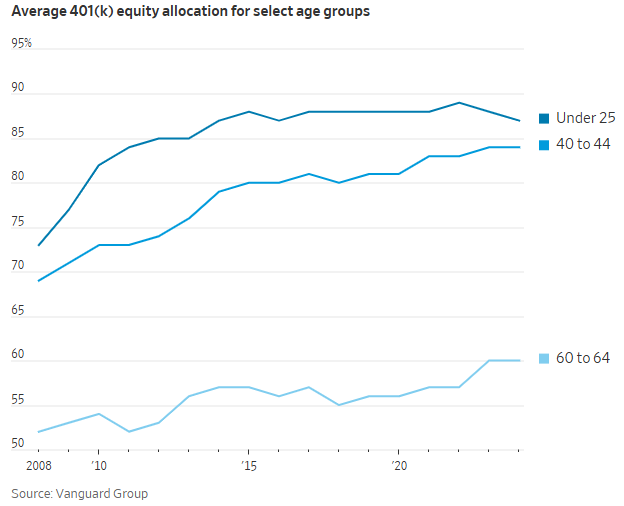
For 401(k) investors in their early 60s, the stock allocation ratio reached 60%, higher than the 57% from ten years ago. Vanguard arrived at these figures by reviewing the average stock allocation ratios of the millions of 401(k) plan participants it manages.
Even in Target-Date Funds, the Money Going into Stocks Has Increased. Target-Date Funds Are Designed to Meet Individual Retirement Investment Needs by Dynamically Adjusting the Ratio of Equity to Fixed-Income Assets to Gradually Reduce Risk—Shifting from Stocks to Bonds as Retirement Nears…
According to Morningstar data, by the end of 2024, the average stock allocation in target-date funds held by workers just starting their careers had risen to 92%, up from 85% in 2014.
U.S. 401(k) Plan Funds Can Be Invested in Stocks, Funds, Annuities, Bonds, and Special Time Deposits, with Employees Choosing Their Investment Methods. Of Course, the Investment Risk Is Borne by the Employees Themselves.

This Greater Bet on U.S. Stocks Can Undoubtedly Yield Rich Returns During Market Upswings, but the Losses They Face During Downturns Will Also Be Greater Than Traditional 60% Stock and 40% Bond Portfolios…
However, given that the S&P 500 index has risen nearly 10% year-to-date and hit its 18th record high of the year on Thursday, an increasing number of 401(k) account investors are undoubtedly attracted by the former’s hefty profits. They say it’s hard to see the advantage of bonds or cash right now…
44-Year-Old Investor Eric Evans Points Out That He Currently Has 100% of His Investments—Including His 401(k) Account—in Stocks. This Dallas Bank Employee Says the Investments in One Account Holding Most of His Retirement Savings Have Nearly Tripled in Value Over the Past Five Years. “I’m Certainly Aware I’ll Need to Diversify Eventually, Just Not Yet.”
“ALL IN” on U.S. Stocks
Morningstar analyst Jason Kephart notes, “When the market performs exceptionally well, people easily develop a higher tolerance for risk.”
He Says: “If We Experienced a Decade-Long Bear Market, I Don’t Know If We’d Still See So Many People Increasing Stock Holdings—Though That’s Often When People Should Be Buying.”
Based on Valuation Metrics Like P/E Ratios, the Current Investor Enthusiasm for the U.S. Stock Market Has Made Many Stocks Appear More Expensive Than Their Historical Averages. However, Despite This Situation Causing Some Investors to Hesitate, It’s Not Enough to Drive Them to Pull Out of the Stock Market.

52-year-old investor Ashish Bhargava says about a third of his portfolio—including his 401(k) plan, individual retirement account (IRA), and Roth IRA, all set aside for retirement—is currently fully invested in the stock market.
“I Can Handle Medium to High Risk,” Bhargava Says. “Over the Long Term, Stock Investments Have More Potential Than Any Other Mix.”
Signs suggest that over the past half-century, Americans have increasingly relied on the stock market. The 1978 tax law change introduced the 401(k) plan, initially aimed at fostering a culture focused on the market and investing in stocks or stock funds.
For a long time thereafter, stocks have nearly always outperformed bonds. Even when U.S. stocks plummeted in 2022, U.S. Treasuries experienced their worst year on record.
During Past Economic Crises, the Fed or Congress Typically Intervened to Support the Economy. The Belief That a ‘Fed Put Option’ Will Eventually Appear Has Led Many Older Americans to Believe the Market Will Always Bounce Back from Slumps—a Trend Seen During the 2020 COVID-19 Pandemic and the 2008 Financial Crisis.

In recent years, many young American retail investors have also reaped rich rewards by buying the dip. Morningstar target-date fund researcher Yang Rohr notes that even during sharp market declines, most 401(k) investors continued to invest a portion of their monthly salaries—demonstrating their ability to persevere through volatility.
58-Year-Old Investor Jason White Says the Recent Strong Market Momentum Is Prompting Him to Increase His Stock Holdings, Maintaining a Larger Proportion Than When He Was Younger. “Until Five or Six Years Ago, I Was Basically a 60/40 Rule Guy (Stock-Bond Ratio), but That Doesn’t Work Anymore.”
White currently keeps about 90% of his self-directed investments, including his IRA, in the stock market.
Target-Date Funds Are Also Shifting
In fact, even for investors who haven’t actively increased their U.S. stock allocation, the target-date funds they invest in may be shifting more toward the stock market.
Morningstar’s Kephart Data Shows That for Investors Five Years from Retirement, the Average Stock Allocation in Their Target-Date Funds Reached 55% in June. By Comparison, This Figure Was 50% in 2020 and 40% in 2014.
Vanguard Group Strategic Retirement Consulting Head David Stinnett says many investors saving for retirement are benefiting from the higher returns of stocks. The rise of target-date funds over the past two decades has brought many young investors into the market, who might not have made such choices on their own.
According to Vanguard Data, in 2005 When Target-Date Funds Were Not Yet Widely Adopted, 401(k) Investors Under 25 Had an Average Stock Market Exposure of Just 57%. Currently, Target-Date Funds Account for About 64% of Inflows into 401(k) Plans.

Yang Rohr notes that target-date fund investors may not always be fully aware of their stock allocation. This includes new employees often automatically enrolled in these funds. Many investors who remain in target-date funds adopt a hands-off approach—unaware of exactly how their money is invested.
In Recent Years, More Asset Management Companies, Including T. Rowe Price and Nuveen, Have Adopted Higher Stock Allocations in Target-Date Funds, At Least for Certain Age Groups.
When T. Rowe Price raised the stock allocation for its target-date fund’s younger investor group to 98%, the company stated this move aimed to help investors avoid the risk of outliving their savings. This adjustment was completed in 2022.
BlackRock Launched a Series of New Fund Products in 2024, Featuring Higher Stock Exposure Throughout an Investor’s Career.